Fish That Start With B [Extensive Freshwater & Saltwater Fish Name List]

The Bamboo shark is one of the many fishes with fish names that start with the letter B. Fish common names with B are almost endless.

Scientific names help a fish species from other fish species of its kind in the same family, but it is common in the hobby to identify a fish species with its common name.

Check out the following list below to see our top picks of fish names starting with B and more!

Our Top 5 Fish Names Beginning with Letter B

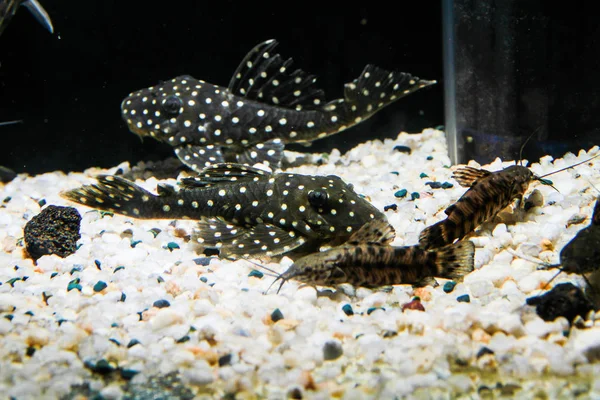
Bandit Cory (Corydoras metae)
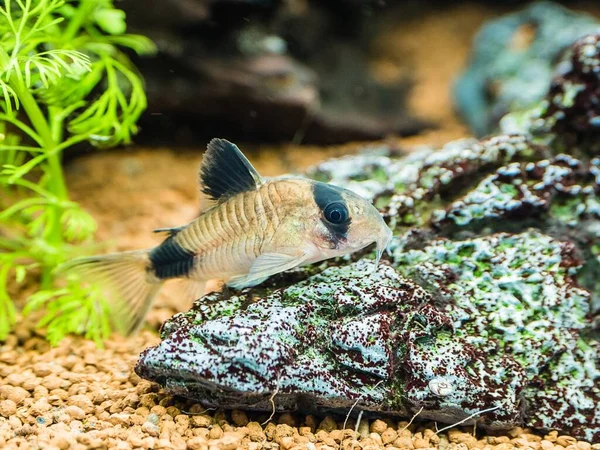
photo of Bandit Cory in aquarium

Corydoras metae is the Latin name of the Bandit Cory. It is a small Columbian fish that only grows about 5cm long.

The Bandit Cory are peaceful and shy bottom dwellers.

A striking feature of this fish is the dark color that runs over its face from gill to gill-like a bandit’s band.

Unlike other fish, the Bandit Cory hardly lives long. If you wish to keep this fish, it should be kept in groups of at least three in a tank.

Black Fin Cory (Corydoras leucomelas)
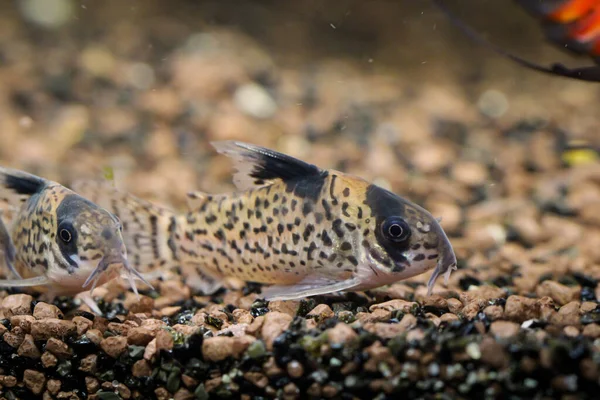
Black Fin Cory with little aquarium stones in a shot

Black Fin Cory is one of the many fishes with common names starting with b. False Spotted Cory Catfish and False Spotfin Cory Cats are other common names for this fish.

It is a small fish that loves a well-planted aquarium. It grows to the maximum length of about 5.5cm (2.2″).

Like many other Cory species, Black Fin Cory are bottom dwellers but will not eat algae or any other plant matter that grows on the wall of your aquarium. Although it does not eat algae, it will eat algae wafers.

It is a bottom-dwelling browser. It will also eat sinking pellets like shrimp pellets, bloodworms, insect larvae, and anything that fits into its mouth.

Top dweller fishes like Betta and Brown Pencilfish are excellent tankmates for the Black Fin Cory, two fish with fish names starting with b!

Black Phantom Tetra (Megalamphodus megalopterus)
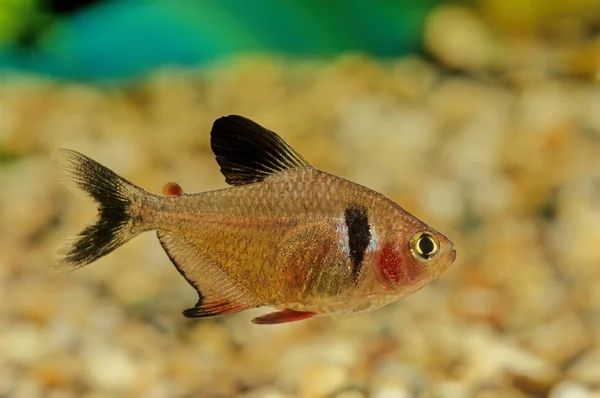
close up shot of Black Phantom Tetra with blurred background

The Black Phantom Tetra is a pretty non-aggressive fish on the list of fish that start with b. Its scientific name Megalamphodus megalopterus, sets it apart from other tetras.

Black Phantom Tetra has a smoky gray color and black edging. One of the distinctive features of this fish is the clear eye-shaped mark just behind but close to the gills.

However, their silver color makes them a great pair with other colorful tetra species.

An adult Black Phantom Tetra can grow up to 4.3cm (1.7″) long. But there have been rare cases of some growing as long as 5.08cm (2″) in length.

It is native to the water bodies of South American countries like Bolivia, Brazil, and Paraguay.

Balloon Platy (Xiphophorus sp.)
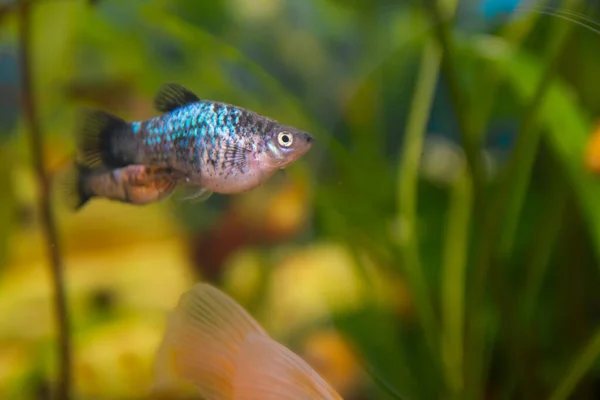
small Balloon Platy in an aquarium

Another great fish that tops the list of fish names starting with “b” is the Xiphophorus sp. Its common name is the Balloon Platy. This fish can live up to 4 years if you set your aquarium to the proper water parameters.

You can find the Xiphophorus sp. in the rivers of southern Mexico and the Central American Eastern coast.

The Balloon Platy usually grows as long as 5.08cm (2″). But the size typically depends on the species, the correct water parameters, and a consistent aquarium maintenance routine.

It is a hardy tropical fish, and it is easy to care for.

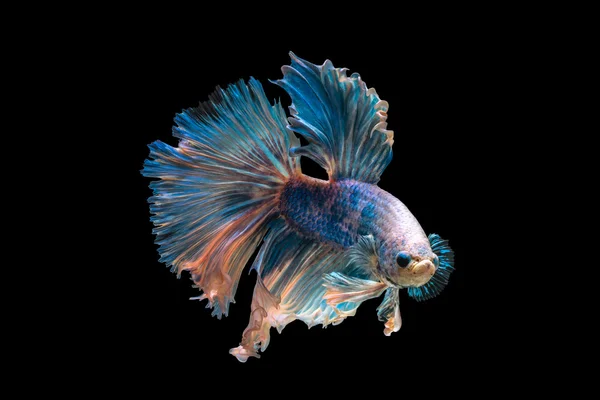
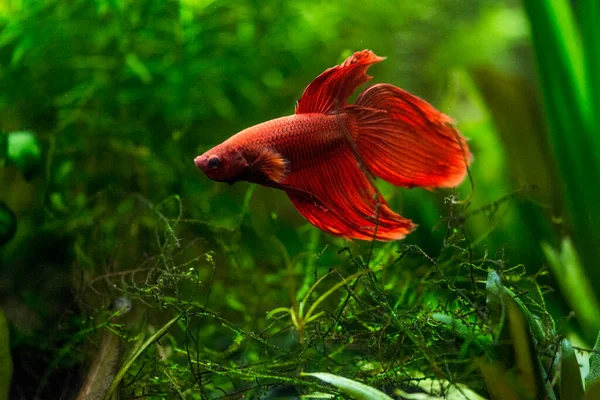
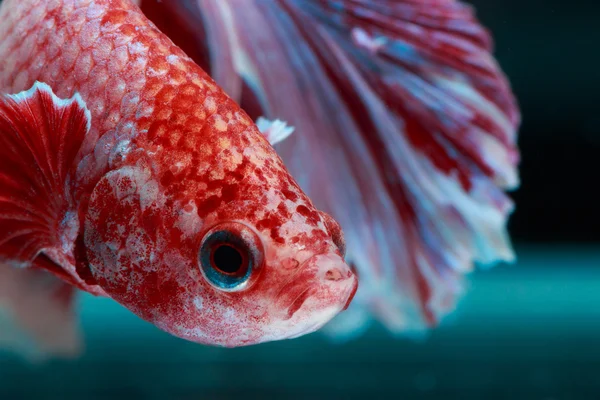
Betta Fish Species (Betta splendens)
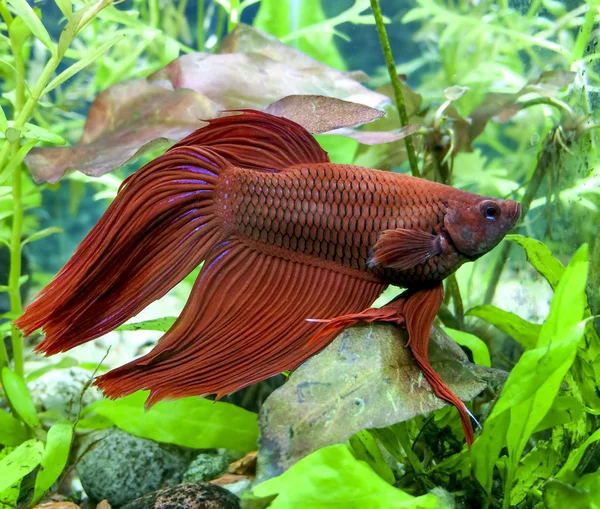
big Betta Fish Species in aquarium

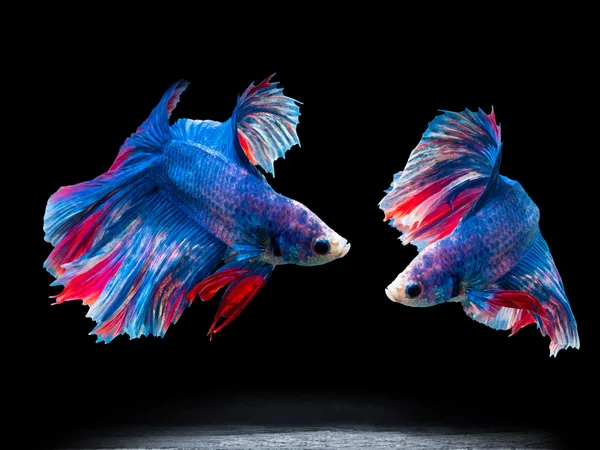
This is one popular aquarium fish that starts with the letter b. it is also known by other common names; Siamese Fighting Fish.

It is one of the many fish with names starting with b. This colorful fish is one of the many popular aquarium fish.

Other common names of the fish include labyrinth fish, Japanese fighting fish, and even Chinese fighting fish. They have these common names even though they are native to neither country.

Of all the colorful varieties, the yellow types are among the most popular varieties in the hobby.

They have a somewhat short lifespan of about 2-3 years. The males are often aggressive and will fight with other colorful tankmates that seem to have more colors.

It is also advised that you do not keep more than a male in a tank because they will fight for dominance.

Baby Whale (Brienomyrus brachyistius)

A baby whale is an impressive fish. It is a freshwater fish indigenous to the murky waters of West Africa.

It is called a Baby whale because it has a face that looks like the face of a sperm whale. But it is not a whale.

A baby whale is, in fact, a kind of elephant fish in the Mormyridae family.

A fascinating characteristic of this fish is its electric organ. It produces a pattern of electric signals for communication and navigation purposes with the electric organ.

These intelligent fish are small but can survive for up to 10 years in your aquarium. But it is important that you replicate their habitat in the aquarium for them to flourish.

List of Fish Beginning With B

Check out the following list below for fish with common names starting with b.

Freshwater Fish Beginning With B

  • Baby Whale (Petrocephalus bovei bovei)
  • Badis (Badis badis)
  • Baenschi’s Peacock (Aulonocara baenschi)
  • Baikal Oilfish (Comephorus)
  • Bala Shark (Balantiocheilus melanopterus)
  • Balzani’s Earth Eater (Gymnogeophagus balzanii)
  • Banded Barb (Barbus fasciatus)
  • Banded Climbing Perch (Microctenopoma fasciolatum)
  • Banded Dwarf Cichlid (Apistogramma bitaeniata)
  • Banded Gourami (Colisa fasciata)
  • Banded Killifish (Fundulus diaphanus)
  • Banded Loach (Botia hymenophysa)
  • Banded Pimelodid (Pimelodus clarias clarias)
  • Banded Rainbowfish (Melanotaenia trifasciata)
  • Banded Shovelnose Catfish (Brachyplatystoma juruense)
  • Bandeira Catfish (Goslinia platynema)
  • Bandfish (Cepola haastii)
  • Bandit Cichlid (Aequidens geayi)
  • Bandit Cory (Corydoras metae)
  • Bangus (Chanos chanos)
  • Banjo (Bunocephalus verrucosus)
  • Banjo Catfish (Bunocephalus coracoideus)
  • Barb (Barbus barbus)
  • Barbatus Corydorus (Corydoras barbatus)
  • Barbel-less Catfish (Trachelyopterus lucenai)
  • Barfish (Morone mississippiensis)
  • Barred Danio (Devario pathirana)
  • Barred Loach (Nemacheilus fasciatus)
  • Bass (Micropterus salmoides)
  • Batfish, Freshwater (Myxocyprinus asiaticus)
  • Beauforti’s Loach (Botia beauforti)
  • Bengal Danio (Danio devario)
  • Bengal Loach (Botia dario)
  • Benny Tetra (Creagrutus beni)
  • Berdmore’s Loach (Botia berdmorei)
  • Berney’s Shark Catfish (Arius graeffei)
  • Betta (Betta splendens)
  • Bichir (Polypterus bichir)
  • Big Scale Tetra (Brycinus macrolepidotus)
  • Big-Eyed Synodontis (Synodontis pleurops)
  • Big-Eyed Xenotilapia (Xenotilapia sima)
  • Big-Toothed Piranha (Serrasalmus denticulatus)
  • Bighead Carp (Hypophthalmichthys nobilis)
  • Bigmouth Buffalo (Ictiobus cyprinellus)
  • Bill Tetra (Phago boulengeri)
  • Bitterling (Rhodeus suigensis)
  • Black Acara (“Cichlasoma” portalegrense)
  • Black Adonis Pleco – Acanthicus hystrix
  • Black and White Julie (Julidochromis transcriptus)
  • Black Angelfish (Chaetodontoplus niger)
  • Black Arowana (Osteoglossum ferrerai)
  • Black Banded Pyrrhulina (Copella nigrofasciata)
  • Black Barred Myleus (Myleus schomburgkii)
  • Black Bass (Micropterus dolomieu)
  • Black Belt Cichlid (Vieja maculicauda)
  • Black Buffalo (Ictiobus niger)
  • Black Bullhead (Ictalurus melas)
  • Black Darter Tetra (Poecilocharax weitzmani)
  • Black Devil Stingray (Potamotrygon leopoldi)
  • Black Diamond Gold Piranha (Serrasalmus spilopleura)
  • Black Fin Cichlid (Paracyprichromis nigripinnis)
  • Black Finned Doradid (Hassar notospilus)
  • Black Ghost Knifefish (Apteronotus albifrons)
  • Black Lancer (Bagrichthys hypselopterus)
  • Black Lined Rainbowfish (Melanotaenia maccullochi)
  • Black Neon Tetra (Hyphessobrycon herbertaxelrodi)
  • Black Pacu (Colossoma macropomum)
  • Black Piranha (Serrasalmus niger)
  • Black Ruby Barb (Puntius nigrofasciatus)
  • Black Shark (Labeo chrysophekadion)
  • Black Spot Barb (Barbus filamentosus)
  • Black Stripe Dwarf Cichlid (Taeniacara candidi)
  • Black Tetra (Hyphessobrycon herbertaxelrodi)
  • Black Wedge Tetra (Hemigrammus pulcher)
  • Black Widow Tetra (Gymnocorymbus ternetzi)
  • Black-Chinned Xenotilapia (Enantiopus melanogenys)
  • Black-Winged Hatchetfish (Carnegiella marthae)
  • Blackfish (Dallia pectoralis)
  • Bleak (Alburnus alburnus)
  • Blood Parrot Cichlid (Amphilophus citrinellus x Paraneetroplus synspilus [hybrid])
  • Blue Catfish (Ictalurus furcatus)
  • Blue Danio (Danio kerri)
  • Blue Gourami (Trichopodus trichopterus)
  • Blue-Redstripe Danio (Danio albolineatus)
  • Bluegill (Lepomis macrochirus)
  • Bluntnose Knifefish (Steatogenys elegans)
  • Bluntnose Minnow (Pimephales notatus)
  • Bonefish (Albula vulpes)
  • Bonytail (Gila elegans)
  • Bowfin (Amia calva)
  • Bream (Abramis brama)
  • Bristlenose Catfish (Ancistrus)
  • Bronze Corydoras (Corydoras aeneus)
  • Brook Lamprey (Lampetra planeri)
  • Brook Stickleback (Culaea inconstans)
  • Brook Trout (Salvelinus fontinalis)
  • Brown Trout (Salmo trutta)
  • Buffalo Fish (Ictiobus cyprinellus)
  • Bull Trout (Salvelinus confluentus)
  • Burma Danio (Danio tinwini)
  • Burrowing Goby (Croilia mossambica)

Saltwater Fish Beginning With B

  • Ballan Wrasse (Labris bergylta)
  • Bamboo Shark (Chiloscyllium griseum)
  • Bangus (Chanos chanos)
  • Barbeled dragonfish (Astronesthes niger)
  • Barbeled houndshark (Leptocharias smithii)
  • Barracuda (Sphyraena barracuda)
  • Barracudina (Lestidium atlanticum)
  • Barramundi (Lates calcarifer)
  • Barreleye (Opisthoproctus soleatus)
  • Basking Shark (Cetorhinus maximus)
  • Bat ray (Myliobatis californica)
  • Beachsalmon (Leptobrama muelleri)
  • Beaked salmon (Gonorynchus greyi)
  • Beardfish (Polymixia nobilis)
  • Beluga Sturgeon – Huso huso
  • Bicolor goat fish (Parupeneus barberinoides)
  • Bigeye (Heteropriacanthus cruentatus)
  • Bigeye squaretail (Tetragonurus atlanticus)
  • Bigscale (Scopelogadus mizolepis mizolepis)
  • Bigscale Pomfret (Taractichthys longipinnis)
  • Billfish (Makaira nigricans)
  • Black Fin Shark – Arius seemanni
  • Black Mackerel (Scombrolabrax heterolepis)
  • Black Scabbardfish (Aphanopus carbo)
  • Black Scalyfin (Parma alboscapularis)
  • Black Sea Bass (Centropristis striata)
  • Black Swallower (Chiasmodon niger)
  • Black Triggerfish (Melichthys niger)
  • Blackchin (Neoscopelus macrolepidotus)
  • Blackfin Tuna (Thunnus atlanticus)
  • Blacktip Reef Shark (Dallia pectoralis)
  • Blenny (Ophioblennius steindachneri)
  • Blind Goby (Typhlogobius californiensis)
  • Blind Shark (Brachaelurus waddi) 
  • Blobfish (Cottunculus microps)
  • Blowfish (Torquigener albomaculosus)
  • Blue Eye Trevalla (Hyperoglyphe antarctica)
  • Blue Shark (Prionace glauca)
  • Blue Triggerfish (Pseudobalistes fuscus)
  • Blue Whiting (Micromesistius poutassou)
  • Bluefin Tuna (Thunnus maccoyii)
  • Bluefish (Pomatomus saltatrix)
  • Boafish (Stomias boa boa)
  • Boarfish (Capros aper)
  • Bobtail Snipe Eel (Cyema atrum)
  • Bocaccio (Sebastes paucispinis)
  • Boga (Haemulon vittatum)
  • Bombay Duck (Harpadon nehereus)
  • Bonito (Sarda sarda)
  • Bonnethead Shark (Sphyrna tiburo)
  • Bonnetmouth (Emmelichthyops atlanticus)
  • Boxfish (Lactophrys bicaudalis)
  • Bramble Shark (Echinorhinus brucus)
  • Brill (Scophthalmus rhombus)
  • Bristlemouth (Bonapartia pedaliota)
  • Bull Shark (Carcharhinus leucas)
  • Bullhead Shark (Heterodontus francisci)
  • Buri (Seriola quinqueradiata)
  • Butterfish (Selenotoca multifasciata)
  • Butterfly Ray (Gymnura micrura)
  • Butterflyfish (Chelmon rostratus)

Final Thoughts on Fish That Start With B

This piece features saltwater fishes usually found in the seas, coral reefs, and various coastal waters all over the world.

It also features freshwater fishes that can only be found in tropical streams, rivers, lakes, and brackish waters in some parts of the world.

Although it is not exhaustive, it is a good place for a start if you want to research names of fish that start with b.
Fish Names That Start With B - Featured Image

source https://aquariumlabs.com/fish-that-start-with-b/

Fish That Start With M [Extensive Freshwater & Saltwater Fish Name List]

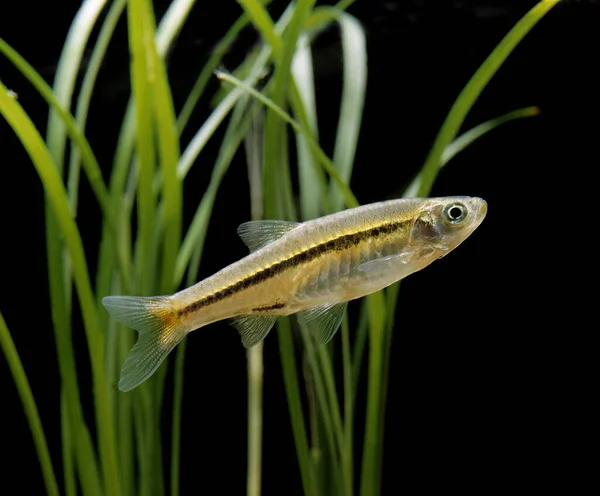
Incredibly, many fishes with fish names start with M. Some are strictly ornamental fish, others are subtropical reef-dwelling fish, and some are either, depending on the type of species.
But researching fish names is easier when you know their scientific names and common names.

Check out this article for fish that start with M.

Our Top 5 Fish Names That Start With M

Magnificent Rasbora (Rasbora borapetensis)

a photo of a Magnificent Rasbora in an aquarium

The Magnificent rasbora is a very peaceful fish native to the freshwater rivers in Asia. You can find them in the freshwaters of South East Asia and South East China.

Rasbora is a genus in the Cyprinidae family. As a common English name in the aquarium hobby, it covers many species, including the Boraras, Megarasbora, Microrasbora, Rasboroides, and Rasbosoma species.

The Magnificient rasbora is a small fish with a maximum length of no more than 6 inches.

Its body is fairly yellow with a black line that runs along the middle from the back of the gills to the caudal fin.

It is a very hardy fish. But an unfavorable water condition will result in a paler red area on the tail. It is a schooling fish, so keeping about 8-10 of the same species in the community tank would be best.

Loaches, Tetras, and catfish are great choices if you want them in a community tank.

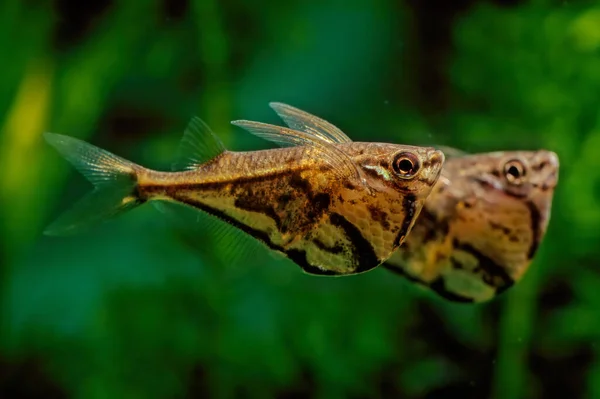
Marbled Hatchetfish (Carnegiella strigata)

Photo of a Marbled Hatchetfish in aquarium

The Marbled Hatchetfish is native to South America. Their ideal habitat is black acidic water wit to keep h a lot of decaying organic matter.

Although the Marbled Hatchetfish is a small fish, you want to keep a lid on your aquarium. This is important because they have a penchant for jumping out of the tank when stunned.

It has a magnificent appearance with a gold line that runs from its eyes to its caudal fin.

Its underside looks like marble, so it is called the Marbled Hatchetfish. Another distinguishing feature of this fish is its hatchet shape. It has a flat back and widespread pectoral fins.

Marbled Hatchetfishes are usually wild captured.

You want to limit the chances of spreading any bacteria by putting the fish in a quarantine tank before introducing it to your aquarium. Quarantine the fish for 14 days to keep your community tank safe.

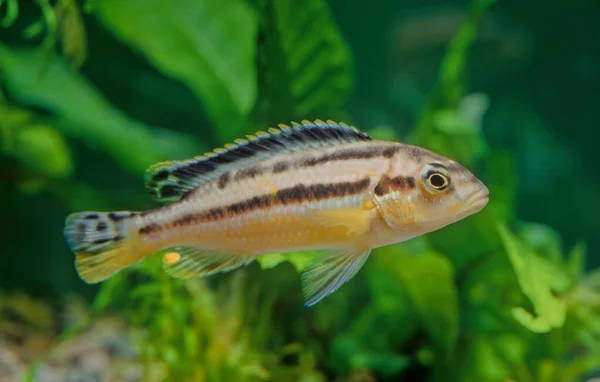
Malawi Golden Cichlid (Melanochromis auratus)

This dazzling tropical fish is a must-mention in our top 5 list. It is part of the Cichlidae family. Golden Mbuna is another name for this fascinating fish.

You can find them in the Malawi lake, especially along the South of Jalo Reefs, to Crocodile Rocks.

It is a small fish, and it is trendy in the hobby. They grow up to a maximum length of 4.3 inches.

They display sexual dimorphism with body colors. Females and young Malawi golden cichlids are primarily yellow. The males have dark brown or black.

They also have a brighter shade of blue or back on the upper half of their body.

Interestingly, females can also change their sex to become males if there are no males in the tank.

They will appear to have a dark deep body color to signal their dominance.

In pet stores, the male in the tank would have black color for dominance while the rest will be yellow.

After the dominant male is purchased, another dominant male will emerge in black color.

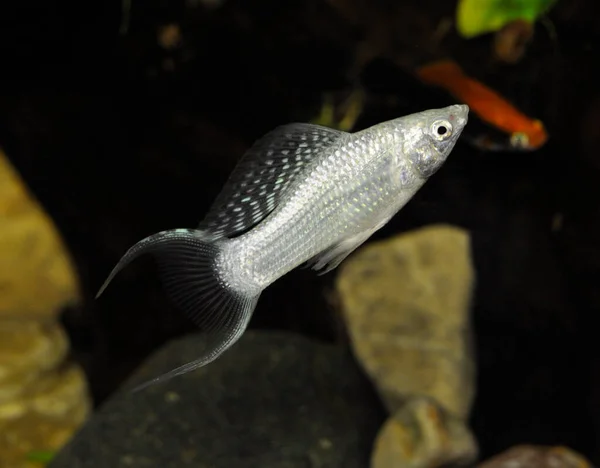
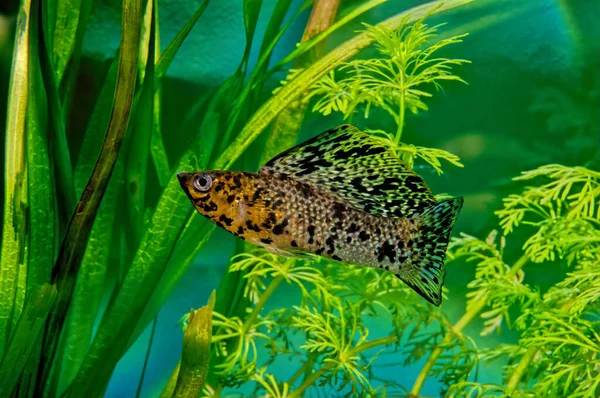
Molly (Poecilia sp.)

Photo of a Fish Silver Molly - Featured Image

Molly comprises many fish species. The Molly fish species are great beginner choices for amateurs in the hobby.

Fish species known as Molly include the Sailfin Molly (Poecilia latipinna), Common Molly (Poecilia sphenops), Elegant Molly (Poecilia elegans), and Amazon Molly (Poecilia formosa), etc.

Their natural habitats include shallow water surfaces, small streams, and planted brackish waters. It is popularly believed that they are freshwater species that usually spend a short time in brackish waters.

These fish species have been spotted flourishing in the coastal sea waters, brackish streams, reef areas, estuaries, and freshwater streams.

Molly species are closely related as they are from the same genus in the Poeciliidae family. You can notice the difference between the specific species in their appearance.

The Sailfin Molly has a dorsal fin that looks like the sail of a boat, while Common Molly has a shorter dorsal fin.

The Black Lyretail Molly is dark with black scales and white highlights on its dorsal and anal fins. Many other Molly species have their distinguishing features.

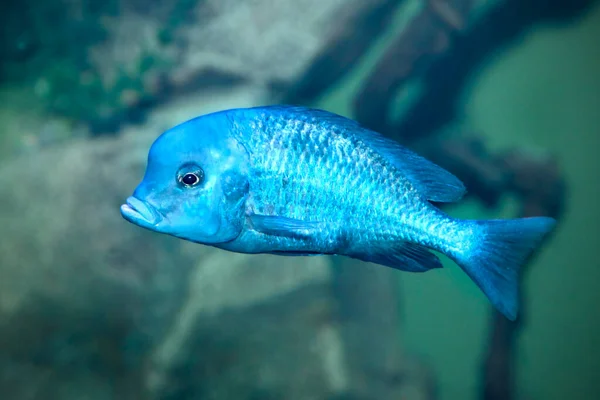
Malawi Blue Dolphin (Cyrtocara moorii)

Photo of Malawi Blue Dolphin in an aquarium

This large and striking Malawian Cichlid is endemic to Lake Malawi. This fish was previously identified with the scientific name Haplochromis moorii.

It grows up to an impressive size of 10 inches in length. They sometimes grow larger than 10 inches in the aquarium if well taken care of.

Over time, it grows a large bump on its head and an elongated snout. It also grows a large mouth and an extended tight body with age.

The dorsal fins of these giant Malawian Cichlids are usually long and span from the back of their heads to their tails.

Their pelvic fins stand out close to a small budge under their big heads. It is not uncommon to find them with a long anal fin that almost touches their tails.

Unlike other blue cichlids with bright blue line fins, Malawi Blue Dolphins are usually plain blue.

They may appear to have bright blue line fins, but their colors are generally not as bright as the Electric Ram Cichlid.

List of Fish Beginning with M

Apart from our top picks above, there are other great fishes with fish names that start with M. Check out the lists below.

Freshwater Fish Beginning with M

  • Macculloch’s Rainbowfish (Melanotaenia maccullochi)
  • Macmaster’s Dwarf Cichlid (Apistogramma macmasteri)
  • Madagascar Rainbowfish (Bedotia geayi)
  • Madeirae Swamp Eel (Synbranchus madeirae)
  • Madtom (Noturus placidus)
  • Magnificient Rasbora (Rasbora borapetensis)
  • Mahseer (Tor tambroides)
  • Mail-Cheeked Fish (Pterois antennata)
  • Malarmo Catfish (Duopalatinus malarmo)
  • Malawi Blue Dolphin (Cyrtocara moorii)
  • Malawi Golden Cichlid (Melanochromis auratus)
  • Malawi Eye-Biter (Dimidiochromis compressiceps)
  • Malay Combtail (Belontia hasselti)
  • Manchurian Loach (Leptobotia mantschurica)
  • Mandarinfish (Siniperca scherzeri)
  • Mangrove Red Snapper (Lutjanus argentimaculatus)
  • Many Banded Shell-Dweller (Neolamprologus multifasciatus)
  • Many-Spotted Cory (Corydoras polystictus)
  • Marakeli Cichlid (Paratilapia polleni “Madagascar”)
  • Marbled Bichir (Polypterus palmas)
  • Marbled Hatchetfish (Carnegiella strigata)
  • Marbled Headstander (Abramites hypselonotus)
  • Marbled Lamprologus (Lepidiolamprologus attenuatus)
  • Marbled Livingston’s Hap (Nimbochromis livingstonii)
  • Marbled Otocinclus (Otocinclus paulinus)
  • Marbled Sleeper Goby (Oxyeleotris marmorata)
  • Marbled Swamp Eel (Synbranchus marmoratus)
  • Marigold Swordtail (Xiphophorus helleri)
  • Marigold Wag Swordtail (Xiphophorus helleri)
  • Marlier’s Julie (Julidochromis marlieri)
  • Marylin’s Pencilfish (Nannostomus marylinae)
  • Masked Julie (Julidochromis transcriptus)
  • Maylandia Aurora (Pseudotropheus aurora)
  • Medaka (Oryzias latipes)
  • Meridionalis Gray Bichir (Polypterus senegalus meridionalis)
  • Mexican Golden Trout (Oncorhynchus chrysogaster)
  • Mexican Sailfin Molly (Poecilia velifera)
  • Mexican Swordtail (Xiphophorus montizumae)
  • Mexican Tetra (Astyanax fasciatus mexicanus)
  • Mickey Mouse Platy (Xiphophorus maculatus)
  • Midas Cichlid (Amphilophus citrinellus)
  • Millions Fish (Poecilia reticulata)
  • Minnow (Pimephales promelas)
  • Modest Loach (Botia modesta)
  • Modoc Sucker (Catostomus microps)
  • Mola Mola (Mola mola)
  • Molly “Black” (Poecilia sphenops)
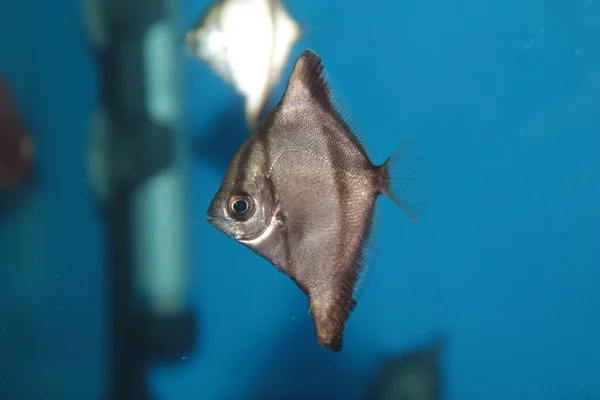
  • Mono (Monodactylus argenteus
  • Montezuma helleri (Xiphophorus montizumae
  • Mooneye (Hiodon tergisus)
  • Moonfish “Red Wag” (Xiphophorus maculatus)
  • Moonfish “Vtiatus Sunset” (Xiphophorus maculatus)
  • Moonlight Gourami (Trichogaster microlepis)
  • Moore’s Lamprologus (Variabilichromis moorii)
  • Mosaic Gourami (Trichogaster leeri)
  • Mosquitofish (Gambusia affinis)
  • Moss Barb (Capoeta tetrazona)
  • Motoro Stingray (Potamotrygon motoro)
  • Mottled Ctenopoma (Ctenopoma oxrynchum)
  • Mottled Stingray (Potamotrygon hystrix)
  • Mozambique Tilapia (Oreochromis mossambicus)
  • Mrigal (Cirrhinus cirrhosus)
  • Mud Catfish (Mud cat)
  • Mud Minnow (Galaxiella munda)
  • Mudfish (Neochanna apoda)
  • Mudminnow (Umbra pygmaea)
  • Murray Cod (Maccullochella peelii)
  • Muskellunge (Esox masquinongy)

Saltwater Fish Beginning with M

  • Mackerel (Rastrelliger brachysoma)
  • Mackerel Shark (Carcharodon carcharias)
  • Mahi-Mahi (Coryphaena hippurus)
  • Mako Shark (Isurus oxyrinchus)
  • Man-of-War Fish (Nomeus gronovii)
  • Mandarinfish (Synchiropus splendidus)
  • Manta Ray (Manta alfredi)
  • Marblefish (Aplodactylus arctidens)
  • Marine Hatchetfish (Argyropelecus hemigymnus)
  • Marlin (Makaira nigricans)
  • Masu Salmon (Oncorhynchus masou)
  • Medusafish (Centrolophus niger)
  • Megamouth Shark (Megachasma pelagios)
  • Menhaden (Brevoortia patronus)
  • Merluccid Hake (Merluccius bilinearis)
  • Midshipman Fish (Porichthys notatus)
  • Milkfish (Chanos chanos)
  • Minnow of the Deep (Cyclothone microdon)
  • Mojarra (Gerres equulus)
  • Monkeyface Prickleback (Cebidichthys violaceus)
  • Monkfish (Lophius piscatorius)
  • Moorish Idol (Zanclus cornutus)
  • Mora (Mora moro)
  • Moray Eel (Anarchias seychellensis)
  • Morid Cod (Laemonema barbatulum)
  • Morwong (Cheilodactylus spectabilis)
  • Moses Sole (Pardachirus marmoratus)
  • Mudskipper (Periophthalmus novemraditus)
  • Mudsucker (Gillichthys detrusus)
  • Mullet (Mugil cephalus)
  • Mummichog (Fundulus heteroclitus)
  • Mustache Triggerfish (Balistoides viridescens)
  • Mustard Eel (Dysomma anguillare)

Fish Names that Start With M

source https://aquariumlabs.com/fish-that-start-with-m/

Fish That Start With T [Extensive Freshwater & Saltwater Fish Name List]

The letter “T” is the 20th letter of the alphabet, but it starts with more than 20 fish names. Examples of common fish names that begin with the letter “T” include Tiger shark, Trout cod, Thresher shark, Talking catfish, Tiger barb, and many more!

Sometimes, their common names are part of their scientific names, and at other times, their scientific names are entirely different from their common names.

Looking up names of fish that start with the letter T? Check out this article for common fish names that begin with “T.”

Our Top 5 Fish Names Beginning with Letter T

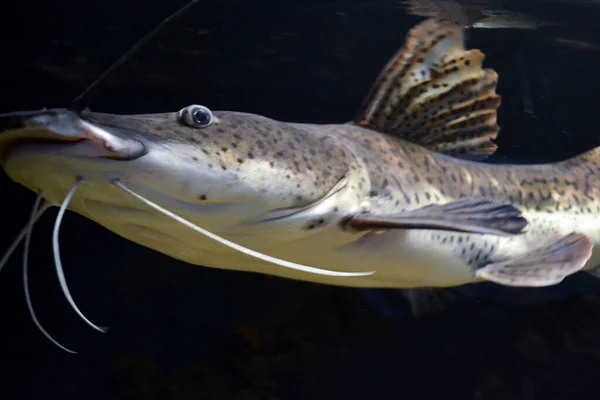
Tiger Shovelnose Catfish (Pseudoplatystoma fasciatum)

Photo of a Tiger Shovelnose Catfish Underground water

This is a very impressive South American fish that prefers shaded waters. You will find them in heavily planted water bodies like large rivers and flooded forest areas.

Their lifespan can reach anywhere between 18-25 years in the wild.

They can reach 25 years in captivity with proper aquarium care. They also grow pretty fast and large. The Tiger Shovelnose Catfish can reach 33 inches in length.

This fish has a long and flat mouth. They also have barbels, and they use their barbels for hunting prey and navigating their environment.

These cats are hardy freshwater fish that can tolerate a wide range of water parameters. But it would be best to maintain their preferred water parameters to avoid any unfavorable shift.

It is a pretty large fish. The least aquarium size for the juveniles is 180 gallons. They quickly come under stress if housed in a blank aquarium.

You want to replicate their natural environment with many plants that provide shade. You also want to ensure that the tank is big enough so they don’t feel cramped.

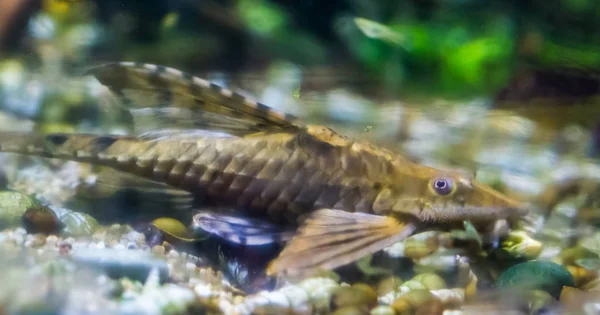
Twig Catfish (Farlowella acus)

This is a very delicate fish with a name that starts with the letter T . It is not a good beginner’s choice for an amateur hobbyist as it is susceptible to incorrect water parameters.

You also want to keep it in a separate tank to limit the chances of any instability in water parameter ranges.

The Twig catfish, like many other fish in the Loricariidae family, is a voracious eater. This catfish will typically satisfy itself if you feed it too much.

It would be best to provide no more than it can finish in about a minute. Dividing the day’s ration into portions to be fed at different times of the day will also prevent overfeeding them.

This fish is a shy cat. It prefers to stay in a densely planted tank and scavenge food at the bottom of the tank undisturbed.

Although they are nocturnal scavengers and are mainly active at night, younger Twig catfishes are usually active during the day.

They are bottom feeders. If you have a few of them in your tank, it would be ideal to feed sinking pellets to ensure that they do not starve.

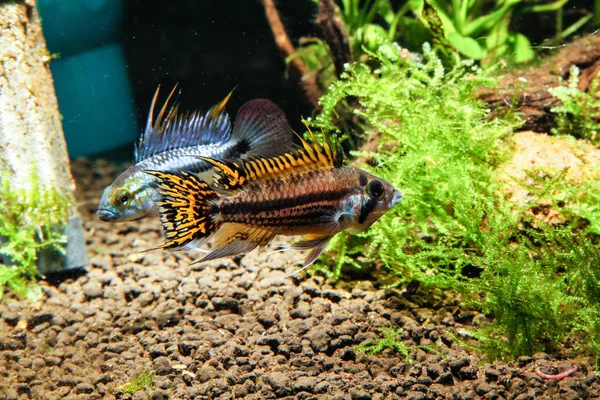
Three Striped Dwarf Cichlid (Apistogramma trifasciata)

Three Striped Dwarf Cichlid

Also known as the Redfin Three-Striped Cichlid, aquarists do not commonly keep this fish.

Although this fish needs a good amount of open space, it prefers a well-planted aquarium.

It is a very colorful fish. The males usually have yellow faces and neon blue bodies. But over time, the males develop a bright margin on their dorsal fin. This margin on their dorsal fin is usually red.

The females usually have a brilliant yellow body with some black.

This fish species is very peaceful, but they often become very territorial when they breed. During the spawning period, it would be best to limit the population of other tank mates in the tank.

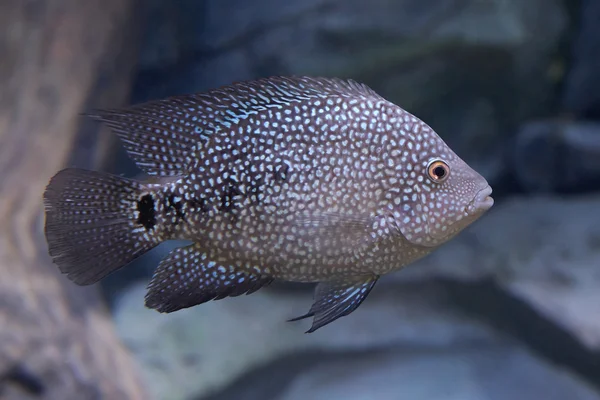
Texas Cichlid (Herichthys cyanoguttatus)

This is a freshwater fish that loves to hide. Texas cichlids appear to be one of those fishes with varying scientific names. Their former scientific name was Cichlasoma cyanoguttatum.

Like many other cichlids, this fish belongs to the Cichlidae family. They love densely planted aquariums with lots of hides.

They also have a penchant for digging and rearranging the aquarium to their taste.

They grow up to an impressive length of 13 inches. They are an aggressive fish species, so it would be ideal to choose tank mates with similar aggression.

A distinguishing factor for the male Texas Cichlid is the traditional nuchal hump they grow on their head with time.

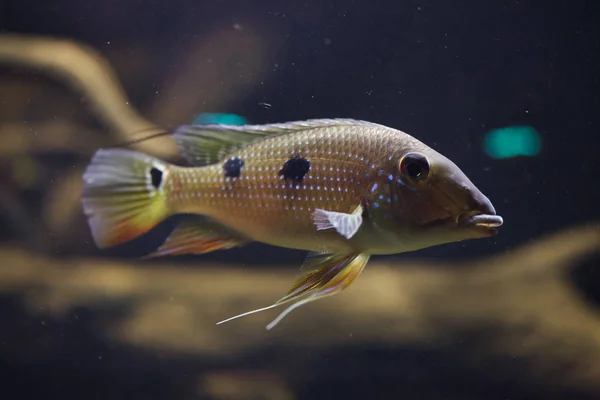
Three-Spot EarthEater (Satanoperca daemon)

Photo of a Three-Spot EarthEater

Interestingly, the meaning of the scientific name of this fish means Satan or Demon. But this fish is nothing close to evil. It is a very peaceful fish.

It can become somewhat territorial during spawning periods as it tries to protect its eggs. It is a common fish in the South American freshwaters of the Amazonas.

You will typically find them in acidic and mineral-poor water bodies such as the brown tannin-stained tributary of the Orinoco in southwestern Venezuela.

Three spot eartheater is an excellent fish for your community tank if you want to house it with other peaceful fish. But you want to avoid bottom dwellers and aggressive fish species.

Avoiding bottom dwellers as tankmates will prevent possible clashes with these Cichlids as they become territorial with the area where they laid their eggs during spawning.

It is a social Cichlid that likes to live in groups. Their juveniles exhibit impressive social instincts. Depending on the size, it is better to keep about 5-8 of them in a tank at once.

Remember to keep only tankmates that share the same water parameters.

List of Fish Beginning with T

Below are two lists of fish names that start with T. Check these lists below for freshwater and saltwater fish names that begin with T.

Freshwater Fish Beginning with T

  • T-Barb (Barbus lateristriga)
  • Tail-Spot Corydoras (Corydoras caudimaculatus)
  • Taillight Tetra (Bryconops melanurus)
  • Taimen (Hucho taimen)
  • Talking Catfish (Amblydoras hancocki)
  • Tanganyika Catfish (Lophiobagrus cyclurus)
  • Tapah Catfish (Wallago leerii)
  • Tapetail (Gyrinomimus grahami)
  • Tarpon (Megalops cyprinoldes)
  • Temperate Bass (Dicentrarchus labrax)
  • Temperate Ocean-Bass (Synagrops bellus)
  • Temperate Perch (Percichthys trucha)
  • Temporalis Cichlid (Telmatochromis temporalis)
  • Tench (Tinca tinca)
  • Tenpounder (Elops)
  • Tenuis Tetra (Mimagoniates lateralis)
  • Ternetzi Anostomus (Anostomus ternetzi)
  • Texas Cichlid (Herichthys cyanoguttatus)
  • Thick-Lipped Gourami (Colisa labiosa)
  • Thomas’ Chaetostoma (Chaetostoma thomasi)
  • Thorny Catfish (Platydoras armatulus)
  • Thread-finned cichlid (Acarichthys heckelii)
  • Threadfin Acara (Acarichthys heckelli)
  • Threadfin Rainbowfish (Irantherina werneri)
  • Three Spot Gourami (Trichopodus trichopterus)
  • Three Striped Pencilfish (Nannobrycon eques)
  • Three-Lined Pencilfish (Nannostomus trifasciatus)
  • Three-Lined Pimelodid (Pimelodus albofasciatus)
  • Three-Lined Rasbora (Rasbora trilineata)
  • Three-Spot Earth Eater (Satanoperca daemon)
  • Three-Spot Gourami (Trichogaster trichopterus)
  • Three-Spot Tetra (Odontostilbe kriegi)
  • Three-Striped Dwarf Cichlid (Apistogramma trifasciata)
  • Ticto Barb (Barbus ticto)
  • Tidewater Goby (Eucyclogobius newberryi)
  • Tiger Barb (Puntigrus tetrazona)
  • Tiger Characin (Hydrocynus vittatus)
  • Tiger Loach (Botia helodes)
  • Tiger Ray (Potamotrygon menchacai)
  • Tiger Shovelnose Catfish (Pseudoplatystoma fasciatum)
  • Tiger Tetra (Hoplias malabaricus)
  • Tiger Tilapia (Tilapia mariae)
  • Tigerperch (Terapon jarbua)
  • Tilapia (Oreochromis niloticus)
  • Tinfoil Barb (Barbodes schwanefeldii)
  • Tire Track Eel (Mastacembelus armatus)
  • Toadfish (Torquigener pleurogramma)
  • Toae Cichlid (Neolamprologus toae)
  • Tonguefish (Symphurus pusillus)
  • Topminnow (Fundulus heteroclitus)
  • Torrent Catfish (Amblyceps mangois)
  • Torrent Fish (Cheimarrichthys fosteri)
  • Trahira (Erythrinus sp.)
  • Tretocephalus Cichlid (Neolamprologus tretocephalus)
  • Trewavas’ Mbuna (Labeotropheus trewavasae)
  • Trewavas’ Neolebias (Neolebias trewavasae)
  • Trimac Cichlid (Cichlasoma trimaculatum)
  • Tropical Gar (Atractosteus tropicus)
  • Trout (Salmo trutta)
  • Trout Cod (Maccullochella macquariensis)
  • Trout-Perch (Percopsis omiscomaycus)
  • True Red Congo Tetra (Micralestes stormsi)
  • Tui Chub (Siphateles bicolor)
  • Turquoise Severum (Heros appendiculatus)
  • Twig Catfish (Farlowella acus)
  • Twin-Stripe Pencilfish (Nannostomus digrammus)
  • Two Point Tetra (Brycinus bimaculatus)
  • Two-Banded Cichlid (Telmatochromis bifrenatus)
  • Two-Lined Pencilfish (Nannostomus bifasciatus)
  • Two-Rayed Banjo Catfish (Bunocephalus hypsiurus)
  • Two-Spot Barb (Barbus bimaculatus)
  • Two-Spot Cichlid (Cichlasoma bimaculatum)
  • Two-Spot Pink Bagrid (Mystus micracanthus)
  • Two-Spot Rasbora (Rasbora elegans elegans)

Saltwater Fish Beginning with T

  • Tadpole Cod (Guttigadus globosus)
  • Tadpole Fish (Ijimaia plicatellus)
  • Tailor (Pomatomus saltatrix)
  • Tang (Acanthurus sohal)
  • Tarwhine (Rhabdosargus sarba)
  • Telescopefish (Gigantura chuni)
  • Thornfish (Cottoperca gobio)
  • Thread-Tail (Stylephorus chordatus)
  • Threadfin (Polydactylus octonemus)
  • Threadfin Bream (Pentapodus emeryii)
  • Three-Toothed Puffer (Triodon macropterus)
  • Threespine Stickleback (Gasterosteus aculeatus)
  • Thresher Shark (Alopias pelagicus)
  • Tiger Shark (Galeocerdo cuvier)
  • Tilefish (Malacanthus latovittatus)
  • Titan Triggerfish (Balistoides viridescens)
  • Tommy Ruff (Arripis georgianus)
  • Tompot Blenny (Parablennius gattorugine)
  • Torpedo (Torpedo torpedo)
  • Treefish (Sebastes serriceps)
  • Trevally (Symphurus thermophilus)
  • Triggerfish (Canthidermis maculata)
  • Triplefin Blenny (Notoclinops caerulepunctus)
  • Triplespine (Triacanthus biaculeatus)
  • Tripletail (Lobotes surinamensis)
  • Tripod Fish (Bathypterois grallator)
  • Trumpeter (Mendosoma lineatum)
  • Trumpetfish (Aulostomus chinensis)
  • Trunkfish (Lactophrys bicaudalis)
  • Tube-Eye (Stylephorus chordatus)
  • Tube-Snout (Aulorhynchus flavidus)
  • Tubeblenny (Emblemaria atlantica)
  • Tubeshoulder (Platytroctes apus)
  • Tuna (Thunnus sp.)
  • Turbot (Scophthalmus maximus)
  • Two Spotted Goby (Gobiusculus flavescens)

Fish Names That Start With T

source https://aquariumlabs.com/fish-that-start-with-t/

How Fast Do Clownfish Grow?

Introduction

Not everyone would like to buy a matured clownfish. It is often more enjoyable to witness a clownfish reach maturity from babyhood. But the challenge of going through this route is the uncertainty about the eventual size.

Exactly how fast do clownfish grow? Clownfish may live for a long time if given proper care. It is not unusual for these species to live to be twenty years old.

A species that stays for about twenty years does not become too large too quickly. That’s nature’s working principles. Now, how fast do they grow?

Is there anything you can do to help clownfish grow? Does this process have a cost undertone? We’ll go over everything regarding the rate of growth of a typical clownfish and more vital information in this article.  

Clownfish: Growth Rate Vs. Species

The rate at which clownfish grow varies depending on the species.

We’ve answered the “how fast do clownfish grow” question below to help you see how quickly each variety grows to let you know the distinction.

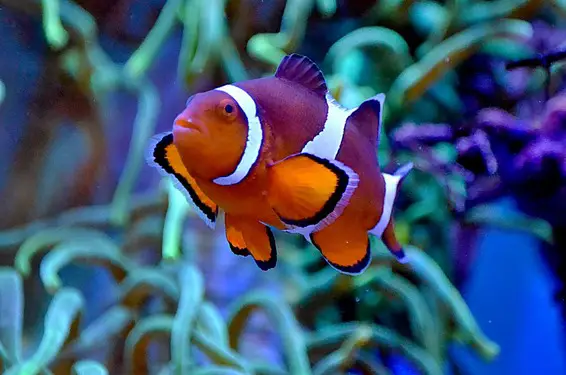
Ocellaris Clownfish

photo of Ocellaris Clownfish which makes many people wonder how fast do clownfish grow

Ocellaris Clownfish is the most widely accessible of the thirty clownfish species. This is why they are known as Common Clownfish.

These marine creatures are simple to care for and grow. Typically, Ocellaris tend to grow between three to four inches tall. But some other Ocellaris Clownfish can reach 4.3 inches.

They will grow approximately half an inch during their first year. The next year, they will reach a height of one inch.

Tomato Clownfish

The Tomato Clownfish is a Western Pacific native. These species are bigger than Ocellaris, the Common Clownfish.

Although this sea creature appears to be a sweet little animal, it could be violent at times. They have a long white stripe around their heads and are generally orange-colored.

Tomato Clownfish can reach 5-5.5 inches in length and increase by one inch every year.

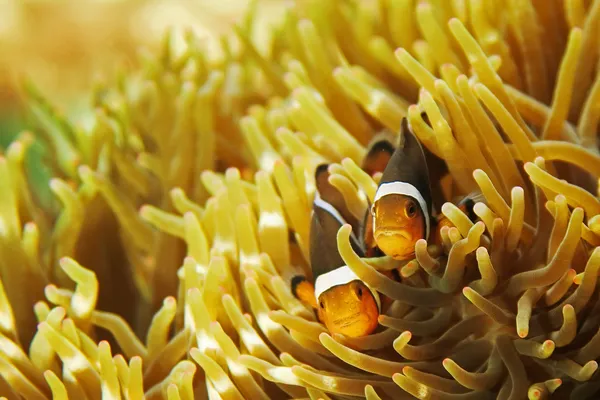
Cinnamon Clownfish

photo of a cinnamon clownfish

Although the Cinnamon Clownfish is part of the tomato complex, its development rate is distinct.

The body of this fish is generally dark orange with shades of mahogany by its sides.

Cinnamon Clownfish grow to reach 4.7 inches. Their annual rate of growth is upwards of one inch.

Clarkii Clownfish

Clarkii Clownfish are one of the smallest, although they are quite beautiful.

The Pacific Ocean is home to this species of fish.  They’ve got black and white stripes with a brilliant yellow body.

Clarkii fish may reach a length of four inches and typically increase half an inch per year.

Darwin Clownfish

The Darwin Clownfish is among the varieties of the Ocellaris Clownfish.

It has markings that are comparable to that of Common Clownfish. Their hue, though, is white with black stripes. They are the tiniest, at about three inches long.

Darwin Clownfish grow half an inch to an inch every year. They take two to three years to completely grow.

Maroon Clownfish

It is now time to meet the biggest of all the different clownfish.

The largest and most violent clownfish is none other than the Maroon Clownfish. It may grow up to seven inches long and has a deep maroon coloration with straight white lines.

Maroon Clownfish typically grow one inch every year and require between six to seven years to reach full maturity.

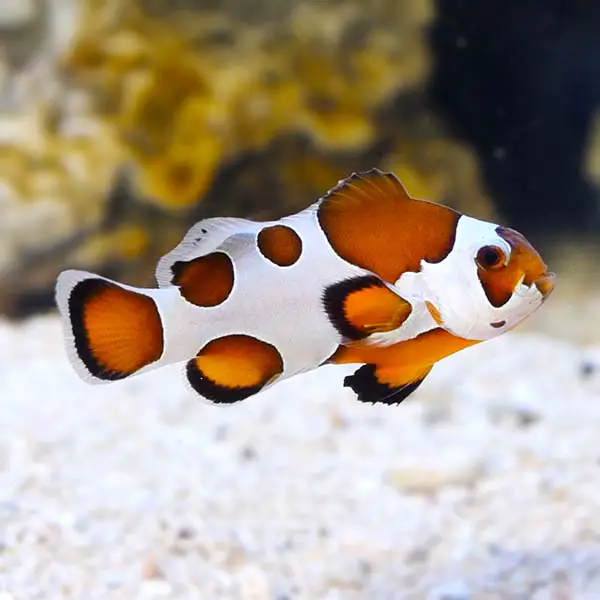
Frostbite Clownfish

Snowflake and Wyoming White Clownfish were crossed to produce this type of clownfish.

While they can grow to be approximately four inches in length, the majority of them are just three inches.

Like Percula and Ocellaris Clownfish, these fish increase at a pace of 0.5 – 1 inch every year.

As a result, they require about three years to reach their maximum size.  Their usual buying size is between half to one inch.

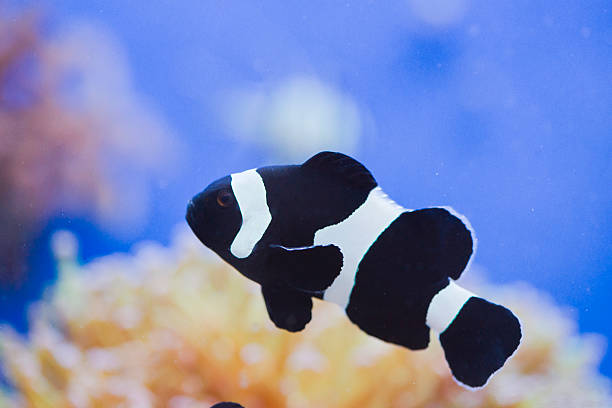
Black Clownfish

Black Clownfish
Marine fish Amphiprion ocellaris black

Black Clownfish are part of the Percula species. As a result, their highest size and development rate are equal to those of false Percula Clownfish.

In adulthood, these fish reach a length of roughly three inches, growing at a pace of 0.5–1 inch each year. As a result, it takes those around three years to reach their maximum size.

Pink Skunk Clownfish

Do not judge a book by its cover. These clownfish species are by far the most violent of the bunch.

Yearly, they grow four inches at a pace of 0.5 – 1 inch. As a result, they might take between three to five years to achieve their size limit.

The estimated purchasing size of a Pink Skunk Clownfish is between ¾ – 1-¼ inches.

Orange Storm Clownfish

Orange Storm Clownfish

The Orange Storm Clownfish is as beautiful as its names suggest.

They are small, only reaching a maximum size of 3 inches. These species have a growth pace of about 0.5 – 1 inch per year, taking around three years to attain full size, just like their other clownfish cousins.

The usual purchasing size of this type of clownfish is between 1 – 2 inches.

Clownfish Fry 

The eggs of Clownfish Fry are spherical and measure between four to six millimeters.

It takes between six to seven days for the eggs to hatch. Feeding Clownfish Fry will have metamorphosis occurs on the tenth day; thus, hatching fish need around ten days to transition from the larval stage to juveniles.

Clownfish Fry grows about four to six inches in one or two years.

Relationship Between Clownfish’s Growth Rate And Their Sexes

Of course, size is important when you are a clownfish. Clownfish thrive in pairs of two or three. The female is always the largest part of the pair.

She is a dominant female. And she’s at the top of the rank, and she’s always given the greater portion of the resources to keep her hefty body.

The mating male is the second largest fish after that. And unsurprisingly, he is ranked second. As a result, the ranking order is determined by the magnitude of the fish.

Furthermore, researchers have discovered that when the hierarchy drops, there’s a mean size differential of about ten millimeters. 

Species, Growth Rate, and Average Size: How They Compare 

Species Growth Rate per Year (Inches) Average Size (Inches)
Percula Clownfish 0.5-1 3
Saddleback Clownfish 1 4.7
Tomato Clownfish 1 5-6
Maroon Clownfish 1 5-6
Frostbite Clownfish 0.5-1 3
Darwin Clownfish 0.5-1 3
Cinnamon Clownfish 1 4.7
Black Clownfish 0.5-1 3
Clarkii Clownfish 0.5-1 6
Pink Skunk Clownfish 0.5-1 4
Orange Storm Clownfish 0.5-1 3
Ocellaris Clownfish 0.5-1 3-3.5

Helping Clownfish Grow Quickly

So far as you feed most clownfish the correct foods, they will grow quickly. Here are a few tips to ensure that your clownfish grow quickly and healthily.

Feed Your Clownfish Twice a Day

Feed them at least two times every day. Occasionally, it is good to give them special delicacies.

Use of Clean Tanks

Don’t keep the tank dirty for lengthy periods of time as this might cause their illnesses, especially for clownfish growing in disease-prone environments to get a healthy fish.

Keep An Eye Out For Diseases

Take your fish to the doctor if you see any skin patches or grill and fin rots.

Such conditions might impede their growth rate. The fact is that none of these tricks will make your clownfish grow. A clownfish increases by around 1 inch every year.

However, supplying them with essentials can boost their health.

Clownfish Thrive in a Stress-Free Setting

Clownfish, all thirty types of them, are territorial creatures.

You must make certain that each fish has enough space to establish his area, that the aquarium is free of dangers, and that there are enough resources and hiding sites.

As with all fish, Clownfish release a larger quantity of the hormone cortisol when they are stressed. This hormone suppresses a fish’s desire for food while also weakening its innate immunity.

Constant Water Changes

According to many studies, fish send certain secretions into their environment that has been proven to limit how much the other fishes in the area grow.

These secretions, known as pheromones, would not have been a significant issue in a saltwater fish because of the larger body of water where they would be quickly washed away and diluted.

However, in confined systems such as aquariums, they have nowhere to go but to be incorporated into the body of the fish.

To eliminate these pheromones, it is necessary to do regular water changes.

The Role Of A Well-Balanced Diet

There are no hard and fast rules when it comes to these fishes or some other fishes.

Some enthusiasts feed two times every day, while others would stick to just feeding once per 48 hours. Everything comes down to the clownfish’s requirements and your comfort.

Regardless of the amount or the frequency with which you feed them, the most essential thing is to give them well-balanced food that’s enriched with all of the essential nutrients they require. Clownfish eat everything.

As a result, feeding them is a breeze. You’ve got several alternatives available to you. Make a conscious effort to give them a high-protein live and frozen food several times weekly to provide them with a diverse yet balanced diet. 

The Role Of A Get A Bigger Tank

Most clownfish only reach 3 inches in length, while others reach six inches. As a result, the suggested minimum tank capacity ranges from twenty to seventy gallons.

Although it is a fallacy that fish adapt to small tanks, a tiny container can certainly limit their growth. It does it in a variety of ways.

Firstly, the growth-stunting pheromones aren’t rinsed away or weakened enough to be harmless.

Secondly, denying a fish the opportunity to tread the water to its heart’s desire results in a dearth of activity and an elevated risk of muscular atrophy.

Clownfish Lack of Growth: What Causes It?

An adult clownfish may not be increasing in length for a variety of factors.

The difference in the size of certain small clownfish might be hard to discern. One other consideration is feeding because it helps clownfish reach maturity faster.

Do Clownfish Couple Better?

Adult and baby clownfish could be raised in pairs or as solitary fish. It’s much more typical to store them in couples, though.

They are better at ease in groups, and their behavioral patterns indicate that they dislike being the sole clown inside the water.

Conclusion

Knowing what to anticipate before getting a clownfish is safer and better.

It wouldn’t be any more difficult to care for them after reading this post. Don’t get discouraged if your clownfish takes a long time to grow. It will develop to its full size and thrive well.

How Fast Do Clownfish Grow - Featured Image

source https://aquariumlabs.com/how-fast-do-clownfish-grow/

Do Clownfish Have Teeth? Can They Bite?

Clownfish are very popular saltwater pets for many hobbyists. Nothing compares to the sight of your fish swimming happily within the sea anemones in your tank.

But cute as they may be, you may wonder if clownfish have teeth.

This interesting piece answers the question: do clownfish have teeth? It also discusses many other important concerns.

Do Clownfish Have Teeth?

Yes, they do. But they do not have regular teeth in their jaws like many other aquatic omnivores. They have what is known as pharyngeal teeth.

These types of teeth are lined in the pharyngeal arch of their throat. This is common with many other fish species lacking the regular teeth structures.

gold fish in reef

However, some species appear to have teeth right in their mouth seated on a very strong jaw, especially the larger ones!

What Do Clown Fish Do With Their Teeth?

Like many other aquatic creatures, clownfish use their teeth to respond to the changes in their immediate environment. 

Although they do not have teeth like sharks and other big saltwater fish, their aggressive nature makes these small and sharp teeth effective in doing the little tasks they depend on them for. 

Clownfish use their teeth for the following:

Protection

Clownfish are very territorial, using their teeth to guard their territory. They love to stay within sea anemones. 

They enjoy a symbiotic relationship with their sea anemone, which is often called mutualism. The host anemone provides shelter, protection, and, sometimes, food since the clownfish nimble on leftover food particles from its host. And the clownfish appears like a weak prey to lure fish into the anemone.

It is not unusual to find clownfish already established in the tank attacking a newcomer for trying to invade their space.

They also bite to protect their eggs. This job to protect the eggs is usually carried out by the males. Although they are smaller than the females, the males will guard the eggs until they hatch.

They will bite anything and anyone that comes near the eggs. In the wild, they are usually fierce when they perform their guard duties because if they do a sloppy job, the female clownfish will leave them for other capable mates.

Communication

Clownfish and many other fish species with pharyngeal teeth use their teeth to communicate. When they bang their teeth together, the quick collision is a way for them to communicate with other clownfish.

Although they are not the only fish known to communicate, one of the things they do with their teeth is to communicate with each other.

Do All Clownfish Bite?

All clownfish have teeth, and they bite. There are no such clownfish species if you are searching for a species that will spare your hands when you clean the tank.

But how aggressive they are and how often they bite varies with the species.

Are All Clownfish Aggressive?

It is difficult to find any clownfish that has absolutely no aggression. While some hobbyists may have clownfish that are not aggressive, their portrayal as non-aggressive in Finding Nemo is not accurate.

These fish are all aggressive and territorial but at varying degrees. The marrons, saddlebacks, and tomato clowns are some of the most aggressive types. These types will not hesitate to bite your hands and other fish that appear to be trespassing into their territory.

They will also attack if another clownfish tries to interfere with the relationship they are keeping with their breeding mate.

However, Ocellaris clownfish are reportedly the least aggressive clownfish. They are the right choices for pet owners that do not want to deal with the risk of clownfish biting.

Are Clownfish Bites Serious?

Their bites are not usually more than a scrap. Clownfish bites don’t even hurt at all.

But if you keep a very big clownfish and it manages to sink its big teeth into your skin, it will hurt because those tiny teeth will feel like having many needles in your skin at once.

You can deal with the hurt by applying some ice to the injury. It is never a big deal, so the scratch should heal in a few days.

You can also wear gloves to avoid the bites.

How To Stop Clownfish From Biting

Give Them an Exclusive Tank

Clownfish love to have the tank to themselves. In the absence of any intruder, you will find harmony in your fish tank. You will typically find the pair stick with each other in peace, exploring the tank together in unison, and cleaning their space.

Use a Larger Community Tank

There are many reasons for your clownfish to be aggressive in the community tank. They may have to bite other aggressive fish to protect their territory, eggs, or partners.

There is hardly much room for your clownfish to mark out their territory in a small tank because confrontations with other tank mates are inevitable.

But in a large tank, clownfish bites will hardly be experienced because there will be enough room for the fish to swim around as they please, and the risk of confrontations will be minimal.

Do Clownfish Bite Each Other?

Clownfish bite to deter other clownfish from interfering with their love life. You will notice this, especially when you want to breed clownfish.

Clowns accept each other as pairs and will usually bite any other intruder as a warning that they cannot be part of their relationship.

Typically, the most prominent male among them turns into a female to breed clownfish. A mated pair will go about together in their exclusive relationship, so it is common to see the male attack other clownfish that try to interfere in their love life.

Dealing With Clownfish Bites During Cleaning

putting on protective gloves

After getting a bite or two from their clownfish, some guys swear while trying to pick out some small chunks of uneaten feed. This does not mean that clownfish are cannibals. They see the hands as intruding into their private space, and this makes them “attack” the hands, as it were.

Wearing gloves does not prevent bites, but it reduces the chances of the bites hurting. Wear a pair of gloves before dipping your hands in the aquarium.

There are times when you would want to get in there and take out that piece of uneaten food without wearing gloves. You would be extremely lucky not to get bitten. But you are likely to experience the biting no matter how fast you may be.

These bites are often painful and may even give way to some blood, but there is no reason to fear as the bites are never too deep. They have very strong jaws, but their jaws are not strong enough to cause serious bites.

Final Words

Clowns are a popular fish that do not require much effort to keep. However, a few things must be kept in mind when rearing them.

You want to use a large aquarium for a community tank so that everyone can have their territory and not feel the need to attack other tank mates.

If you are not keeping a community tank, you want to keep a pair: a male and a female, so that the chances of an interference with their relationship are limited.

And always remember that they do not like humans invading their space. Wear gloves to avoid their wrath when you invade their space to take out uneaten feed.

Related Reading:

source https://aquariumlabs.com/do-clownfish-have-teeth/

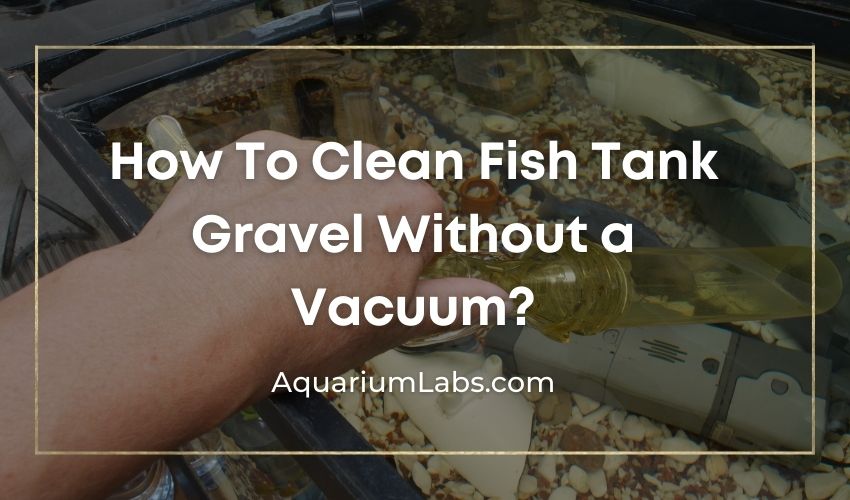
How To Clean Fish Tank Gravel Without a Vacuum?

Using gavel vacuums is the best way to clean the gravel in your tank, especially when you have excess substrate algae. But without a guide like this, you may have had to break the bank for a vacuum to clean the gravel inside your aquarium.

Perhaps, for this reason, you have been wondering how to clean fish tank gravel without a vacuum. This article is it.

This guide explains how to clean fish tank gravel without a vacuum.

Why You Need To Clean Fish Tank Gravel

The gravel as your aquarium substrate is usually where uneaten food, debris, and fish waste, such as fish poop waste, settle.

If you do not have a regular cleaning routine that properly cleans the gravel substrate, your aquarium will likely experience a nitrate buildup.

As you know, nitrate buildup is bad news for your fish because polluted water poses health risks for the pets.

You need to keep a clean tank with regular water changes and other maintenance routines like cleaning the gravel substrate no less than once every two months.

How Often Should You Clean Aquarium Gravel?

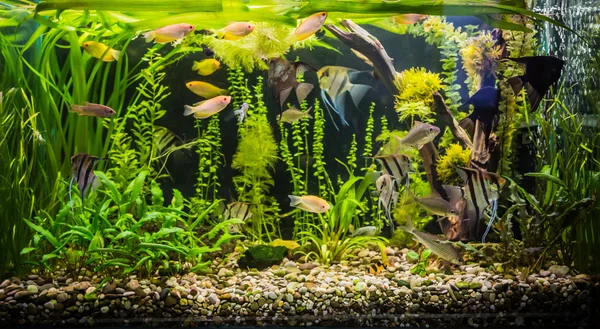
fish tank with fishes and aqua plants inside

Cleaning fish tank gravel requires consistency. The frequency of cleaning aquarium gravel depends on how big the tank is and the rate at which the fish pollute the water. Some fish produce more fish waste at a much more rapid rate than others.

Another factor to consider is the amount of uneaten food that has sunk to the bottom of the aquarium to be trapped in the gravel substrate.

But generally, it would be best for you to have a consistent routine of cleaning gravel in the aquarium. You can choose to clean the gavel completely every two months or after each water change.

How To Clean Fish Tank Gravel Without a Vacuum

How to clean fish tank gravel without a vacuum is practical knowledge that every responsible hobbyist ought to know.

Knowing how to clean fish tank gravel without a vacuum will come in handy, especially when a vacuum is unavailable.

Check out this detailed explanation of the process.

Set Up Another Tank

This step is a very important step for cleaning your fish tank gravel. You want to start the cleaning process by setting up another tank to hold your fish while you do the cleaning.

You want this new tank to be free from any toxins or chemicals. If any chemical has been used to treat the container, wash the bucket clean and ensure that no chemical residue is left in the bucket, as this will affect the health of your fish.

Choose a container that is big enough to hold all your fish. After setting up this make-shift fish tank, you want to siphon about 50% of your fish tank water into this new tank. This will ensure that the fish are kept in the same water parameters as before while you do the cleaning. 

Move Your Fish

After setting up the holding tank, move your fish into this holding tank. Be careful not to hurt them. You can move them with a net or other tools that will not cause any harm to their bodies.

But if you keep fish with long and flowy wings like angelfish and bettas, it would be better to move them into this holding tank with your hands.

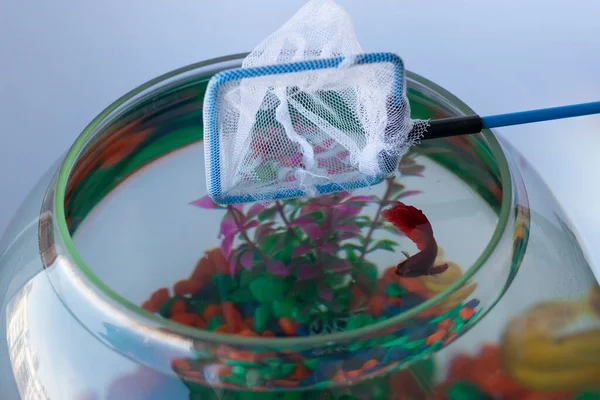
Scoop-net device on a tank

Long fins of fish tend to get entangled in nets. When this happens, your fish is likely to end up with damaged wings and injuries.

You want to avoid that by moving them into the holding tank with your hands.

Take the System Apart

To clean the fish tank gravel thoroughly, it would be best to remove the filters, air pumps, lighting systems, decorations, hides, and anything that might get in the way of the cleaning.

You want to take the system apart so that you do not accidentally damage any aquarium appliances. You also want to unplug the electrical appliances attached to the tank and not just the ones inside the tank.

Take out some of the rocks and set them apart in a separate bucket. You want to keep about a cup or two full in a bucket, to be returned later into the tank.

This process is important because if you clean all the tank gravel without setting any aside, you would have lost beneficial bacteria necessary for the breakdown of fish waste in your fish tank. These healthy bacteria are called nitrifying bacteria, and they play a significant role in the aquarium.

So you want to have a cup or two of your tank gravel in a separate bucket to keep some of these healthy bacteria.

Clean Your Aquarium Gravel

While there are many methods to clean your tank gravel without a vacuum, using a strainer is one of the most effective ways. Pour the fish tank gravel into the strainer and put the strainer inside a bucket. Shake the strainer as much as possible under running water to rinse the gravel.

It is important that you do not mix the water with any solution or cleanser. Ordinary tap water is sufficient for straining the fish tank gravel.

You want to repeat this process with running water until you have lost as much grime as possible. You will notice that you have lost as much grime as possible when the water in the strainer runs clear.

If you are using gloves, you want to ensure that the gloves are chemical-free.

Set Up Your Aquarium

After cleaning the fish tank gravel, some hobbyists like to clean the aquarium. If you wish to clean the aquarium, it would be best to do so without harsh chemicals.

Avoid any chances of leaking any chemical residue into the new aquarium water. Any chemical residue in the tank would be harmful to your fish.

But it would be best to clean the whole aquarium before setting your rocks back in. A light cleaning would do as you do not want to remove all the healthy bacteria in the fish tank.

You may use your hand to arrange the clean gravel on the fish tank floor. Remember to add the gravel you set aside earlier for reintroducing the beneficial bacteria back into the aquarium.

Return the tank decorations and all the other electrical appliances you removed at the start. Arrange everything back in place as it should be; the filters, the air pump, the tank decorations, the hides, and other electrical hardware.

You can slowly fill the aquarium with water using a hose for slow water movement. Test to ensure that they work and pose no risk of electrocution. Test for the correct water parameters after cleaning.

Check the temperature, pH level, water flow, water hardness, and other water parameters. Make the necessary changes to bring the water quality to the ideal condition for your pets.

Related Reading:

Return Your Fish

It would be best to return your fish with the remaining water inside which you set them aside. This will help restore the balance of the ecosystem in the tank with the reintroduction of the beneficial bacteria.

What If You Have Live Plants With Roots Deep in the Substrate?

It may be challenging to empty the tank of the dirty gravel, especially if you have live plants. The obvious reason for this challenge is that the roots of the live plants will be damaged if you remove all the gravel. This will injure and may even kill your plants.

But you can clean your fish tank and the dirty gravel in it without harming your plants. This method is particularly useful when you have live plants.

Aquarium fish in a freshwater aquarium

You need to remove all the electrical appliances and decorations to do this. Leave the plants intact in the gravel. Reduce the water level to about half.

Raise the aquarium gently to slide the gravel and the plants to one side. Work up the dirty gravel and stir carefully around the plants to raise the dirt in the substrate and around the rock.

Clean your fish tank by taking out about 35% to one half of the silty water left in the aquarium. Taking out only one half or about 35% of the silty water left in the aquarium will ensure that the microscopic organisms essential for the ecological balance of the tank repopulate themselves in the new water.

There are other ways to clean gravel in fish tanks. Check out this video to know more.

Final Thoughts

Cleaning aquarium gravel with or without a vacuum is one sure way to have fish tanks smelling and looking fresh again.

With this guide, you are guaranteed to save yourself the stress of investing more than you should in the task.

You want to ensure that you rinse with clean water that has not been contaminated with chemicals all through the process.

After setting up the fish tank, you also want to ensure that the water level is the same as before and the parameters are also the same. This is important to prevent stress from a rapid change in the environment.

Related Reading:

How To Clean Fish Tank Gravel Without a Vacuum - Featured Image

source https://aquariumlabs.com/how-to-clean-fish-tank-gravel-without-a-vacuum/

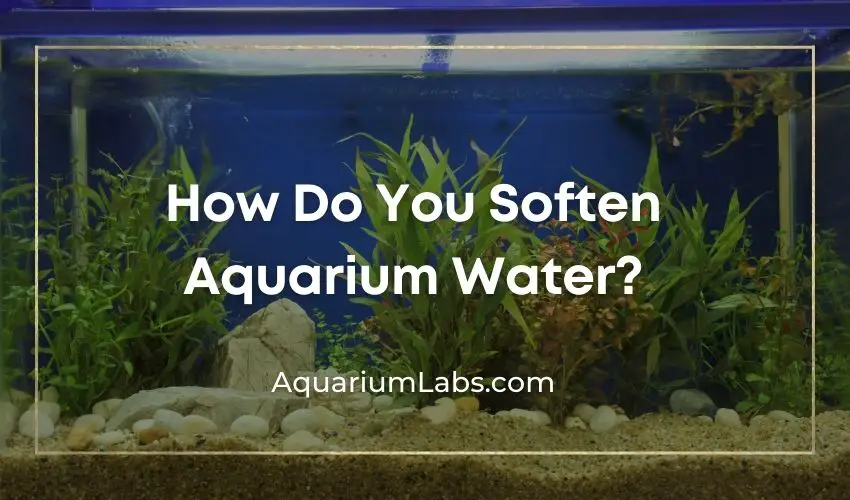
How To Soften Aquarium Water

Carbonate and magnesium ions are naturally occurring mineral content in water. These minerals affect the aquarium water hardness.

Water hardness in a fish tank is a parameter that must be considered carefully if your aquarium fish is to have access to great water quality. Softening hard water is a great way to ensure water quality for these soft water fish.

Although there is a lot to know about softening aquarium water, rainwater is the easiest and most natural method to soften water for aquarium use.

But, how to soften aquarium water? There are many other ways to soften tank water. This article discusses them all in detail.

What Is Water Hardness

Water hardness is the total amount of dissolved magnesium and calcium in a water volume. It is usually rendered as the concentration of calcium carbonate (CaCO3).

Water is hard when it is high in dissolved minerals, especially calcium and, to a lesser extent: magnesium. Other minerals usually present in the water may include iron and manganese.

You will notice the concentration of dissolved minerals in water when the water leaves a slimy film of chalky deposit on your hand after washing with soap. Hard water also leaves unsightly residues on glass containers, as you may have noticed with your aquariums.

On the other hand, soft water is water with negligible or no amount of dissolved mineral content. This means that when your water is soft, it has a low concentration of dissolved mineral contents.

The higher the concentration of the dissolved minerals in the water, the harder the water will be. There are many reasons for water hardness. These include the location and the source of the water.

Hard water typically has a higher pH level than soft water, which usually has a lower pH level. But the minerals in hard water act as a buffer to prevent the acidification of the water in your aquarium.

Measuring Water Hardness

There are two ways to determine water hardness. These are GH and K. They are also known as the degree of general hardness (GH) and carbonate hardness (KH). They are often used interchangeably, and this inaccurate way of using them often leads hobbyists into confusion.

Here is a quick explanation for both.

General Hardness (GH)

The general hardness of water is the measure of the concentration of calcium and magnesium per volume of water in your aquarium. It is also known as the degree of general hardness.

General hardness also tells if your aquarium has enough minerals and salts to sustain the biological functions of aquatic life.

Carbonate Hardness (KH)/Alkalinity

Carbonate hardness, also known as the degree of carbonate hardness, measures the concentration of carbonate and bicarbonate ions per volume of water in the aquarium. 

There is always some kind of confusion because both can be rendered as parts per million (ppm). This table below illustrates how they measure different things:

Hardness (GH) Hardness (KH)
Measurement Unit Degree of General Hardness or Parts per Million (PPM) Degree of Carbonate Hardness or Parts per Million (PPM)
Degree Equivalent 1 dGH = 17.84ppm or 0.01g of Calcium Oxide per Liter of Water 1 dKH = 17.86ppm or 0.01786g of Calcium Carbonate per Liter of Water

Testing for General Hardness and Carbonate Hardness

You need an aquarium test kit to test for either of the water hardness parameters you wish to test.

But the aquarium test kits to use will depend on whether you are testing for the degree of general hardness or carbonate hardness.

  • Testing for General Hardness (GH). You need a general water hardness test kit like the Aqua Care Pro 18 test strips 6 in 1 to measure general hardness. The test kits will indicate how much dissolved calcium and magnesium are in your water.

  • A reading in the range of 0-8 dGH means that you have soft water, while higher values in the range of 9-12 and above indicate that you have hard water.
  • Testing for Carbonate Hardness (KH)Alkalinity (Carbonate hardness) tests require the use of a carbonate hardness test kit like the Aqua Care Pro 18 test strips 6 in 1.
  • This test measures the level of alkalinity in the water. Alkalinity is directly linked to its capacity to cushion the variations in the water pH level.A low KH value indicates that the water is vulnerable to risky sudden changes in the pH levels, while a high KH value means that the water’s resistance to sudden pH variations has increased. However, a KH value of 4.5dKH means that you must pay more than usual attention to the pH level.
Water Condition Saltwater Aquariums Freshwater Aquariums
General Hardness 8-12 dGH 4-8 dGH
Carbonate Hardness (Alkalinity) 8-12 dKH 4-8 dKH

Determining Your Tap Water Hardness Level

Water hardness is a very crucial aquarium water parameter. While aquarium fish may tolerate slight changes with other parameters, drastic changes in water hardness level could occasion serious health issues since aquarium fish are accustomed to the water conditions of their natural habitats.

Natural water bodies increase in general hardness and alkalinity as water washes pass rocks such as limestone and other rocks containing calcium and magnesium.

The increase is sometimes also spiked when the water passes a limestone deposit in the soil. This means that your tap water may be too hard to use directly in your aquarium upon reaching your home, depending on your location.

However, here is an easy guide to help you determine how hard your water is when you get your water hardness test result.

Water Hardness Level Ranges of General Hardness (dGH) Ranges of Carbonate Hardness/Alkalinity (dKH)
Extremely Soft 0-4 dGH 0-4 dKH
Soft 4-8 dGH 5-7 dKH
Slightly/Barely Hard 8-12 dGH 7-8 dKH
Moderately Hard 12-18 dGH 9-12 dKH
Hard 18-30 dGH 13-20 dKH
Extremely Hard > 30 dGH > 20 dKH

How To Soften Aquarium Water With These Water Softening Methods

Use a Reverse Osmosis Unit

You can soften aquarium water with a reverse osmosis unit. This unit uses reverse osmosis, a water purification process for demineralizing water.

The procedure entails forcing the water through a semi-permeable membrane filtration unit to eliminate the water’s mineral content and other impurities. 

While the purification process aims to filter out the contaminants in the water, such as large particles and sediments like dirt, salt, and chlorine, eliminating the ions in the water naturally softens the water.

But RO water leaves you with pure water that has zero hardness. So you have to mix the filtered water with some dechlorinated tap water to restore minimal measures of some of the crucial minerals needed in the aquarium.

The benefit of the reverse osmosis system is that its effectiveness is not limited to small fish tanks only. You can use it for small tanks, but it would be particularly helpful for larger tanks.

You can check out the iSpring RCC7.

Peat Moss

Peat moss is dried decomposed moss. It is also called Sphagnum moss and is used for softening tank water because of its natural ability to soften water.

Peat moss softens aquarium water by releasing gallic and tannic acid into the aquarium water to neutralize the carbonate compounds in the aquarium water. This leads to a decrease in the water’s hardness and pH level.

Before using peat moss, it would be best to boil the peat moss for about an hour to decontaminate it.

You can also decontaminate the peat moss by soaking it in a bucket of water for about 3-4 days. After decontaminating the peat moss, you may use it to soften aquarium water in any of these ways:

  • Using peat moss to soften the water before use in the aquarium.

You can soften tap water with peat moss before using it in the aquarium. To do this, you have to place the already decontaminated peat moss inside small mesh bags.

After that, leave the filter bags containing the already decontaminated peat moss in the bucket of water you want to soften. Test the degree of general hardness and pH level every 10-12 hours until you get the target water hardness level.

You can use the softened water in your aquarium or add it to the aquarium when you do your water changes.

  • Putting it inside the aquarium filter and using it as peat moss filters in a filter media.

Put the already decontaminated peat moss in small sized mesh bags and seal the bags. Leave the peat moss bag in the aquarium filter to serve as a filter bag.

It would be best to put the mesh bags containing the decontaminated peat moss between the filter pad and the charcoal media. This will ensure more effectiveness.

  • Using the peat moss as a substrate.

Using peat moss as a substrate is another effective way to soften aquarium water. You do not need to have them in a filter bag for this process.

After decontaminating the peat moss, you can simply spread them on the aquarium floor.

Since they are very fluffy and can be moved by curious fish or the water flow in the aquarium, it would be best to have another substrate on them to firmly hold them down.

You can use gravel or sand as the additional substrate. Apart from firmly holding the peat moss down, this other substrate will also check the possibility of having anaerobic pockets that will facilitate the growth of harmful bacteria.

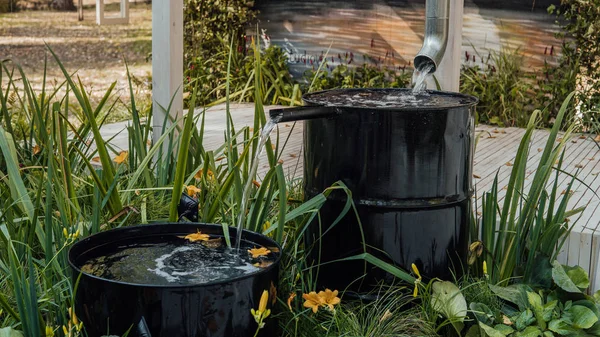
Rainwater

Rainwater is naturally soft as a result of the water cycle. The sun heats water from rivers and lakes, causing it to evaporate.

The water turns into vapors and rises into the air to form clouds by condensation. The clouds eventually break apart to form rainfall or precipitation, so properly called.

The rainfall washes into the ground to mix with the minerals in the soil, and the sun heats the water again to repeat the process. 

Rainwater flows from a drainage pipe into the metal barrel

The water vapors that rise through the air to form clouds and later rain usually contain almost no mineral content. This is why the water that falls from the skies as rain is mineral content free.

Although it is not totally mineral content free, the amount of mineral content in the water is usually a very negligible amount of the mineral content that must have been present in the water bodies where it must have evaporated from.

The evaporation process ensures that only pure water free of mineral content rises to form the cloud and later rain. This is why rainwater is usually soft.

You can soften aquarium water by using rainwater, but you have to be cautious with your rainwater harvesting method so that you do not endanger the health of your fish.

Ensure to follow these steps to make sure that your rainwater is safe for use in the aquarium:

  • Collect rainwater in a large and clean container. This will limit the chances of introducing any harmful bacteria into your aquarium.
  • Choose your container carefully. Containers marked “food grade” are better for collecting rainwater as they will not discharge chemicals into your rainwater.
  • If you test the rainwater and notice that it is too soft for your aquarium water, you can mix it with some tap water to raise the water hardness level to your desired level. Ensure to use only dechlorinated tap water for the safety of your fish.

The location where you are collecting the rainwater matters. Collecting rainwater in an industrial area is not ideal. The rainwater is highly likely to be contaminated by the poor air quality and high pollution levels prevailing in the area.

Distilled Water

distilled water

You can soften aquarium water by diluting the tap water with distilled water. Distilled water is completely mineral-free.

The process of distilling water is similar to the natural process of the water cycle. The water is boiled, and the vapors are condensed and collected into a liquid state.

Distilled water is mineral-free because the vapors leave the minerals and other impurities behind, like in the natural water cycle.

But if you want to use distilled water, you must dilute it with some dechlorinated tapwater. You have to partially mix tap water with the distilled water to do this.

This is important because the distillation process removes more than 99.9% of all the minerals and other impurities in the water. You want to increase the general hardness of the distilled water by adding some dechlorinated tap water to make it conducive for your aquarium fish.

Use Driftwood

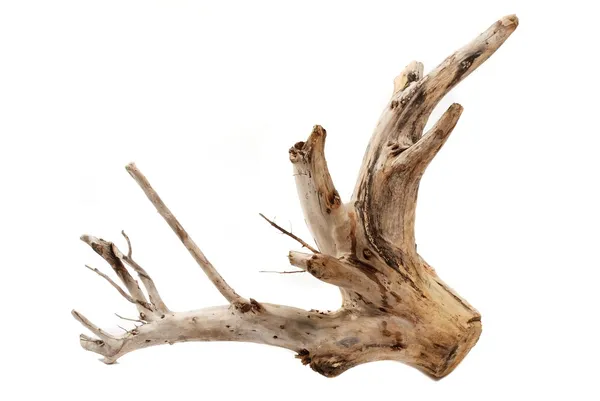
Driftwood tree in white background

You can find driftwood on the shores of lakes and other water bodies. It contains tannins and softens the aquarium water by releasing tannic acid to neutralize the carbonate compounds in the aquarium water. 

Store-bought driftwood is a better choice than sourcing driftwood from the wild as the stores often cure and prepare them so they are safe for your aquarium.

But whether store-bought or wild-sought driftwood, you want to do the following to make them safe for use in your aquarium:

Ensure that the driftwood is completely dry.

Remove the grime around the driftwood, especially if you sourced yours from nature. You can do this with a moderately damp toothbrush and a screwdriver for the crevices.

Sand the driftwood to enhance its beauty.

Wash the driftwood with water with a pressure washer. Do not use a detergent or soap as this will be toxic to the aquatic life in your aquarium.

Ensure that the pressure is not too low to leave it unclean or too high to crack or strip the wood.

Sterilize the driftwood by dousing a piece of cloth in vinegar or hydrogen peroxide and using it to wipe all the parts of the wood, including the crevices.

You can also do this by either boiling, baking, or bleaching the driftwood. Cover the driftwood with foil and leave it in the oven for about 2-4 hours at 200 to 215 degrees to sterilize by baking. 

The final step to preparing your driftwood is curing. You would need to cure the driftwood to make sure it sinks when introduced into the aquarium.

Check out the pros and cons of using driftwood below:

Advantages Disadvantages
Releases tannic acids into the water to soften it. Browns aquarium water for a while.
Tannins are not toxic to fish. Can introduce parasites and harmful bacteria if not decontaminated properly.
Tannins can improve fish’s immune system to protect them against fungal infections. Must be monitored closely for fungal growth especially if the aquarium has poor aeration.

Related: Why Is Driftwood Expensive?

Water Softening Pillows

Water softening pillows are a special type of chemical filtration media consisting of ion exchange resins. They are typically pouches full of ionized resins. You can place these pouches in your aquarium filter (related: where to place your filter).

Water softener pillows absorb soluble heavy metal ions from your aquarium water, including calcium and magnesium.

This absorption lowers the hardness of the water as it removes the mineral contents in the aquarium water.

The ion exchange resins have no harmful effect on your fish or the aquatic plants in your aquarium. Also, you will no longer experience the crusty white residue that is typical of hard water in aquariums.

But the effectiveness of this method is also limited to small aquariums, especially anything around 25 gallons and below.

Additionally, they need to be frequently recharged if they must retain their efficacy. You have to soak the softener pillows in brine for 2-4 hours.

Using this method for larger tanks would be time-consuming as you would have to recharge almost too frequently to keep the pillows effective.

Importance of Softening Aquarium Water

There is almost no room for flexibility with water parameters like salinity, nitrate level, and pH. Aquarium fish will experience stress and other health complications if these water parameters are not properly fixed.

But water hardness is one of the few water parameters aquarium fish have learned to cope with in terms of slight differences. However, here are some compelling reasons to soften aquarium water if you keep soft water fish species.

Prevent Hard Water Stain and Limescale Deposit

Hard water leaves unappealing residues on the walls of your glass aquariums, as you may have noticed. 

This residue is called limescale build-up. It is usually a hard and chalky deposit or residue that builds up where hard water is left standing for a long time. 

This residue or deposits can present aesthetic issues, especially when you leave scrub marks on the glass in an attempt to remove the residues.

You will hardly have these issues when you soften aquarium water before using it in the fish tank.

Protect Your Fish Equipment From Malfunctioning

Aquarium equipment such as canister filters, air pumps, LED lights in the fish tank, powerheads, etc., tend to last longer in soft water than in hard water. 

One noteworthy reason for this is that they are naturally protected from limescale buildup since the water in the aquarium is soft. The chances of a buildup deposit interfering with the functioning of these systems are significantly eliminated.

Breeding Soft Water Fish Species

Although soft water fish species may survive in hard water, breeding for soft water species is only largely possible in soft water that is slightly acidic with the optimal temperatures. 

So if you have soft water species and want to encourage breeding, it would be best to reduce the hardness in the aquarium water even though they can survive in it. 

You want to also acclimatize the breeding pair to the new water parameters before introducing them to the breeding tank. This will prevent any stress shock due to a rapid change in the different water conditions.

Soft Water and Hard Water Fish Species

Soft Water Fish Species/Fish Species That Thrive in Soft Water

These soft water fish species are usually found within water bodies that flow over low mineral soil. Here is a list of some for which you want to ensure that you soften the water in your fish tank.

Soft Water Fish Species Range of General Hardness
Tetras 2-10 dGH
Ram Cichlids 3-6 dGH
Angelfish 3-8 dGH
Discus 3-8 dGH
Barbs 3-10 dGH
Cory Catfish 3-10 dGH
Apistogramma Dwarf Cichlids 3-12 dGH
Rasboras (Only Some) 4-12 dGH
Guramis (Only Some) 5-12 dGH

Hard Water Fish Species

If you cannot keep up with the extra cost, care, and requirements of keeping soft water fish species, here are some fish species that love and flourish in hard water.

Hard Water Fish Species Range of General Hardness
Paradise Fish 5-30 dGH
Guppy Fish 8-12 dGH
Mono Fish 8-14 dGH
Platy Fish 10-28 dGH
Swordtail Fish 12-35 dGH
Molly Fish 15-30 dGH
Archerfish 20-30 dGH

Final Thoughts

Water softening pillows are also great, but their effectiveness is limited to small tanks. Softening tank water with an RO system would be a wise and better investment if you have a larger capacity tank.

But remember that you would have to remineralize the water with some magnesium and calcium ions to restore a measure of the vital minerals.

Follow these steps on how to soften aquarium water, and you will improve your aquarium water quality for your fish, especially your pet fish that prefers softer water.

Related Reading:

How To Soften Aquarium Water

source https://aquariumlabs.com/how-to-soften-aquarium-water/

Fish That Start With S [Extensive Fish Name List]

While finding names of fish that start with S may not be daunting, getting them all together in a list is definitely a daunting task. The list of fish with names that start with S is almost unending.

S starts the name of so many interesting fish. So there is a need to specifically identify one fish from the other. Scientific nomenclature is the system of identification that makes it possible to tell one living organism from the other and even distinguish between two very identical species.

The living organism is classified from the highest group to the lowest subgroup with the following classification:

  • Kingdom
  • Phylum
  • Class
  • Order
  • Family
  • Genus
  • Species
  • Subspecies

This is the same with fish as it helps identify one specific species from another closely related and very identical species. For example, check how it applies to the Siamese Tiger fish below:

  • Kingdom: Animalia
  • Phylum: Chordata
  • Class: Actinopterygii
  • Order: Perciformes
  • Family: Datnioididae
  • Genus: Datnioides
  • Species: Pulcher

Our Top 6 Fish Names Beginning With Letter S

This list of our top 6 fish names that start with S is a great place to start if you are looking for names of fish that start with S.

Picking these 6 top fish species from the list of fish below was challenging. As many hobbyists would agree, there is hardly any aquarium fish that is not special. From the peaceful fish to the not so pretty fish, hobbyists see them as special. But these 6 are worth the hype.

Seba Mono (Psettus sebae)

African moony in an aquarium

The beautiful, exceptional shape of the Seba mono earned the fish a spot on this list. The Seba mono is usually peaceful and will mind its business.

But it will also spring back to life with energy during feeding time to get its “piece of the pie.”

It prefers brackish water and can cohabit with other peaceful fish. But you don’t want to keep it with smaller fish as the Seba is known to eat smaller fish that can fit into its mouth.

You want to use coral sand as a substrate for the aquarium and provide plenty of aquatic plants to make this fish comfortable.

Salvini Cichlid (Cichlasoma salvini)

The Salvini cichlid, like many other cichlids, is territorial and aggressive. Their anger and territorial nature tend to keep the community tank active. But if you wish to keep more than one in a tank, a large tank with sufficient space for these territorial fish would do a lot to limit the show of aggression.

Although it might eat plant matters sparely, this fish is largely carnivorous. They will also do well with pellets that are specifically designed for carnivores. But they enjoy live and frozen foods.

It is best to keep them in a large planted tank that closely replicates their natural environment to provide them enough room to swim and enough covers to hide.

As with many other carnivores, you want to be very picky when choosing tank mates for the Salvini Cichlid. They will eat tankmates that are small enough to fit into their mouths.

Sailfin Molly (Poecilia velifera)

Poecilia velifera in aquarium with plants at the back

As the name implies, the Sailfin molly has a huge dorsal fin that looks like the sail of a boat. This unique trait earned the fish its place on this list.

The Sailfin Molly is a hardy fish species that prefer hard water. They live in brackish waters in the wild and have the ability to the ability to adjust themselves to various salt levels in the aquarium.

Although they can cope with a bit of sunlight, they love a heavily planted tank with floating covers. But they also love to have enough room to swim around.

They are omnivores and will do well with a rich and balanced diet. You can feed them live and feed dried foods but always add leafy greens to their diet.

Do not house the Sailfin molly with notorious fin nippers like the betta species, barbs, and tetras. They will ruin the beautiful dorsal fin of your Sailfin molly.

Snakehead (Channa argus)

Channa micropeltes

This fish is called the snakehead because of its ability to survive on land for days as it wriggles its way like a snake on land to another water body for survival!

It is a very interesting freshwater fish, and it grows enormously. Sometimes, a snakehead can grow more than 30 inches long and weigh more than 15 lbs.

The size of the fish makes it a very expensive investment for the hobby. It is not a fish you want to keep as a pet. But the size also makes the fish a prize for Asian fishermen as it is a famous food in Asia.

Siamese Fighting Fish (Betta splendens)

Siamese fighting fish in isolated black background

Also known as the Japanese fighting fish, the siamese fighting fish is a very colorful fish with beautiful fins that make them great display fish. They are also called betta fish.

The Siamese fighting fish is very territorial. It would be best to keep only one in a tank except when you temporarily house a male and a female betta fish for breeding purposes.

Avoid choosing colorful tankmates for the Japanese fighting fish. Although small, male bettas will often become aggressive toward other fish with vibrant colors. They may see them as competition. So you want to avoid colorful fish.

Suitable tankmates for the siamese fighting fish are corydoras and other bottom feeders.

Be sure to catch them when they stretch out their fins for a breath-taking sight. They will usually do this to attract a female or when they are angry.

Spotted Bristle-Nosed Pleco (Ancistrus hoplogenys)

Baryancistrus fishes in aquarium

The Spotted Bristle-nosed pleco is a nocturnal and easy-going fish. They usually have extended branched antennae, which is usually noticeable in males when they mature.

The spotted bristle-nose pleco is largely herbivores but will not hesitate to devour bloodworms, insects, and shrimps if fed.

They are native to the tropical northeastern South America and prefer an aquarium environment that replicates their natural habitat. They like a well-filtered tank with lots of plants and hides.

If you do not provide covers for them, do not be surprised to see the males trying to dig up your tank’s substrate to make one for themselves. They need a lot of hides and covers at the bottom of the tank to keep them comfortable.

They love a spacious tank as well. Ensuring that they have enough room to swim, hide and explore is very important if you want them to stay stress-free.

List of Fish Names Starting With S

Below is a list of freshwater and saltwater fish with names that start with S. Read on to discover the beauties of the water bodies on earth.

You will find strange names for some of these weird creatures and names of some common fish you already know. So, check the lists out!

Freshwater Fish Beginning with S:

  • Sábalo (Alosa alosa)
  • Saber-Toothed Blenny (Aspidontus taeniatus)
  • Sacramento Blackfish (Orthodon microlepidotus)
  • Sacramento Splittail (Pogonichthys macrolepidotus)
  • Saddle Cichlid (Aequidens tetramerus)
  • Saddleback Hill-Stream Loach (Gastromyzon punctulatus)
  • Saddled Bichir (Polypterus endlicheri)
  • Saddled Hillstream Loach (Homaloptera orthogoniata)
  • SAE (Crossocheilus siamensis)
  • Sailfin Brochis (Brochis splendens)
  • Sailfin Characin (Crenuchus spilurus)
  • Sailfin Marbled Pimelodid (Leiarius pictus)
  • Sailfin Pleco (Pterygoplichthys gibbiceps)
  • Sailfin Silverside (Marosatherina ladigesi)
  • Sajica Cichlid (Cichlasoma sajica)
  • Salamanderfish (Lepidogalaxias salamandroides)
  • Salaween River Danio (Brachydanio shanisis)
  • Sand Knifefish (Rhamphichthys marmoratus)
  • Sandbar Shark (Carchathinus plumbeus)
  • Sandroller (Percopsis transmontana)
  • Sauger (Sander canadensis)
  • Saulosi Mbuna (Pseudotropheus saulosi)
  • Schwanefeld’s Barb (Barbodes schwanefeldii)
  • Scissor-Tail Rasbora (Rasbora trilineata)
  • Scissortail Rasbora (Rasbosoma spilocerca)
  • Sculpin (Myoxocephalus octodecemspinosus)
  • Senegalus Bichir (Polypterus senegalus)
  • Serpae Tetra (Hyphessobrycon eques)
  • Serrated Piranha (Serrasalmus serrulatus)
  • Sevan trout (Salmo ischchan)
  • Seven Spotted Archerfish (Toxotes chatareus)
  • Severum (Heros severus)
  • Shad (Alosa fallax)
  • Shark (cl. Chondrichthyes)
  • Sharp Toothed Tetra (Micralestes acutidens)
  • Sheepshead (Aplodinotus grunniens)
  • Shiner (Notropis chrosomus)
  • Short-Finned Congo Tetra (Hemigrammopetersius intermedius)
  • Short-Lined Pyrrhulina (Pyrrhulina brevis brevis)
  • Shortnose Gar (Lepisosteus platostomus)
  • Shortnose Sturgeon (Acipenser brevirostrum)
  • Shortnose Sucker (Chasmistes brevirostris)
  • Shovelnose Catfish (Sorubim lima)
  • Shovelnose Sturgeon (Scaphirhynchus platorynchus)
  • Siamese Algae Eater (Crossocheilus siamensis)
  • Siamese Flying Fox (Crossocheilus siamensis)
  • Siamese Tigerfish (Coius microlepis)
  • Sierra Leone Barb (Barbus leonensis)
  • Sierra Leone Dwarf Characin (Ladigesia roloffi)
  • Silver & Red Barb (Hampala macrolapidota)
  • Silver Arowana (Osteoglossum bicirrhosum)
  • Silver Carp (Hypophthalmichthys molitrix)
  • Silver Cichlid (Vieja argentea)
  • Silver Distichodus (Distichodus affinis)
  • Silver Dollar (Metynnis argenteus)
  • Silver Dory (Cyttus australis)
  • Silver Gourami (Trichogaster trichopterus)
  • Silver Hatchetfish (Gasteropelecus sternicla)
  • Silver Hemiodopsis (Hemiodopsis immaculatus)
  • Silver Mylossoma (Mylossoma duriventre)
  • Silver Needlefish (Xenentodon cancila)
  • Silver Pacu (Colossoma brachypomus)
  • Silver Prochilodus (Semaprochilodus taeniurus)
  • Silver Scat (Selenotoca multifasciata)
  • Silver Shark (Balantiocheilus melanopterus)
  • Silver Silk (Polynemus paradiseus)
  • Silverside (Melanotaenia boesemani)
  • Silvertip Tetra (Hasemania nana)
  • Sind Danio (Devario devario)
  • Six Barred Epiplatys (Epiplatys sexfaciatus)
  • Six-Bar Lamprologus (Neolamprologus sexfasciatus)
  • Six-Barred Distichodus (Distichodus sexfasciatus)
  • Skunk Loach (Botia morleti)
  • Slant Nosed Gar (Ctenolucius hujeta hujeta)
  • Sleeper (Odontobutis obscura)
  • Sleepy Cod (Oxyeleotirs marmoratus)
  • Slender Hemiodus (Hemiodus gracilis)
  • Slender Mbuna (Pseudotropheus elongatus)
  • Slender-Tail Hap (Buccochromis lepturus)
  • Slimy Sculpin (Cottus cognatus)
  • Smallmouth Buffalo (Ictiobus bubalus)
  • Smelt (Hypomesus olidus)
  • Snakefish (Erpetoichthys calabaricus)
  • Snakeskin Gourami (Trichogaster pectoralis)
  • Snow King Pleco (Liposarcus anisitsi)
  • Snubnose Eel (Simenchelys parasitica)
  • Socolof’s Mbuna (Pseudotropheus socolofi)
  • Socolof’s Tetra (Gymnocorymbus socolofi)
  • South American Darter (Characidium fasciatum)
  • South American Lungfish (Lepidosiren paradoxa)
  • Southern Julie (Julidochromis ornatus)
  • Southern Smelt (Retropinna retropinna)
  • Southern Soft-Spined Rainbowfish (Rhadinocentrus ornatus)
  • Spangled Jewel Perch (Leiopotherapon unicolor)
  • Spanner Barb (Barbus lateristriga)
  • Sparkling Earth Eater (Satanoperca acuticeps)
  • Sparkling Geophagus (Geophagus acuticeps)
  • Sparkling Panchax (Aplocheilus lineatus)
  • Speciosus Cichlid (Lamprologus speciosus)
  • Speckled Gobie Cichlid (Tanganicodus irsacae)
  • Speckled Trout (Salvelinus fontinalis)
  • Spike-Tailed Paradise Fish (Pseudosphromenus cupanus)
  • Spilotum (Cichlasoma nicaraguense)
  • Spiny Dogfish (Squalus acanthias)
  • Spiny Dwarf Catfish (Scoloplax dicra)
  • Spiny Eel (Macrognathus aculeatus)
  • Spiny Pleco (Pseudacanthicus spinosus)
  • Spinyfin (Diretmus argenteus)
  • Splash Tetra (Copella arnoldi)
  • Splitfin (Xenotoca eiseni)
  • Spookfish (Dolichopteryx longipes)
  • Spot-Line Peacock Cichlid (Cichla temensis)
  • Spotfin Tetra (Hyphessobrycon erythrostigma)
  • Spotnosed Gar (Lepisosteus platostomus)
  • Spottail Pinfish (Diplodus holbrooki)
  • Spotted African Lungfish (Protopterus dolloi)
  • Spotted Barb (Barbus binotatus)
  • Spotted Barramundi (Scleropages leichardtii)
  • Spotted Blue-Eye (Pseudomugil gertrudae)
  • Spotted Bristle-Nosed Pleco (Ancistrus hoplogenys)
  • Spotted Cachorro (Acestrorhynchus falcatus)
  • Spotted Climbing Perch (Ctenopoma acutirostre)
  • Spotted Danio (Danio nigrofasciatus)
  • Spotted Doras (Agamyxis pectinifrons)
  • Spotted Gar (Lepisosteus oculatus)
  • Spotted Gourami (Malpulutta kretseri)
  • Spotted Hoplo (Hoplosternum pectorale)
  • Spotted Pike Characin (Boulengerella maculata)
  • Spotted Pimelodid (Pimelodus maculatus)
  • Spotted Pimelodus (Pimelodus pictus)
  • Spotted Piranha (Serrasalmus rhombeus)
  • Spotted Rasbora (Boraras maculatus)
  • Spotted Shovelnose (Hemisorubim platyrhynchos)
  • Spotted Silver Dollar (Metynnis lippincottianus)
  • Spotted Snakehead (Channa punctata)
  • Spotted Tail Mosquitofish (Heterandria bimaculata)
  • Spotted Thick-Lipped Loach (Nemacheilus strauchi)
  • Spotted Zamora (Auchenipterichthys longimanus)
  • Sprat (Sprattus sprattus)
  • Springfish (Crenichthys baileyi)
  • Squarehead Catfish (Chaca chaca)
  • Squarehead Earth Eater (Gymnogeophagus gymnogenys)
  • Squawfish (Ptychocheilus lucius)
  • Squeaker (Synodontis njassae)
  • Star-Gazing Doradid (Astrodoras asterifrons)
  • Star-Gazing Pike Cichlid (Crenicichla cametana)
  • Starry Flounder (Platichthys stellatus)
  • Steelhead (Oncorhynchus. m. irideus)
  • Steindachners Dwarf Cichlid (Apistogramma steindachneri)
  • Sterbas Corydoras (Corydoras sterbai)
  • Sterlet (Acipenser ruthenus)
  • Stickleback (Apeltes quadracus)
  • Stoliczkas Loach (Nemacheilus stoliczkai)
  • Stone Loach (Barbatula barbatula)
  • Stonecat (Noturus flavus)
  • Stoneroller Minnow (Campostoma anomalum)
  • Stream Catfish (Acrochordonichthys rugosus)
  • Strigata Pike Cichlid (Crenicichla strigata)
  • Striolatus Piranha (Serrasalmus striolatus)
  • Striped African Darter (Nannocharax fasciatus)
  • Striped Anostomus (Anostomus anostomus)
  • Striped Goby Cichlid (Eretomodus cyanostictus)
  • Striped Headstander (Anostomus anostomus)
  • Striped Julie (Julidochromis regani)
  • Striped Lamprologus (Neolamprologus buescheri)
  • Striped Metynnis (Metynnis fasciatus)
  • Striped Panchax (Aplocheilus lineatus)
  • Striped Phyrrhulina (Pyrrhulina vittata)
  • Striped Pike Characin (Boulengerella lateristriga)
  • Striped Silver Dollar (Metynnis hypsauchen fasciatus)
  • Striped Sleeper Goby (Dormitator maculatus)
  • Striped Snakehead (Channa striata)
  • Striped Synodontis (Synodontis flavitaeniatus)
  • Striped Tailor (Alburnoides taeniatus)
  • Sturgeon Catfish (Platystomatichthys sturio)
  • Sucker (Catostomus commersonii)
  • Sucker Barb (Barbichthys laevis)
  • Suckermouth Armored Catfish (Pterygoplichthys sp.)
  • Sucking Loach (Gyrinocheilus aymonieri)
  • Sulphurhead Hap (Otopharynx lithobates)
  • Sumatran Barb (Capoeta tetrazona)
  • Sun Loach (Botia eos)
  • Sundaland Noodlefish (Sundasalanx malleti)
  • Sunfish (Centrarchus macropterus)
  • Suriname Eartheater (Geophagus proximus)
  • Swamp-Eel (Monopterus albus)
  • Swampfish (Chologaster cornuta)
  • Swordtail (Xiphophorus hellerii)
  • Swordtail Characin (Corynopoma riisei)

Saltwater Fish Beginning with S:

  • Sabertooth (Coccorella atrata)
  • Sablefish (Anoplopoma fimbria)
  • Sailfish (Istiophorus albicans)
  • Salmon (Salmo salar)
  • Salmon Shark (Lamna ditropis)
  • Sand Dab (Citharichthys sordidus)
  • Sand Diver (Trichonotus filamentosus)
  • Sand Goby (Pomatoschistus minutus)
  • Sand Lance (Ammodytes hexapterus)
  • Sand Stargazer (Dactylagnus mundus)
  • Sand Tiger Shark (Carcharias taurus)
  • Sand Tilefish (Malacanthus latovittatus)
  • Sandburrower (Tewara cranwellae)
  • Sandfish (Trichodon trichodon)
  • Sandperch (Parapercis hexophtalma)
  • Sarcastic Fringehead (Neoclinus blanchardi)
  • Sardine (Escualosa elongata)
  • Sargassum Fish (Histrio histrio)
  • Saury (Cololabis adocetus)
  • Saw Shark (Pristiophorus cirratus)
  • Sawfish (Pristis pristis)
  • Sawtooth Eel (Serrivomer beanii)
  • Scabbard Fish (Evoxymetopon taeniatus)
  • Scaly Dragonfish (Stomias boa boa)
  • Scat (Scatophagus argus)
  • Scorpionfish (Scorpaenopsis oxycephala)
  • Scup (Stenotomus chrysops)
  • Sea Bass (Centropristis striata)
  • Sea Bream (Diplodus vulgaris)
  • Sea Catfish (Bagre marinus)
  • Sea Chub (Girella fimbriata)
  • Sea Devil (Ceratias holboelli)
  • Sea Dragon (Phyllopteryx taeniolatus)
  • Sea Lamprey (Petromyzon marinus)
  • Sea Raven (Blepsias cirrhosus)
  • Sea Snail (Elassodiscus tremebundus)
  • Sea Toad (Chaunacops cf. melanostomus)
  • Seahorse (Hippocampus sp.)
  • Seamoth (Eurypegasus draconis)
  • Searobin (Chelidonichthys spinosus)
  • Sergeant Major (Abudefduf saxatilis)
  • Sharksucker (Remora remora)
  • Sharpnose Puffer (Canthigaster rostrata)
  • Sheatfish (Silurus glanis)
  • Sheepshead Minnow (Cyprinodon variegatus variegatus)
  • Shortnose Chimaera (Hydrolagus alberti)
  • Shrimpfish (Aeoliscus strigatus)
  • Sillago (Sillago parvisquamis)
  • Silver Hake (Merluccius bilinearis)
  • Sixgill Ray (Hexatrygon bickelli)
  • Sixgill Shark (Hexanchus griseus)
  • Skate (Amblyraja hyperborea)
  • Skilfish (Erilepis zonifer)
  • Skipjack Tuna (Katsuwonus pelamis)
  • Sleeper Shark (Somniosus microcephalus)
  • Slender Mola (Ranzania laevis)
  • Slender Snipe Eel (Nemichthys scolopaceus)
  • Slickhead (Alepocephalus tenebrosus)
  • Slimehead (Gephyroberyx darwinii)
  • Slimy Mackerel (Scomber australasicus)
  • Slipmouth (Eubleekeria splendens)
  • Smalleye Squaretail (Tetragonurus cuvieri)
  • Smalltooth Sawfish (Pristis pectinata)
  • Smelt-Whiting (Sillago japonica)
  • Smooth Dogfish (Mustelus canis)
  • Snake Eel (Myrichthys ocellatus)
  • Snake Mackerel (Gempylus serpens)
  • Snapper (Lutjanus sp.)
  • Snipe Eel (Avocettina acuticeps)
  • Snipefish (Macroramphosus gracilis)
  • Snook (Centropomus undecimalis)
  • Sockeye Salmon (Oncorhynchus nerka)
  • Soldierfish (Myripristis jacobus)
  • Sole (Solea solea)
  • Southern Dolly Varden (Salvelinus curilus)
  • Southern Flounder (Neoachiropsetta milfordi)
  • Southern Hake (Merluccius australis)
  • Southern Sandfish (Leptoscopus macropygus)
  • Spadefish (Platax teira)
  • Spaghetti Eel (Moringua javanica)
  • Spanish Mackerel (Scomberomorus regalis)
  • Spearfish (Tetrapturus pfluegeri)
  • Spiderfish (Ipnopidae family)
  • Spikefish (Parahollardia lineata)
  • Spinefoot (Siganus puellus)
  • Spiny Basslet (Plesiops coeruleolineatus)
  • Sprat (Sprattus sprattus)
  • Squaretail (Tetragonurus cuvieri)
  • Squirrelfish (Holocentrus rufus)
  • Staghorn Sculpin (Leptocottus armatus)
  • Stargazer (Kathetostoma laeve)
  • Stingray (Myliobatiformes order.)
  • Stonefish (Synanceia verrucosa)
  • Stout Moray (Gymnothorax eurostus)
  • Striped Bass (Morone saxatilis)
  • Striped Burrfish (Chilomycterus schoepfi)
  • Sturgeon (Acipenser oxyrinchus oxyrinchus)
  • Summer Flounder (Paralichthys dentatus)
  • Surf Sardine (Iso flosmaris)
  • Surfperch (Embiotoca lateralis)
  • Surgeonfish (Acanthurus sohal)
  • Swallower (Eurypharynx pelecanoides)
  • Sweeper (Pempheris schomburgkii)
  • Swordfish (Xiphias gladius)

Final Thought

This list of fish with names that start with S is by no means exhaustive. Scientists continue to discover new fish species as they study nature. But the classification system has made it easier to identify them and classify them appropriately.

So any new species in the family of these listed fish or a new order or class will be classified accordingly. But this list of fish is a great starting point.

source https://aquariumlabs.com/fish-that-start-with-s/

How To Raise KH in Freshwater Aquariums [Guide & Tips]

One of the parameters to monitor in fish keeping is KH which is the same as carbonate hardness. KH is a term commonly used in water chemistry. Understanding KH is very important to keep your aquarium fish healthy and flourishing.

Carbonate hardness functions as a blocker to cushion the effects of naturally occurring acids in the tank. But a very low KH level will ultimately lead to fluctuations in the pH level of your aquarium. Sadly, raising the KH level will raise the pH level as well. So it is necessary to know how to raise KH level.

This article discusses what you need to know about raising the carbonate hardness level of your freshwater aquariums while maintaining a stable pH level.

What Is KH (Carbonate Hardness)?

KH stands for carbonate hardness, a water parameter that measures how much dissolved carbonates (CO3) and bicarbonates (HCO3) are present in your aquarium water. It can also be indicated as dKH (degree of carbonate hardness).

Why Does KH Matter in a Freshwater Aquarium?

KH is one of the most critical water parameters that aquarists need to pay attention to. Here are three compelling reasons why KH matters in a freshwater aquarium.

Prevent a pH Crash

KH affects the resistance of your aquarium water to pH variations.

Acidic compounds in the aquarium, such as nitrates and nitrates, are the natural results of the nitrogen cycle in your aquarium’s ecosystem.

Carbonate hardness (KH) neutralizes these naturally occurring acids to prevent any sudden pH variations in the aquarium, as this would be damaging to your aquarium fish’s health.

Related: How to Lower pH Levels in Aquariums

To Buffer Against pH Fluctuation

A low KH level means that your aquarium water has less water buffering capacity and is less resistant to pH variations. Aquarium water with little or no dissolved carbonates and bicarbonates is likely to experience a sudden drop in the pH level.

This could be fatal to your aquarium fish, as a sudden and rapid change in the water’s pH level could lead to serious health issues and even death.

A high KH level increases the water’s buffering capacity. This means that aquarium water has a high amount of dissolved carbonates and bicarbonates, which makes it resistant to pH fluctuations.

The water’s buffering capacity is increased as the pH level is less likely to change suddenly because the high amount of dissolved carbonates and bicarbonates will continue to neutralize the naturally materializing acids in the tank.

To Provide for the Needs of Certain Fish Species

Some freshwater fish species are native to water bodies with high KH levels.

Fish like the African cichlids will not just survive but will flourish in the aquarium water with a high KH, especially in the range of 9-12 dKH.

While many aquarium fish may adapt to the recommended KH range for freshwater aquariums (4-8dKH), it would be impossible to breed fish species that prefer hard water with high KH levels in such waters.

Aquarium plants may also benefit from a higher level of carbonate hardness in the aquarium, especially if the increase is a replication of the KH level in their natural habitats.

What Causes KH To Drop in a Freshwater Aquarium?

how to raise kh in aquarium

Excess Carbon Dioxide (CO2)

Carbon dioxide is crucial for the growth and development of aquarium plants. Aquarium plants also rely on carbon dioxide and light to produce food through photosynthesis.

Aquarists often supplement the fish tanks with carbon dioxide so that plants can thrive and flourish in the aquarium.

However, when there is excess carbon dioxide in your fish tank, KH will drop. The extra carbon dioxide dissolves into carbonic and will make the water in the aquarium acidic if the aquarium plants do not use it up.

Although the KH will initially buffer the high acid level in the water, it will ultimately drop after being eaten away by the excess carbon dioxide.

After the drop in the KH, your tank will also experience a dip in the pH level.

Overcrowded Aquarium

Overcrowded aquariums can also cause a drop in the KH levels. Stocking a fish tank up to 80% of its capacity and beyond is another reason for the drop in KH levels. Overcrowding a tank increases the rate at which the naturally occurring acids in the aquarium are being produced.

You can expect a drop in the KH level of an overcrowded tank because the excess naturally occurring acids will eventually use up a significant portion of the dissolved carbonates and bicarbonates in the water.

This will ultimately lead to a drop in KH levels and a pH crash since KH levels will no longer be sufficient to ensure pH stability.

Irregular Water Changes Routine

Dissolved carbonate and bicarbonate are carbonate hardness resources that can be used up. Carbonate hardness is used up in the conversion of fish waste into ammonia, nitrites, and nitrates by some beneficial bacteria. These bacteria are called nitrifying bacteria.

So the concentration of dissolved carbonate and bicarbonate must be replenished to maintain an optimal KH level. This maintenance is one of the benefits of regular water changes. Frequent water changes must be performed to replenish the depleted carbonate hardness.

How To Raise KH in Freshwater Aquariums Recommended Methods

Water Changes With Dechlorinated Tap Water

A weekly partial water change of about 20-25% of the aquarium water with dechlorinated tap water can raise the KH of your aquarium water.

This is especially true if your tap water is hard with a higher alkalinity level.

Be careful not to perform the partial water change with ordinary tap water. First, you want to dechlorinate the tap water with a water conditioner or any other chemical-free method. You also want to let the water rest for about 24-48 hours before using it for the water change.

Supplement the Freshwater With Potassium Bicarbonate

Although adding aquarium water with potassium bicarbonate is a way to fertilize aquarium plants, the alkaline mineral also helps in raising the KH levels of the freshwater aquarium.

Potassium bicarbonate is so easy to use as it is a great substitute for baking soda and is also sold in powder form. You want to try out the potassium carbonate in small doses. This will help you get evaluate its effectiveness in raising the KH level.

You can check this potassium bicarbonate dose guide for a start.

Potassium Bicarbonate/Carbonate Dosage Expected Result on KH In Freshwater Aquariums
3.5g of Potassium Bicarbonate per 26.5 gallons of water. Increases KH by 1 dKH
2.5g of Potassium Carbonate per 26.5 gallons of water. Increases KH by 1 dKH

This guide is useful for calculating how much potassium bicarbonate you will need for your aquarium, especially if your aquarium is bigger than a 20-gallon tank.

Use Limestone, Aragonite, or Dolomite As Substrate Sand

You can also raise KH levels by using limestone, aragonite, and dolomite as a substrate in your freshwater aquarium.

Limestone is a sedimentary rock. It is largely made of calcite which is calcium carbonate (CaCO3). Calcium carbonite and other carbonate compounds like magnesium carbonate supply carbonate ions to your freshwater aquariums.

So using limestone as a substrate will naturally help raise KH (carbonate hardness) levels in the fish tank.

Using dolomite rock as a substrate can also help to increase KH levels in the aquarium. Dolomite rock contains dolomite, a double carbonate of magnesium and calcium.

It is also very useful in raising KH levels and improving the alkalinity buffer capacity of the water in your freshwater aquariums when used as a substrate.

As a carbonate mineral, using aragonite as a substrate is another sure way to increase KH levels in your aquariums.

But this method is pretty slow. It can take anywhere from 14 days to about a month and 2 weeks. However, this method is the best if your choice of aquarium fish is hard water fish like the African cichlids.

A great choice of aragonite is the Carib Sea ACS00020.

Add Crushed Coral

Crushed coral is another great choice to increase carbonate hardness and even general hardness over time in your tank.

You can add crushed coral (a few chips) to your substrate or tie the crushed coral in a filter bag and add it to the tank’s filtering system.

Crushed coral is perhaps the healthiest way to raise KH levels in a fish tank because this alkalinity booster increases KH levels steadily.

The acidic compounds that are naturally produced due to the nitrogen cycle in your aquarium will slowly dissolve crushed coral.

This process causes the crushed coral to release calcium and carbonate ions into the aquarium water, raising KH levels.

You can get them at the market at cheap prices. One great recommendation is the Florida Crushed Coral.

Use Alkalinity Buffers

There are commercially available alkalinity buffers specially designed to help you raise the KH of your freshwater aquariums.

These alkalinity buffers are designed to give you flexibility as they can raise both the KH and the pH levels. They are designed to raise pH levels first before increasing KH levels.

If you do not wish to raise your tank’s KH and pH levels, you can opt for alkalinity buffers that maintain pH levels.

Typically, the alkaline buffer will first raise the KH, which will, in turn, raise the pH level, but the release of chemicals will help reduce the pH to bring it to a stable pH level.

You can try the Seachem Alkaline Buffer 600gram.

Use Baking Soda

Baking soda is an easy and fast way to raise KH levels. But it can be risky sometimes because baking soda will increase KH and pH levels together.

And it can raise both water parameters very quickly, causing a sudden change in water condition in the fish tank.

Remember that a rapid change in water parameters such as KH and pH levels can be fatal for your aquarium fish.

You want to be very careful with measuring it. A teaspoon of baking soda can raise the KH of 13 gallons of water by 4dKH!

You also want to remember that baking soda is different from baking powder.

Baking soda consists of alkaline, while baking powder consists of baking soda and many other ingredients that you don’t want in your aquarium.

How To Increase KH Without Raising pH

It is impossible to increase KH levels without raising pH levels.

Every technique used in raising KH level also raise pH levels, and any natural attempt to reduce pH levels will also lead to a decrease in KH levels.

Hobbyists refrain from raising the carbonate hardness level of their freshwater aquariums because they realize how interconnected KH levels are with pH levels.

However, it is safer to maintain the KH and pH of your freshwater tank at levels close to the maximum limit of the recommended ranges.

This is a better alternative to having low KH and pH swings.

Suppose your aquarium water source has a very low KH level, and you keep freshwater fish species that will not tolerate even a slightly high pH level beyond their recommended pH range.

In that case, these unorthodox methods can help you out.

  • Allow your pH value to drop below 6.5. This will naturally happen due to the activities of the nitrifying bacteria in your tank as they break down the fish waste in the fish tank.
  • Put some aragonite chips into the filter of your aquarium (preferably a spoonful or two). It would be best to add the aragonite behind a pre-filter.
  • The aragonite will break down at the same rate that the bacterial nitrification releases acids into the water. This means that the more ammonia, nitrate, and nitrites are released into the water, the faster the aragonite breaks down. The effect is that there will fewer acids affecting the water’s pH level.

It would, however, be best to test the water KH and pH level periodically. This will help you access its effectiveness.

How To Test and Measure KH in an Aquarium

It is important to first check the carbonate hardness of the tap water you use to fill your aquarium.

Measuring the KH of the water in your aquarium is also a significant step in determining whether the aquarium’s KH is sufficient or if it needs to be raised.

You can do this with aquarium test kits, as they usually contain test kits for a number of water parameters.

Using a KH test kit is the most effective way to determine the carbonate hardness of your tank water. These aquarium test kits also help you decide if you need to increase the tank’s KH.

Water testing Recommendations for your freshwater aquariums are as follows:

  • Test once every 30 days if the water’s KH level is 4.5 dKH or more.
  • Test once every 7 days if the water’s KH is less than 4.5 dKH. Keep testing until you have gradually raised it to a value higher than 5 dKH.

A Low KH level is a prompt to pay closer attention to your tank’s water parameters until you have stabilized the carbonate hardness levels. Failure to do so will leave your freshwater tank to risky pH swings and spikes in the nitrite and nitrate levels.

KH (Carbonate Hardness) vs. GH (General Hardness)

KH and GH are often used as though they were perfect synonyms.

You may also find KH and GH confusing because they almost always have the same values. It is usual for hard water to have a high GH level to also have an increased KH level.

Soft water with low GH tends to also have a comparable KH level. But they do not denote the same thing.

While KH and GH are connected to water hardness, it would be inaccurate to use them as though they meant the same thing.

KH and GH are different, and they measure distinguishable parameters in your freshwater aquariums.

Check out this table below to understand how they work.

General Hardness (GH) Carbonate Hardness (KH)
It measures the concentration of dissolved salt in the water (calcium and magnesium specifically). It measures the concentration of dissolved carbonates (CO3) and bicarbonates (HCO3) in the water.
It specifies whether aquarium water is soft or hard. Aquarium fish and plants usually prefer hard or soft water. It functions as a cushion/buffer between the naturally occurring acids in the aquarium water’s pH level.
Matching the aquarium’s water general hardness to the level that aquarium fish is accustomed to can make all the difference between surviving and flourishing. Keeping the KH level within the optimal range will protect the fish tank from sudden fluctuations that result in biological instability.

KH, unlike GH, usually refers to the following, especially when you are trying to change your water level:

  • Carbonate hardness
  • Temporary hardness
  • Acid neutralizing capacity (ANC)
  • Buffer capacity
  • Alkalinity

The Optimal Freshwater Aquarium KH Level

Water parameters fall into different ranges. This is not surprising every fish species prefers water parameters in the ranges similar to their natural habitat. The KH level is no exception.

However, the alkalinity level of your freshwater aquarium will be greatly determined by several factors, key among them being the fish population in the tank.

Other factors include the inclusion of invertebrates in the tank and whether you will be using heavily planted tanks. These factors determine how stable your KH level can be in the fish tank.

However, an optimal range for freshwater aquariums is anything between 4-8 dKH.

While some species, especially the hard water fish, may require a KH level below this range, finding the ideal range of KH level for the particular fish species you are keeping will help you make an informed decision.

There are many freshwater aquarium setups, and while one KH level range may not work for another, this guide below contains some optimal KH ranges for different freshwater aquariums.

It can help you make the best choice for your aquarium fish.

OPTIMAL KH RANGES FOR DIFFERENT TYPES OF FRESHWATER AQUARIUMS

Freshwater Aquarium Type Optimal KH Range Optimal pH Range
Heavily planted fish tank 6-12 dKH (for 95% aquarium plant species) 6.5-7.5
Tropical fish tank 4-8 dKH 6.8-7.6
Coldwater fish tank 5-9 dKH 6.8-7.8
Cherry shrimp tank 2-4 dKH 6.5-8.0
Discus fish tank 1-2 dKH (particularly in breeding tanks) 6.0-7.0
African cichlid tank 10-12 dKH 7.8-8.5

Influence of KH on Plant’s Growth in Freshwater Aquarium

Increasing KH in a freshwater aquarium also has great benefits for your aquarium plants.

Knowing how KH affects aquarium plants can help you make good decisions for your aquarium’s ecosystem, especially if you have a heavily planted tank.

Your heavily planted tank is less likely to reach its full potential with extremely low carbonate hardness.

While they may survive, they are less likely to flourish because of the excessive acidity and unstable pH level, typical of low KH levels.

A KH level of 2-7 dKH is usually ideal for a freshwater aquarium. However, whether your aquarium plants require lower or higher KH levels depends on whether they are hard or soft water plants.

Check out this carbonate hardness guide below to know how best to care for the plants in your freshwater aquariums.

Freshwater Aquarium Plants Carbonate Hardness
Dwarf Baby Tears 2-10 dKH
Duckweeds 2-12 dKH
Nymphaea Lotus 2-12 dKH
Anubias 3-8 dKH
Red Leaf Ludwigia 3-8 dKH
Staurogyne Repens 3-10 dKH
Scarlet Temple 4-5 dKH
Ammannia Gracilis 4-6 dKH
Monte Carlo Plant 4-10 dKH
Java Moss 5-20 dKH
Beckett’s Water Trumpet 7-20 dKH
Bacopa Caroliniana 2-18 dKH
Christmas Moss 4-5 dKH
Marimo Moss 3-8 dKH
Java Fern 3-8 dKH

Summing Up

Closely monitoring the water chemistry of your freshwater aquariums, especially the KH pH relationship, is a very important step to keeping a healthy aquarium.

Regularly performing water changes and making out the time to measure pH level cannot be overemphasized.

These are the parameters that must be closely watched so that your aquarium fish does not experience serious health issues due to the rapidly changing water condition.

Since water hardness depends on the introduction of alkaline compounds into the tank, increasing the KH level will raise the tank’s pH level.

However, keeping an optimal KH range will reduce the chances of pH fluctuations and pH crashes.

If you wish to raise KH with an alkaline buffer or any of the methods listed above but are scared of raising pH, you can wait until the pH value drops to the minimum of the safe range before you raise KH.

It is important that you measure pH and KH continuously until you have achieved a more stable pH level.

How To Raise KH in Aquarium Featured Image

source https://aquariumlabs.com/how-to-raise-kh-in-aquarium/

How Long Can Betta Fish Go Without Food?

One of the best aspects of caring for our pet betta fish is feeding them. Fish come right to the surface and engage with us during eating. They are at their most active and really appreciate the attention we lavish on them.

But what if we have to go away for a while – with our betta fish tank unattended, will they be okay without food? Or are we putting a healthy betta fish in real danger?

Just how long can betta fish go without food? Let’s take a closer look at this important question!

Do Betta Fish Need To Be Fed Every Day?

how long can betta fish go without food

Let me first be clear: we do want to know how long betta fish can go without food. But that’s no reason to feed your betta fish regularly. If your fish go without food on a frequent basis, you might want to reconsider owning pets. That being said: how long can betta fish go without food?

Can A Betta Fish Not Eat For 3 Days?

If your betta fish go without food for up to 3 days, you really do not have anything to worry about.

For a weekend trip or short vacation, there is little preparation that you need to do other than ensure all of your equipment is running properly. And maybe top off your aquarium, so the water level does not evaporate too far.

When you return, your betta will be ready to gobble up some betta fish pellets. But he certainly won’t be starving or even severely stressed by the short fast. 3 days will be no problem for a well-fed betta fish that lives in a healthy environment!

Can Betta Fish Survive 5 Days Without Food?

Believe it or not, even 5 days is not likely to harm your betta fish.

We are getting into a longer period where stress levels could rise. Especially if your betta fish has an underlying condition, you weren’t aware of. The lack of food could make a mild sickness worse.

If you intend on leaving for up to 5 days, it is better to buy an automatic fish feeder to dispense food while you are away. You can have a fish sitter like a neighbor, coworker, or family member come by and feed once per day or more.

Just be sure to leave feeding instructions if your fish sitter is not someone who normally keeps wet pets. Otherwise, they might accidentally overfeed, which results in heavy water pollution. Or, almost as worse, underfeeding.

Up Close Betta

Or you can even take the entire betta fish tank over to a safe place. Since these are usually smaller tanks of around 1 to 3 gallons, it is easy enough to move one over to a family member’s house.

If you don’t feed your betta fish for 5 days, it is still unlikely to die from the fast. But it’s certainly not kind to do to your pet, especially when there are so many ways to keep it well-fed while you are away!

Can I Not Feed My Betta For A Week?

A responsible betta owner will likely feel bad and not want to go this long without feeding a betta fish. But even a week or no food won’t kill most fish.

I say “most” because we are definitely at the point where the lack of food is going to increase stress levels.

Your fish are less likely to be picky eaters at this point. They will have used up much of their internal fat reserves, which most fish don’t have very much of.

A betta fish underfed for a long time starts to become lethargic as it slips into starvation mode. It will take a few days to recover, depending on its quality and how much food it gets.

Betta fish can live up to two weeks without food. But we are definitely hitting starvation conditions at this point. And permanent damage can result from not having any food for this long.

feeding fish

How Long Can Betta Fish Fry Go Without Food?

We have established that adult betta fish are very hardy, and you don’t need to be too worried if the fish feed runs dry for a short period.

But what about betta fry? Can they go without food for a long period?

Unfortunately, things get a little complicated when your pet fish have babies. Unlike adults, betta babies are not able to go long without food. They are growing at a tremendous rate, and that takes a constant supply of nutrition.

Baby betta fish can survive without food for 48 hours after birth. In fact, they won’t eat even if you feed them because they are absorbing all of the nutrition that their yolk sack contains.

But once this 48-hour period is up, your baby betta fish need food. And worse, they tend to be very picky eaters at first, looking out for microscopic live prey. Being predators, motion attracts them.

Up Close Betta Fry

You can eventually wean betta fish fry onto powdered and frozen food. But the first few days are critical, and if they don’t eat right away, the betta fish fry will quickly die.

It is better to have a culture of infusoria in a small tank ready for your baby betta fish. This might be the first time that you’ve heard of infusoria. Fortunately, they are not difficult to raise on your own. Here is a short video on what infusoria are and how to raise them for baby pet fish!

How Healthy Is My Betta Fish?

Something else to consider is how healthy your betta fish is. A fish with underlying conditions is going to have a much harder time with not having any food than a healthy pet fish.

Before your trip, take a moment to study the behavior of your betta fish. Do you see signs of stress or disease? Here are a few common symptoms that you might want to think twice about:

  • clamped or frayed fins
  • listless behavior
  • excess slime coat production
  • cloudy eyes
  • rapid or labored breathing
  • red or white patches on the skin

A betta fish that has a mild condition may become severely ill while you are away and not feeding it.

It can even die if you aren’t there to treat it. So always take stock to determine how healthy your betta fish is before subjecting it to a period of fasting.

If you do see signs of stress levels rising, the next step is to examine your water conditions. Every fish keeper should have a master freshwater test kit on hand or a similar test kit.

These allow you to quickly and accurately determine the pH level as well as the concentration of nitrogenous waste products (ammonia, nitrite, and nitrate).

If you see anomalies in any of these parameters, you should perform a water change immediately and otherwise take corrective action.

Is It Healthy For Fish To Go Without Food For A While?

A short fast can actually do a pet fish some good once in a while. Many betta fish owners feed their fish so often that they very easily store fat reserves around their middles. These plump little fish never go without food.

But like any animal, humans included, it is good for betta fish to eat a little less now and again. And skipping meals – or even a day of food here and there – helps keep our pets in tip-top condition.

Why Should Betta Fish Eat Frequently?

Betta fish can eat once per day or up to three times per day. Is it better to feed lightly or more often?

How Often Should I Feed Betta Fish?

As it turns out, small but frequent feedings are best for betta fish healthy living! As carnivorous fish, betta fish normally eat small amounts of protein-rich food continually in nature.

Their favorite prey includes mosquito larvae, small fish fry, tiny shrimp, daphnia, and the like.

A betta fish’s stomach is not very large. The volume is around the same as a single eyeball. And their intestines are very short, just like other carnivorous animals. So food is very quickly processed and released out the other end.

Unlike herbivores that eat slowly digesting meals that last inside the gut longer, carnivores need frequent meals to stay sated. And betta fish are no exception.

Therefore, betta fish owners should feed as often as the water temperature of the tank allows for (see above). Two to three times per day, as much as the betta fish will eat without wasting any, is best for them!

Water Quality And How You Feed Your Betta Fish

There is more to volume when it comes to understanding betta fish’s general health and how to feed them. One important element to think about is the water temperature.

Betta fish, like nearly all fish, are ectothermic. This means that their body temperature and metabolism are mostly or entirely regulated by the external environment.

Unlike us mammals (endotherms), fish grow more active when it is warm and slow down when the water temperature is cool.

So what does this mean when discussing betta fish care?

If your aquarium’s water temperature is on the lower end, you should feed your betta fish less often. A warmer tank temperature means that the fish is more active and needs more food.

Temperature Reading

Since they are very tolerant of cool conditions, betta fish live in unheated aquariums and bowls for a long time. But these are still tropical fish and really should be kept with a heater.

This way, the water temperature never falls beyond the 75-84°F range they prefer.

If you keep your pets in unfiltered betta tanks, you need to be especially careful about how much you feed them. Any leftover food is not being processed by a filter, meaning most of the ammonia released is left in the tank, lowering the water quality.

Betta fish general health is almost always lower in unfiltered tank conditions. I always recommend using a filter in a betta tank for this reason.

Related Reading: Recommended Aquarium Filters for Fishkeeping Hobbyists

Just because a fish can tolerate poor conditions doesn’t mean you should keep them in polluted water at all times.

Not to mention the smell. An unfiltered betta tank tends to become smelly in just a few days. Why would you want that anywhere in your home?

How Can I Feed My Betta Fish While I Am On Vacation?

If you are going on a vacation that is too long for your fish to go without food, then maybe it is better to automate the process somehow. Here are three ways to ensure your betta fish don’t go without food for too long!

Using An Automatic Fish Feeder

Auto Feeder

In my view, the best option for ensuring your pet betta fish does not go without food is to buy an automatic feeder.

These come in an endless variety online, but they all share the same basic design. Most are battery-powered, so they will remain functional even during a power outage.

An automatic feeder is programmed with a timer and left to run. They then dispense a set amount of food at the water’s surface as many times per day as the system allows.

The feeding job is done for you, leaving you free to enjoy your vacation without feeling guilty about your hungry betta fish.

Even if you are taking a short weekend trip, an automatic fish feeder is a good idea to keep on hand. That way, you don’t have to rely on anyone else to care for your pets on short notice.

Vacation Feeding Blocks

Many pet stores carry vacation feeders. These have been around for decades and offer a possible solution to the problem of how long betta fish can go without food. But if you aren’t careful, they can also cause new problems with water quality.

Vacation feeders are pressed blocks of gentle preservatives and freeze-dried food. Usually, they are a mixture of brine shrimp, krill, or tubifex worms. Once they hit the water, they gradually soften slow-releasing food that fish can nibble off of as they please.

The upside is that your fish have access to food whenever they are hungry. But the downside is that there is now a steady source of protein in your water.

Unless you have a heavily populated community tank, your betta fish won’t be able to eat all of the food. Some or even most of it will rot, causing ammonia levels to rise and water quality to drop.

In a small aquarium, the tank conditions can even become fatally poisonous if the water volume is too small and the ammonia concentration is too high. A filter will usually prevent this but not necessarily.

Still, if you intend on being gone 5 to 7 days and have no other option, vacation feeders are a solid and affordable choice!

Adding Live Fish Food

Another way to ensure your betta fish don’t go without food is to add live food to the tank! Live food won’t rot and stays fresh until your betta fish is ready to eat it.

Plus, watching betta fish go crazy for live food is a delight to witness! Many betta fish owners only offer prepared food, which makes their fish slow and lazy eaters. But they really come alive when they have to chase down a wiggling tubifex worm or brine shrimp.

Just make sure that you choose live food that will actually stay alive inside of a betta tank. Brine shrimp are saltwater animals and will eventually die if left in a freshwater aquarium.

It’s also important that the betta fish be able to find any live food that you add. Tubifex and blackworms will burrow into the gravel substrate over time and can be impossible for your betta to eat. Leaving him effectively without food for your trip.

Wrapping Up

2 Fighting Betta

Planning a short or medium-length trip in the next few weeks?

Hopefully, you are less worried about your wet pets. Betta fish go without food often in the wild and will do fine if you are taking a weekend trip away. Even up to 5 days is no real cause for concern and requires little planning.

But what if you are looking at a week or more – or you just don’t want your pets to go without food for so long? Thankfully, you still have a number of creative solutions to the problem of feeding.

Automatic fish feeders ensure that your fish eat regularly and no one else has to step in. You can also try vacation feeders or even add a wriggling batch of live food to keep your betta fish happy.

But know that for short trips, your betta fish will remain happy and healthy, eagerly waiting for your return!

Related Reading:

How-Long-Can-Betta-Fish-Go-Without-Food-Featured-Image

source https://aquariumlabs.com/how-long-can-betta-fish-go-without-food/