How to Clean Fish Tanks the Right Way: A Complete Guide to Cleaning a Dirty Fish Tank

how to clean fish tank

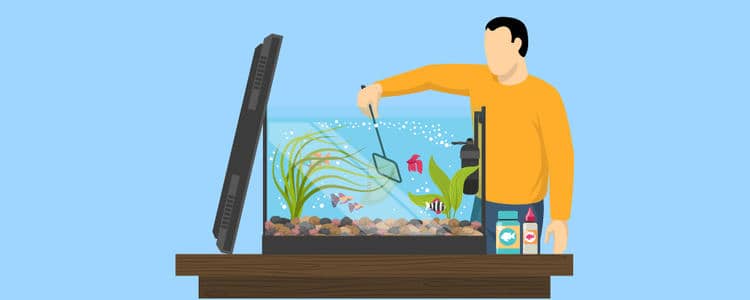
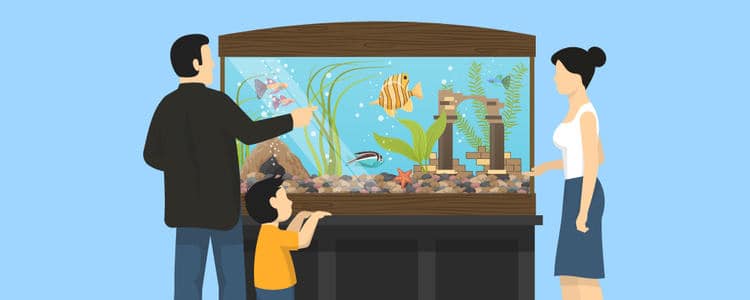
Are you looking at cloudy tank water or slimy decorations? It sounds like it’s time to perform some maintenance so you can enjoy a clean aquarium once more! Poor water quality not only impacts your enjoyment of the tank but how happy and healthy your fish are. Since it only takes a few minutes, let’s talk about how to clean a fish tank the right way!

How Often Should We Clean Fish Tanks?

fish tank

Routine cleaning should be done biweekly to once a month. This depends mostly on how many fish you have, how large they are, how often you feed, how efficient your filter is, and other parameters.

You also need to clean your tank more often when the water is visibly dirty. Perhaps you have a cichlid that loves to dig or accidentally overfeed. A large tank usually needs fewer water changes, especially if you have fewer fish. But tank clean time will tend to take longer since there’s more water to deal with.

Algae Scraper and Other Tools

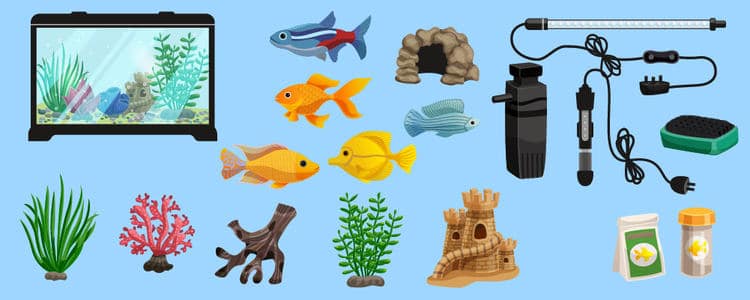
Here are a few of the tools required to clean a fish tank!

  • Algae Pad
  • Fish-safe Glass Cleaner
  • Gravel Vacuum
  • Plastic bucket
  • A Source of Fresh Water
  • Water Conditioner
  • Filter Media
  • Razor Blade
  • Soft Cleaning Brush
  • Bath Towels (to mop up any mess)

When choosing a bucket to use alongside your water siphon, select one that’s never been used with toxic chemicals like paint. Otherwise, they can leach agents into the replacement water that are harmful to fish. I also like keeping a paper towel or three nearby to mop up drips of water or filter gunk before they can create stains.

Cleaning the Aquarium Glass

clean a fish tank

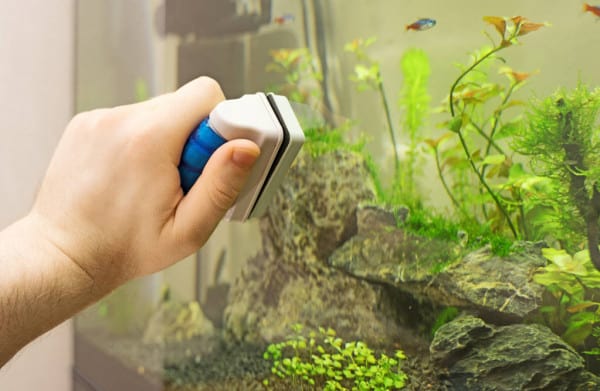
The first step towards a sparkling fish tank is to clean both the inside and outside the glass. The glass panels of your tank will pick up water spots, fingerprints, and other smudges that make viewing difficult. But whatever you do, don’t use a cleaner like Windex! Stick to cleaning vinegar or a non-toxic glass cleaner.

You will also need to clean the interior of algae films and the mineral crust that will form a stubborn residue along the waterline due to evaporation. In a marine tank, this crust is mostly salt, which scrapes and washes away easily. But in a freshwater tank, it will be limescale, which is more resistant. A razor blade can be used to remove light limescale deposits!

When using algae scrapers and other abrasives, make sure that they are rated for the type of aquarium you have. Acrylic and other plastic panels can be permanently scratched by scrapers meant for glass. You’ll have to use gently scrape using a plastic blade or pad to remove algae.

Performing a Partial Water Change

Before removing dirty water and cleaning your fish tank, you’ll need to power off all of the technology running into your aquarium. This includes your aquarium heater, filter, powerhead, protein skimmer (saltwater only), and other devices. Heaters can crack or shatter if left on long enough to dry and then suddenly splashed by water. You can leave your aquarium lights on unless you have uncovered incandescent or fluorescent bulbs, which can shatter if splashed.

fish tank

You’ll next use your gravel vacuum to simultaneously remove 20-50% of the tank’s dirty water and debris that’s collected at the bottom. Gravel vacuums are usually either gravity powered or run using water pressure.

Gravity vacuums are cheap and easy to use but require you to haul buckets from your tank to a disposal place like the kitchen sink. And you’ll then have to do the same in reverse to fill it. However, water pressure aquarium vacuums can be hooked up to any faucet and used to both clean a fish tank and then fill it back up with no buckets required!

Filter Maintenance

Filter maintenance is essential, but it often gets forgotten by aquarists who are in a hurry. A good filter is key to a clean fish tank. Your filtration system uses specialized media to screen out fish waste, chemically bind dissolved organic matter, and provides a home for your ammonia-eating beneficial bacteria. Without a filter, you would need to keep fewer fish in your tank.

Exactly how to clean your filter depends on the kind you have, be it a sponge filter, hang on the back power filter, or a canister filter. Fortunately, there are steps they all have in common. First, we need to disconnect our filter from its power source. This is especially important for filters with pumps. Filter pumps should not be allowed to run without tank water because they rely on it to cool them. A filter pump can overheat and break or even catch fire if ignored for too long.

Changing Your Filter Media

Next, you’ll need to clean and replace any media that’s expired. Your filter media is just as important as your beneficial bacteria. Ammonia absorbers and other ion exchange resins have a limited capacity to capture dissolved chemicals and need to be primed in a salt solution before being reusable.

Activated carbon will need changing biweekly as well as fresh carbon. Make sure that you rinse your new carbon to remove the fine dust and grit that tends to build up in storage. If added to your tank, it can get lodged in fish gills, causing severe irritation.

Filter cotton floss acts as a mechanical screen for large particles and will eventually grow weak and fall apart over time. Fresh filter floss either comes with replacement cartridges or needs to be folded into a filtration chamber. This way, your aquarium water will be polished through the actions of mechanical, biological, and chemical filtration all at once!

Treating Your Tap Water

While you probably have all the drinking water you need from a handy faucet; this water needs a little treatment before adding it to your tank.

The first thing you should do is try to get your tap water as close to the same temperature as your main tank as possible. Fish can be shocked by sudden drops in temperature. While a change of 2-5 degrees won’t be harmful, instant drops of 10 degrees or more can be fatal. I always use a thermometer in the bucket I use to add new aquarium water, so I know that the water temperature is just right.

But warm water is only part of the process. You also need to treat it to remove the chlorine and chloramine that water treatment facilities add to tap water.

A tap water conditioner works great for this. These chemicals are meant to kill any bacteria missed by treatment but are toxic to all aquatic life, including fish and beneficial bacteria.

Fortunately, creating dechlorinated water is very easy to do. Simply add the requisite number of drops or milliliters of solution to the bucket. Then swirl it about for a few seconds. Chlorine and chloramine are instantly neutralized, making your water fish-ready!

If you know for a fact that your local treatment facility uses only chlorine, you can let the water sit for 24 hours. While you’ll need to warm it back up, the chlorine will outgas over time. Chloramine is formulated to stay in solution, though, so you have to treat chloramine-saturated tap water before adding it to your fish tank.

Filling Your Aquarium

When filling your aquarium, we don’t want to simply dump clean water into the tank. This will stir up the substrate and bring particles of waste you missed up into the water column. The force can also dash fish against rocks and other hard surfaces, uproot live plants, and mess up your aquarium gravel. You want to pour water into the tank gently. For small fish, floating a Tupperware container at the surface and pouring onto it will diffuse the force of the water enough.

When using a water pressure-powered siphon hose, you’ll need to get the water temperature right quickly and add a de-chlorinator directly to the tank. Fortunately, water conditioners act instantly to neutralize chlorine and chloramine.

Artificial Plants and Other Decorations

You likely won’t have to clean your aquarium decorations each time, but it’s a good idea to perform a spring cleaning every so often. Algae and bacterial slime can build upon not only the glass but on rocks, plants, driftwood, any other exposed surface in the tank. You’ll need to gently scrub them to clean algae and other biofilms from them.

If you have live plants, a pair of aquascaping shears should be used to cut back overgrown stem plants and dead leaves. Never use paper scissors; they are too dull and will crush the stems, making it harder for the plant to regenerate.

Treating Artificial Plants with Bleach

Silk artificial plants tend to be harder to clean than plastic ones because they have a fine fabric mesh for things to grow into. If you’re finding stains to be too stubborn to be scrubbed away, then you should try soaking them overnight in a 1:5 solution of bleach, followed by a double rinse in water that’s then heavily treated with de-chlorinator to remove any chemical residue before adding them to your fish tank. You can also use a 1:5 solution of white vinegar, which will kill algae and only needs a long soak in freshwater to be returned to your tank.

Conclusion

fish healthy

Cleaning an aquarium sometimes feels like a hassle. But once you fall into a rhythm and learn how to do it the same way each time, it often takes less than an hour for smaller tanks! So why wait? There’s nothing like a regular clean water change to keep your fish happy!

source https://aquariumlabs.com/how-to-clean-a-fish-tank/

Ram Cichlid Types

ram cichlid types

We always find new arrivals in the aquarium trade. But sometimes, the classics are also worth rediscovering! And few dwarf cichlid types are as well known and loved as the Ram Cichlid! With all the Ram Cichlid types and colors they come in, it’s worth getting to know what’s available and how to breed them.

Getting to Know the Butterfly Cichlid

Butterfly Cichlid. Ramirez’s Dwarf Cichlid. Blue Ram. German Ram. Ram Cichlid. These are just a few of the many, many names that Mikrogeophagus ramirezi goes by! As one of the most popular South American dwarf cichlids, the Ram is a beautiful fish that’s a favorite of aquarists of all skill varieties.

The wild type is found exclusively in the Orinoco River Basin, whose slow-moving waters seasonally flood the savannas of Colombia and Venezuela in South America. The mixture of floodwater and plant matter stains their home rivers a dark tea color that keeps the pH and water hardness low. But tank-raised varieties of the Ram Cichlid tend to be much less demanding.

Like most cichlids, they provide parental care for their eggs and fry during successful breeding. They also become much more aggressive during this stage, but with a bit of space, their tank mates should be fine!

Ram Cichlid Types

There are several Ram cichlid types, but they have similar to identical care requirements. All varieties of Mikrogeophagus ramirezi have a maximum length of 2.5 to 3 inches, regardless of appearance.

German Blue Rams

blue rams

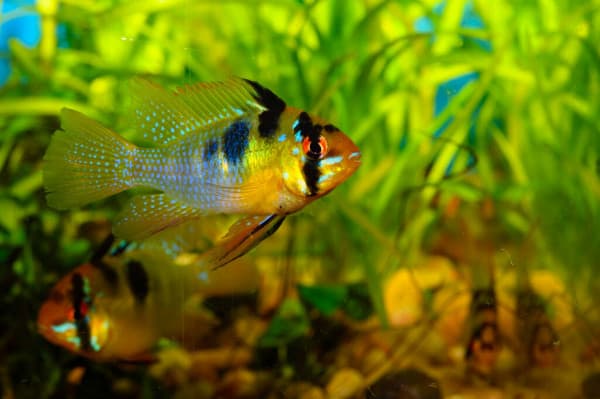
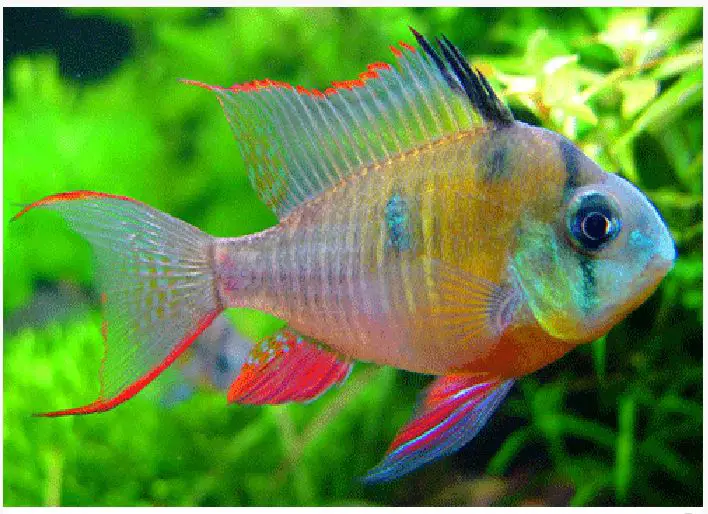
Of all the Ram cichlids out there, the German Blue Ram is by far the most popular. They closely resemble the wild variety Ram cichlid, except they have brighter, denser blue spangling along their flanks. And since they are all tank bred, they are much hardier than wild-caught Ram cichlids, which need excellent water quality to survive.

German Gold Ram

golden ram

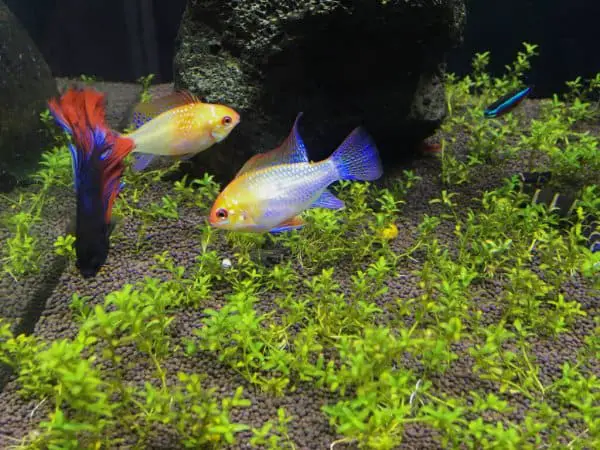
German Gold or Golden Rams are a distant second on the popularity scale. It’s easy to see how they get their name: the yellow tones of Gold Rams outshine every other color and become even more intense when the little fish are breeding or fighting. The Golden Ram is just as easy to keep as the German Blue and also comes in long-finned and balloon varieties!

Electric Blue Rams

blue rams

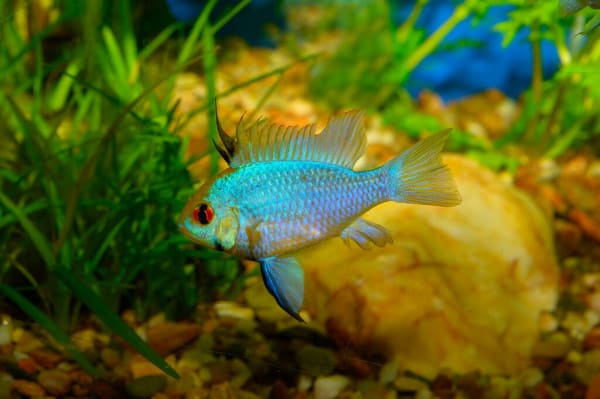
Out of all the varieties of Ram cichlid, the Electric Blue Ram is the most in-demand kind. The Electric Blue Ram is entirely covered in bright, iridescent scales that catch the light in a dramatic way. A bright red eye completes the picture – and both males and females are equally beautiful! One thing to consider is that the Electric Blue Ram Cichlid is a little more sensitive than the rest. They have been selectively bred to strengthen their blue colors and are less resistant to disease and poor water quality.

Black Rams

asian ram
Image Credit: Azgardens.com

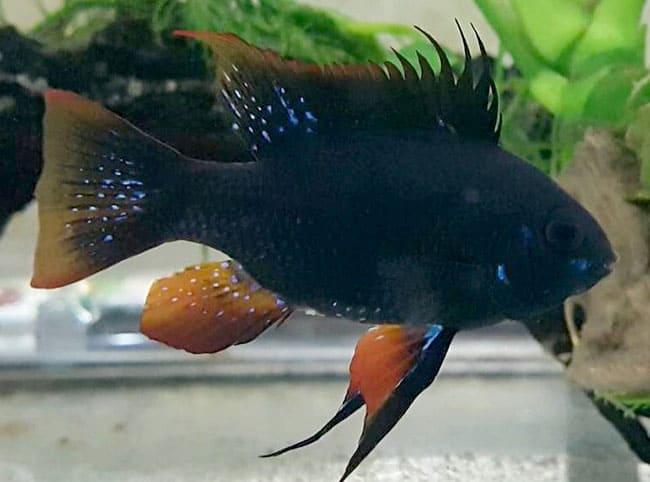
Black Rams are the newest variety to enter the aquarium market. These Ram cichlids have a smokey grey to jet black color, mixed with faint red, yellow, and blue scales. While they are pricey, Black Rams are just as hardy as the standard blue Ram!

Bolivian Ram

dorsal fin
Image Credit: Azgardens.com

The Bolivian Ram is actually another species (Mikrogeophagus altispinosus) that’s rarer than the “true” Ram Cichlid. Bolivian Rams are slightly larger, regularly reaching 3 to 3.5 inches, and are a little more subdued in coloration. But they are quite hardy and not as aggressive as the German Blue Ram. Just don’t keep them alongside each other because there is a chance they may interbreed.

Can You Mix Ram Cichlid Types?

Absolutely! Ram cichlids of all types can live alongside one another with ease and will even interbreed if kept together. With so much potential variety, color-wise, a tank full of just Ram cichlids can be a beautiful sight! It’s not a good idea to keep Bolivian Rams alongside standard Ram cichlids, though; should you give away the fry, their mixed parentage can lead to issues for future breeders.

Just keep in mind that, like all dwarf cichlids, Ram cichlids are quite territorial. You’ll have to plan in order to ensure the males have space for territories and females don’t get harassed constantly. You can also keep different Ram types together in regular community tanks alongside tetras, barbs, livebearers, and other tropical fish!

Aquarium Setup and Tank Mates for Ram Cichlids

Water Parameters

Providing proper water conditions is the most important part of caring for a healthy Ram. You should try to provide neutral to acidic water (pH 6.0-7.0) or even blackwater conditions (pH 4.5-6.0) if possible. Ram cichlids thrive in acidity. Tank-raised Rams will tolerate mild alkalinity (up to pH 7.5), but they do much better in acidic conditions and still require it for breeding.

The water temperature should be very warm; 75-80F is ideal for them. Higher temperatures of 81-84F often encourage them to spawn. Rams are a little more sensitive than other fish to high levels of ammonia, nitrite, and nitrate. So you’ll want to perform regular water changes to keep these levels low and your Rams happy!

Feeding Ram Cichlids

Rams are known as micro predators. This means that Ram cichlids eat small invertebrates, fish fry, eggs, and other protein-rich sources of food in nature. Mosquito larvae, daphnia, small shrimp, and worms are the bulk of their diet normally. So we want to mix their prepared food with brine shrimp, chopped earthworms, and other fresh foods, which have the nutrients they need to put on weight, enhance their colors, and produce both eggs and sperm.

Mix these frozen foods with a high-quality flake or pellet. Take a moment to read the ingredients list when choosing food for Rams cichlids. A blend that has fish or shrimp protein as the first ingredient is what you want!

Tank Mates for Ram Cichlids

Rams are semi-aggressive fish. The males tend to become fairly territorial even towards other species of fish that happen to be in the area. While they won’t often bite them or stress their tank mates out too much, they will still chase certain fish, especially other Rams or other dwarf cichlids. Fish that look too similar in color should be avoided since a male Ram will usually see a competitor.

Fast, peaceful tankmates are the best tank mates. Tetras, danios, and barbs thrive in the same water conditions and have very different color patterns. They are also quick enough to avoid an occasional chase.

Other Ram cichlids can also be great tank mates. Just be careful when planning community aquariums for Rams because they save most of their aggression for each other. One should provide 10-20 gallons of space per male as well as one or two females per male. The tank setup should include plenty of plants, rocks, driftwood, caves, and other breaks in the line of sight. Otherwise, the males will square up and spar constantly. Once one male becomes subdominant, he needs to be able to hide; otherwise, his rival will harass him to death.

Breeding Ram Cichlids

Sexing Ram Cichlids

Unlike many other cichlids, Rams aren’t especially easy to sex visually. It can still be done, especially during the breeding period, but the differences aren’t as obvious as in species where the male is twice the size and far more colorful than his mate.

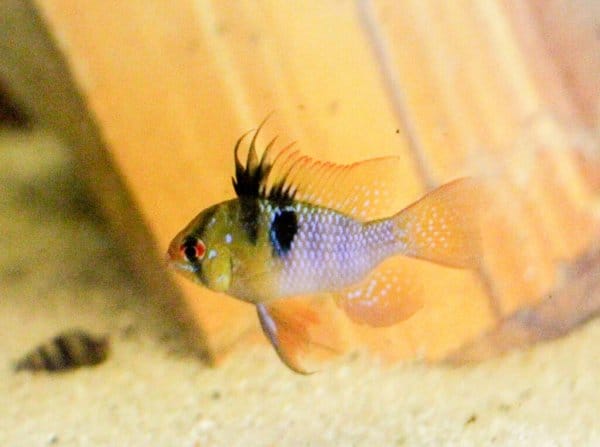
The male Ram Butterfly Cichlid characteristics include taller spiny rays on the dorsal fins, more extensive blue spangling, and a slight hump to the head. Female Rams have a purple belly that becomes even brighter when spawning. They are also smaller and chunkier than males of the same age. Females often have a peaceful nature and don’t chase each other around nearly as much as the males do!

ram cichlids fish

Breeding Ram Cichlids and Raising the Fry

A mixture of densely planted areas, floating plants, sand, and rocks provides the perfect place for your Rams to spawn! Plants like Java Moss and Java Fern provide shade, oxygen and consume ammonia and other waste products as well. We want to replicate their natural habitat as closely as possible.

Ram Cichlids breed the same way that most other South American cichlids do. They are substrate spawners that deposit their eggs onto a hard surface. This can be a clay pot, a small rock, or even the bare aquarium bottom.

In a community tank, you’re much more likely to see parental aggression. Like many cichlids, Rams are devoted to their eggs and will chase off any fish that comes close or even your fingers! So you might be better off moving your happy pair to a breeding tank of their own. The tank size can be as small as 10 gallons, assuming they have no other tank mates.

The Ram cichlid fry will hatch in four to five days. The fry takes around 48 hours to become free-swimming, though. They have to first consume their nutrient-rich yolk sac. After that, you can offer them baby brine shrimp, powdered flakes, and other tiny items!

Conclusion

The Ram Cichlid is an aquarium staple for very good reason! While they aren’t entirely peaceful fish, they still are very manageable compared to some of their larger cousins. Rams are also strikingly colorful and easy to breed, assuming you can provide them with acidic water conditions and warm temperatures! And with so many varieties out there, you can mix and match with ease!

source https://aquariumlabs.com/ram-cichlid-types/

Frontosa Care Guide: Diet, Tank Size, Lifespan, Cost, & Frontosa Cichlid Breeding

frontosa care guide

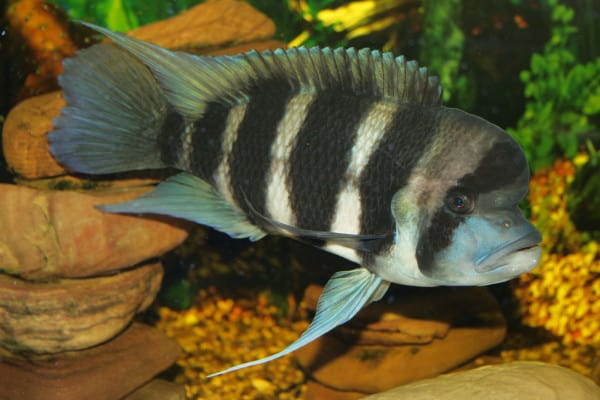
The Frontosa Cichlid is an especially dramatic freshwater fish that grows up to 14 inches in length as an adult! Despite their large size and cichlid temperament, they are fairly peaceful towards any tank mates they can’t eat. They also get along even one another in close quarters, which is rare for such a large cichlid.

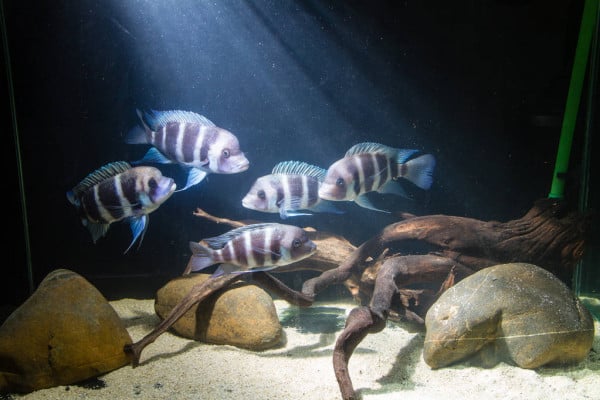
As a large, social cichlid, you’ll need to have the right tank size for a harem of Frontosa fish and their tank mates. If keeping a single male, 75 gallons is the minimum tank size for one. But a group should be kept in an aquarium around 125 to 150 gallons in size. A smaller tank size may cause territorial squabbles since subdominant fish can’t escape the attention of a dominant male.

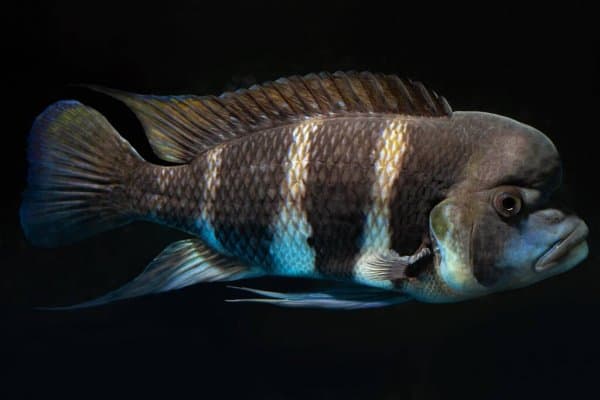
They are large but elegant, with striking dark bars, cream and blue tones, and a distinctively humped head. Hence the alternative common name of “humphead cichlid.” Cyphotilapia frontosa is the Latin name, which also describes their cranial shape; Cypho describes their head, tilapia being a type of cichlid, and frontosa describes its size! There is only one other species in the genus Cyphotilapia; the slimmer Cyphotilapia gibberosa, which is much rarer but similar in Frontosa care!

Frontosa Cichlid Care Requirements

Common Names: Frontosa Cichlid; Humphead Cichlid
Scientific Name: Cyphotilapia Frontosa
Origin: Lake Tanganyika, East Africa
Adult Size: 12 to 14 inches
Diet: Carnivorous
Temperament: Peaceful to Semi-Aggressive; Predatory
Aquarium Size: 75 gallons for a single male; 125+ gallons for a group
Water Conditions: Hard, Alkaline Water Chemistry
Ease of Care: Moderately Difficult
Lipespan: 15 to 25 Years

Frontosa Varieties

Like many rift lake cichlids, Frontosa fish come in regional variants that have slight or significant differences in size, shape, and color. These differences can also increase the price, especially for wild-caught fish found in hard-to-reach places.

The Burundi Frontosa Cichlid or Burundi Six Stripe Frontosa is the type you see the most often in the hobby. They are usually sold simply as “Frontosa Cichlid.” the Zaire Blue Frontosa, with its deep blue body, is rarer and often much more expensive than the others.

Other noteworthy varieties include the Zambian Blue Frontosa, Southern Frontosa, and Tanzanian Seven Stripe Frontosa. All of these Frontosa varieties have different blue coloration but identical care requirements. But special varieties are much more likely to be wild-caught or F1 (one generation removed from the wild), which are not as used to aquarium life. You’ll need to be much more careful when acclimating these fish to your aquarium, using drip acclimation and other slow processes.

Lake Tanganyika: the Home of Frontosa Cichlids

blue frontosa fish

The Frontosa Cichlid is found exclusively in Lake Tanganyika, one of the world’s oldest, deepest, and second-largest lakes. Only Lake Baikal, in Russia, is older, deeper, and holds more water. Lake Tanganyika is one of the largest of a series of African rift lakes found in the eastern part of the continent.

Each of the large lakes is home to a collection of African cichlids found nowhere else on earth. Collectively known as rift lake cichlids, these fish have evolved from just a few species that found their way to each lake into hundreds of different, brightly colored fish. Many are predators of other fish, while others eat only algae, invertebrates, or other specialized food sources.

Cichlids from Lake Malawi are very popular, especially the small but highly aggressive Mbuna. But the Frontosa Cichlid comes from Lake Tanganyika, which is similar in some respects but very different from both Lake Malawi and just about every other body of water on earth!

Frontosa Cichlid Water Chemistry

Lake Tanganyika has some interesting differences from the other rift lakes that you’ll need to take into account when keeping Frontosa fish. In their natural habitat, Tanganyikan cichlids live in water that’s three times as salty as Lake Malawi; and six times as salty as Lake Victoria! This is due to the much greater age of Lake Tanganyika. Water has had a chance to enter and evaporate, leaving behind higher levels of salts and minerals.

When filling an aquarium for the first time, you’ll need to use a water conditioner that adds these salts to your tank because they aren’t found in tap water. You’ll also need to provide extra sources of minerals that help buffer the water constantly towards alkalinity, which we’ll discuss more in aquascaping for Frontosa fish! Just remember that these salts don’t disappear with evaporation, so you should top off the tank with fresh, unmineralized water to counter evaporation. It’s only when performing water changes that you need to remineralize incoming water.

Don’t use iodized table salt, by the way, as a mineral additive for Frontosas. For one, iodine isn’t necessary for them. Also, table salt (sodium chloride) is just one of the salts that Frontosa fish need. They also need magnesium, potassium, and calcium salts that a Lake Tanganyika or general rift lake mineral additive provides.

We recommend Cichlid Lake Salt.

As tropical fish that live very close to the equator, Tanganyikan and Malawi cichlids need continually warm and stable temperatures throughout the year. They prefer a range of 74-80 Fahrenheit, with normal to high levels of dissolved oxygen. This continual stability can make Frontosas a little sensitive compared to other freshwater fish, especially wild-caught specimens. You’ll want to acclimate these extremely carefully.

Once fully acclimated, Frontosa fish are very durable fish and not too sensitive to slightly elevated levels of ammonia, nitrite, and nitrate, and other signs of poor water quality. But you should always keep up with water changes and use canister filters for these large fish. As predators, they create loads of ammonia and other wastes, which makes ensuring high water quality a constant challenge.

They can also be shocked by sudden variations in hardness, salinity, temperature, and nitrogenous waste, much like saltwater coral reef fish (which also come from an extremely stable environment). In fact, this is true of wild-caught Tanganyika cichlids in general.

Aquascaping for Frontosa Cichlids

When caring for the Humphead Cichlid, something to keep in mind is that they love doing their own aquascaping. Large cichlids love nothing more than to shift the substrate around, uprooting plants and creating small holes in the landscape. They do this to delineate their territorial boundaries and prepare areas for spawning.

Fortunately, the aquascape for a Frontosa tank should remain fairly minimal since the African rift lakes feature mostly stony and sandy expanses with few to no plants anyway. Also, the extremely hard water is tough for anything but the toughest plants to survive in.

Cave formations are essential for Frontosas. While they are top predators of the lake they can be quite shy and retiring at times. You should also keep the light levels fairly low – or provide several caves if you’re going to keep lighting intense. Frontosa Cichlids are found in the deeper portions of Lake Tanganyika. They rise to the surface at dawn and dusk to feed on smaller fish and then return to the depths as the sun rises.

aquarium hobby

Many aquarists also use aragonite sands, crushed coral, or other substrates that contain pH buffering minerals. This way, you can keep the pH close to 8.1-8.4, which they prefer. PH buffering agents help keep the water chemistry not only alkaline but help promote stability, which is equally important for Frontosa cichlids. Crushed coral is a little harder for Frontosas to dig in but tends to stay in place better than coral sand will.

Rocks are often rich in minerals that provide the same function. Limestone and marble are two popular choices for aquascaping a rift lake community tank for this reason: they leach mineral salts into the water to counteract any acids that form. Rocks also provide caves and other spaces for fish to hide on occasion.

Since we want the pH to remain both elevated and constant, driftwood should be kept to a minimum. Driftwood contains humic acids and other plant substances that push the pH down towards acidity. If you’re determined to keep plants in these conditions, you can try Anubias (Anubias sp.) and Java Fern (Microsorum pteropus). These plants are hardy, low light tolerant, and are tough epiphytes, meaning they grow attached to hard surfaces like rocks rather than grow roots into the substrate. Once fully acclimated, they are almost impossible for even a determined male Frontosa to remove (though they may bite leaves on occasion).

Feeding Frontosa Cichlids

Frontosas are predators, which makes both feeding and choosing tank mates a little more complicated than usual. Many aquarists offer feeder fish to their Frontosa cichlids. But unless you’re raising your own continual supply, this is actually one of the worst things you can do. Pet store feeder fish are almost always very poor quality. They are raised in dirty, crowded conditions where diseases proliferate. Feeding these fish to your Frontosas is a great way to introduce intestinal worms, ich, and other parasites into your tank.

Instead, I recommend providing your Frontosa cichlid with a diverse spread of protein-rich prepared, fresh, and frozen food. A high-quality predator formula should form the base of their diet. And by high-quality, I mean it should have fish or shellfish protein as the first main ingredient. Many fish food formulas use wheat germ, potato starch, and other cheap fillers that are indigestible to Frontosa cichlids and other predators. Look for salmon, shrimp, and other ingredients.

Frontosas should also be given freshly thawed seafood like chopped shrimp, squid, and white fish like perch. Stay away from terrestrial meat like chicken and beef, which are too high in fat for fish and contain the wrong nutrient profiles.

Tank Mates for Frontosa Cichlids

Choosing tank mates for a Frontosa cichlid can be a little difficult because they are both large and peaceful. Many Malawi and Tanganyikan cichlids tend to be more aggressive and territorial, which makes them poor tank mates despite their love for the same water conditions. And fish that are too small may end up being part of the Frontosa cichlid diet!

I recommend choosing some sort of dither fish when keeping Frontosas because it helps them feel more secure in the open. Dither fish tend to be smaller, schooling, and swim out in the open. This signals to other fish that there are no predators or other dangers lurking nearby, encouraging them to leave their hiding places.

Good dither fish for Frontosas are large, peaceful, and don’t mind living in the mineral-rich, alkaline water that they prefer. This makes the selection fairly small, unfortunately, which is why many Frontosa keepers simply keep their fish alone. But you can try larger rainbowfish, such as adult Red Rainbowfish (Glossolepis incisus). These beautiful fish grow to be 8 inches long; too large to be eaten by a Frontosa Cichlid.

Some of the more peaceful African cichlids also make good tankmates, including the solid blue Malawi Blue Dolphin (Cyrtocara moorii). Large, peaceful bottom-dwelling fish like Clown Loaches and Plecostomus are also great companions! But other Frontosas are by far the best option!

How Do I Breed Frontosas?

Frontosa Cichlid breeding is a little complicated. For starters, they are very slow-growing fish. It takes three to four years for a group of young Cyphotilapia frontosa to reach sexual maturity. And even when close to, or fully mature, Frontosas have very subtle differences between the sexes and require close inspection to tell them apart.

Sexing Male and Female Frontosas

The best way to breed them is to set up a breeding tank with a group of six or more young Frontosas as a minimum. Eight to twelve is even better; you can sell off a few as they mature so that you can choose the females with the best color and are left with one or two sexually mature males. Removing males is especially important in order to minimize aggression when they are ready to spawn.

You’ll want to raise the young fish together so they can sort out the breeding process on their own. As they mature, you’ll start to notice their sexual characteristics showing up in both their behavior and their body shape.

one male

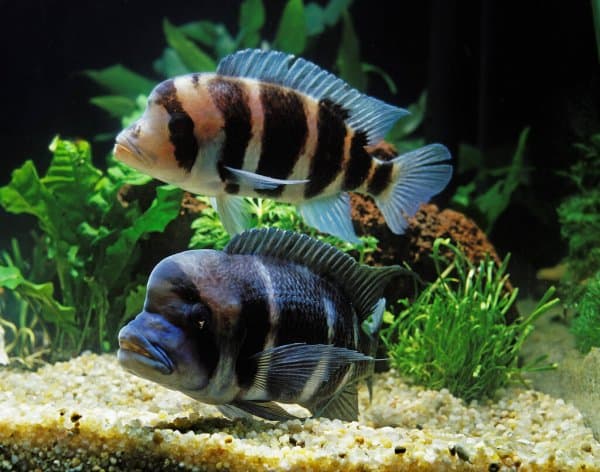
Male Frontosas will have slightly more intense blue accents. Their nuchal (head) hump will grow larger, especially on a dominant male. And they will grow longer, more impressive pectoral and dorsal fin extensions with time. A female Frontosa Cichlid never grows quite as large and won’t have as prominent a hump as a male of the same age. She will have fin extensions but are less impressive, and her light blue tones are more subdued by comparison.

Males will also spend more time displaying to rival males and competing for the attention of females. Male Frontosas will set up territories that they defend from rivals when ready to breed, while females will cruise throughout the territories of multiple males. Watching how Frontosas interact socially with each other is one of the easiest ways to sex a group of them!

Raising Frontosa Cichlid Fry

The majority of rift lake cichlids are mouthbrooders, meaning the female will collect the eggs immediately after fertilization and hold them in her mouth as they develop. Since she won’t eat for an entire month as the eggs develop, you’ll want to make sure she’s very well fed beforehand so she has ample fat reserves to draw from.

The male meanwhile patrols the territory the couple has claimed, chasing off any tank mates that intrude. Keeping a pair of breeding Frontosas with other fish means a minimum tank size of 150 gallons; otherwise, the male will harass other fish severely, even fatally.

The newly hatched fry will be very obvious once they are born because they are quite large for cichlid fry. Once they hatch, they won’t eat right away, though. Frontosa fry will nourish themselves from their yolk sac for the first 48-72 hours before being ready to swim freely and feed on small prey.

Frontosa fry are large enough to immediately start eating live brine shrimp nauplii, daphnia, and other small invertebrates! You can eventually wean them onto frozen brine shrimp and crushed protein-rich flakes. It’s often easier to move the fry to a rearing tank since they are often too tempting a target for other fish to ignore as a possible meal.

Frontosa Care Conclusion

blue face frontosa

The Frontosa Cichlid is an attractive rift lake cichlid that offers unique challenges for aquarists looking for a stately tank resident! So long as you can provide for their unique water quality needs and are willing to keep them mostly together or with carefully chosen tank mates, you’ll be rewarded with years of beauty and interesting interactions. When well cared for, Frontosas can live for 15 to 25 years in-home aquariums!

Just remember their peaceful but predatory nature and need for rocky, reclusive environments, and you’re bound to find some Frontosa fry in the not-too-distant future!

source https://aquariumlabs.com/frontosa-care/

Why Is My Goldfish Turning White? Is It Normal or Serious?

Goldfish are beautiful tiny creatures that come in different colors. They are delightful and cost almost nothing to keep. One unique feature that sets out these lovely little aqua pets from other aquatic species is their bright skin color.

These enchanting creatures possess such beautiful skin coloring we just want to see them keep glowing! A change in the color of orange fish is bound to raise some questions and concerns from you as a pet owner.

It’s not so delightful watching your beautiful goldfish lose its beautiful flashy skin color to unexplainable white patches. If you discover a change in the color of your goldfish, it might not be entirely bad.

Have you ever asked why is my goldfish turning white? This article will discuss possible causes for color change in goldfish, preventive measures to take to prevent your goldfish from turning white, and what to do when your goldfish starts turning white.

Is It Bad If My Goldfish Turned White?

As frightening as it may seem, a sudden change in color of your goldfish, such as your goldfish turning white, might not necessarily point to it being ill. Color changes in goldfish are pretty common, and the most common color for a goldfish during color change is white.

A goldfish turning white doesn’t mean you have a sick fish. Some causes of color changes are quite natural and environmental, which are most often not harmful to the health of your fish.

Why Is My Goldfish Losing Color?

It’s alarming to watch your goldfish lose its bright orange to white.

There are so many reasons that could be responsible for the color change your goldfish might be experiencing. Goldfish can turn white for the following reasons.

1) Inadequate Sunlight

One of the major and most common reasons for most goldfish turning white is the lack of adequate sunlight or exposure to light. If you discover or spot a color change in your little aqua pet, investigate the amount of direct sunlight the fish is getting.

It could be that your fish is not getting enough sunlight. One attractive feature of goldfish is their bright skin colors which are more commonly found on goldfish that dwell in outdoor ponds where they get enough access to natural sunlight.

Your goldfish might be missing these benefits as most pet goldfish are kept indoors. Having discovered the reason for your goldfish turning white due to lack of or inadequate sunlight, you may be bothered about how to fix this, and here’s good news.

Natural sunlight for your goldfish can be substituted for Full Spectrum LED lights. Although this artificial lighting is not the same as sunlight due to the lack of UV light in these artificial lights, they can provide similar benefits.

You can also consider giving your goldfish some “sunbathing” time by moving her from the darker area to sunny areas for a short while to expose your fish to extra sunlight.

Think of it as your goldfish getting a good tan. Ensure not to expose your goldfish too frequently to sunlight, especially on sunny or hot days. Also, make sure to use a thermometer to keep track of the water temperature to avoid overheating.

2) Goldfish Is Turning White Due To Aging

As your fish ages, it is expected that they undergo a natural transformation from their original color to white. Most old goldfish aren’t spotting their natural bright orange color but have changed to pale white.

This transformation is similar to humans, who tend to get gray hair as they age. So, also, goldfish tend to lose their glow associated with their youth due to old age.

Old age is a natural cause of your goldfish losing its original color, and this is no cause for alarm but just a reminder that your little pet isn’t so little anymore.

Related: How long do goldfish live?

3) Lack Of Vitamins

Another reason for the unexpected signs of color change on your goldfish can be due to a lack of vital vitamins. It’s not enough to just make sure your goldfish is eating well, but ensure your fish is getting the proper food.

Lack of a proper diet will not only cause your beautiful orange aqua pet to lose color and turn pale white but will also affect her life span and health.

Ensure you do not only feed your goldfish gel food but also supplements like algae wafers. Make sure to mix up various nutritious meals to keep your fish in good health and perfect shape.

4) Genetics

Although most goldfish turn white as they get older, a color change is mainly linked to genetics. Goldfish coloration is complex and, most times, unpredictable. The color changes you see on your goldfish may be pointing to the reality that your goldfish possess the genetics to undergo a color change to white.

Most goldfish species were created through selective breeding, which can lead to them undergoing unstable color changes.

The good news is these genetic reactions do not in any way affect the health of your goldfish, so there’s no worry that your goldfish is sick or dying.

5) Illness and Stress

One underlying cause of most goldfish changing color is a potential illness. Although other related causes to color change may include lack of light, genetics, aging, and dieting.

However, when all these causes seem not to be in play, and once you observe the scales of your goldfish falling off and its color-changing to white, you have an ill fish to bother about.

Make sure to pay a quick visit to a vet for examination or seek advice from a fish expert once you notice your goldfish starts losing scales or other symptoms of illness like lethargy, weakness, or difficulty swimming.

Stress can also cause an unexpected change in the color of your goldfish. Your goldfish might be experiencing stress if it has undergone certain tedious or rigorous activities like reallocation or transfer from one tank to another.

In this case, there’s no cause for alarm as your goldfish will surely regain her normal color once her stress level drops.

6) Low Oxygen Level In The Aquarium

Low oxygen levels in your aquarium tank can be very dangerous for your fish’s health as it can lead to severe illness or even death. To ensure the longevity of your fish life span, ensure that water quality is okay for your goldfish.

You can do this by testing the water in your goldfish aquarium for oxygen levels to ensure your goldfish is receiving enough oxygen. Check the numbers with a test kit to ensure they correspond with the original oxygen level requirements for your aquarium type and size.

If oxygen levels appear low from testing results, you have to begin with a water change. A quick water change could just be what your goldfish needs.

Also, add an air stone, powerhead, or any other form of aeration to ensure that oxygen levels remain stable.

7) Low Water Temperature and Environmental Changes In Goldfish Tank

Poor water conditions can be caused by a high level of ammonia and nitrate in your aquarium. High ammonia levels can make your goldfish turn white, cause severe illness and shorten the lifespan of your fish. Goldfish are very adaptive to change and are known for adopting certain features from their environment.

These aqua creatures are very sensitive to their habitat and react to changes in their tank-like PH levels, temperature, and new decoration or new tank placement.

Goldfish are hyper-sensitive and can easily detect even the slightest change in the environment. It could take a few months for your goldfish to become comfortable in a new environment.

Do Goldfish Change Color When Sick?

Goldfish are fragile creatures requiring care and close monitoring to ensure their lifespan is not cut short. In other to achieve this, there are signs apart from a color change that goldfish owners must look out for to avoid losing their little friend.

Illness is one major cause of death for goldfish, and most illnesses are contracted from their diet or habitat, which can lead to a color change or other noticeable symptoms.

One of the major symptoms of a sick goldfish is that it exhibits color change which can happen overnight or begin by displaying various discolored skin patches quite different from the natural ones.

What Are The Signs That Your Goldfish Is Dying?

The following signs are pointers to a dying goldfish;

  • Color Change: Your goldfish suddenly turning white or black can indicate a severe illness that can lead to death if not addressed urgently.  
  • Breathing Disorders: Symptoms such as gasping for air, rapid breathing can be caused by breathing disorder. In these cases, you may likely find your goldfish skimming the surface of the tank water or lying at the bottom of the tank, which can be caused by poor water quality or illness.
  • Swim Bladder Disease: If you observe your fish swimming abnormally or upside down, this could have been caused by a swim bladder disease or improper diet or feeding.
  • Internal Parasite: Goldfish are known for their appetite! So, if you notice any contrary behavior in your goldfish, such as loss of appetite or weight loss due to lack of eating, this may be an internal parasite at work.
  • Fungal Disease: Symptoms such as turn or folded fins, lumps, bumps, protruding eyes, pale or bloated gills, milky white areas on fins or tails could all be indicators of a fungal disease.

Conclusion

The symptoms above explain the reasons why your goldfish suddenly changed color. Goldfish can regain their coloring through certain deliberate measures such as; correct dieting, adequate lighting, good oxygen levels, reduced stress level, and moderate environmental changes.

However, not all goldfish regain their normal color after they change color.

Once you notice your goldfish is changing color, contact your vet for proper advice to protect your goldfish’s health.

source https://aquariumlabs.com/why-is-my-goldfish-turning-white-is-it-normal-or-serious/

How Long Do Goldfish Live? A Guide On Increasing Goldfish Lifespan

Introduction

Goldfish lifespans are often thought of as very short, just like many other fish. Perhaps your first fantail goldfish purchased at a local carnival died in just a week. Or a fancy goldfish you bought a nice small bowl for only lived for a few years. But is that really the average lifespan of a common goldfish?

As it turns out, goldfish can live for a very, very long time. In fact, a goldfish may outlive you if you care for it well enough! So how long do goldfish live, anyway? What affects their lives, and how can I increase the lifespan of my pet goldfish?

How Long Do Goldfish Live?

Like all aquarium fish, the average lifespan of a goldfish varies mostly due to environmental factors. Food quality, food amounts, water quality, temperatures, diseases, tank mates, and more can affect goldfish lifespan. That said, there are some major differences in goldfish lifespan that depends on the variety…

Common Goldfish Versus Fancy Goldfish

Even if you provide proper care for your pets, common goldfish tend to outlive fancy goldfish. This is mostly due to their more diverse genetic heritage. Thanks to selective breeding, fancy goldfish like ranchus, telescope eyes, and oranda goldfish tend to live from 10 to 15 years. Fancy goldfish lifespan is still very impressive compared to guppies, which live only 1 to 3 years even if given proper care.

But common and comet goldfish are the record setters for how long goldfish live! According to Guinness World Records, the oldest goldfish was Tish, who won at a local fair in 1956. Tish lived for 43 years! Comets are simply long-finned common goldfish and have none of the selective breeding that shortens a fancy goldfish’s lifespan.

Feeder goldfish are also worth talking about. While they are also common and comet goldfish, these fish rarely live a healthy life. Feeder goldfish are kept crowded next to sick fish in tanks with high ammonia levels. Their immune systems are constantly being assaulted by bacteria and parasites as well – and 99% of them end up as food for other animals. But genetically speaking, nothing is preventing them from having long lifespans like their non-feeder cousins. If you decide to rescue a feeder goldfish, you may find that it, too, lives to a ripe old age of 30-40 years!

Wild Carp and Koi Lifespans

As impressive as Tish’s lifespan was, wild carp and koi can live as long or even longer! The European Common Carp have been known to live around 38 years of age. Being close relatives of the Asian Carp that Goldfish are descended from, it’s not surprising that common and comet goldfish are so long-lived.

Koi are another close relative that takes longevity to a whole new level! Instead of keeping them in a tank, the vast majority of koi are kept in outdoor ponds, making a big difference. Seasonal variations in temperature and water chemistry stimulate their immune system. They have the chance to hibernate each year. And an abundant supply of algae, insects, and other natural fare supplements their diets.

Koi are especially long-lived in Japan, where they were first domesticated. On average, Koi will reach 40 to 60 years of age. But there are several examples of Koi that lived to be 100 years old – and the oldest known Koi was Hanako (“flower girl” in Japanese), who was verified upon her death as being 226 years of age! She also weighed 16.5 lbs and was nearly 28 inches in length.

The Longest Living Fish of All

Goldfish and Koi have impressive lifespans for fish. But what about other fish, both freshwater and saltwater? The Bigmouth Buffalo (Ictiobus cyprinellus) is a North American carp relative that regularly lives up to 80 years and can exceed 110 years in age.

Saltwater fish are even more impressive when it comes to life expectancy; the oldest Rougheye Rockfish was dated 205 years of age. And the oldest known Greenland Shark, a prehistoric-looking polar fish, was 392 years, plus or minus 120 years. Scientists also estimate that they actually take 150 years just to be old enough to breed!

How Can I Ensure My Goldfish Have a Long Lifespan?

Goldfish lifespans are dependent not only on their breed but environmental factors as well. Let’s take a closer look at what these factors are.

Goldfish Health Problems

One way to identify goldfish health problems is to study their body shape. Round bodies are one of the best indicators of good health. While some goldfish, such as fancy orandas and ranchus, tend to be especially plump, even common goldfish should be nice and stout if well fed. Round bodies are also a sexual indicator, with females being noticeably rounder than males even when not in breeding condition.

Slim-bodied goldfish are sometimes just naturally trim. But a slim profile can also indicate a lack of regular or good quality food. Goldfish suffering from parasitic infections like intestinal worms may not be getting enough nutrition and remain skinny despite eating frequently.

What Is the Correct Diet for Goldfish?

To improve fish lives, we need to offer a diet that goes beyond prepared formulations. Most goldfish enjoy variety in their diet. This means pairing your high-quality flake or pellet regime with live and frozen foods, similar to what they’d find in nature.

Notice how your fish spend a lot of time rooting along the bottom of your tank or pond. In their natural habitat, they would dig up small worms, clams, snails, shrimp, and other hidden goodies to go along with their diet of soft aquatic plants. Goldfish are known as “omnivores,” meaning they eat both plants and animals, just like humans.

That’s why offering them brine shrimp, tubifex worms, water fleas, bloodworms, small snails, chopped shrimp, and other invertebrate-based delicacies is one of the best ways you can increase their life expectancy!

And like I mentioned before, vegetable matter is also important for goldfish because it provides them with both roughage and necessary vitamins missing from conventional formulas. Spirulina algae flakes, algae wafers, and even bunches of soft plants like Anacharis and Cabomba form a salad buffet your goldfish will love you for!

Outdoor Ponds Versus An Indoor Aquarium for Goldfish

When keeping goldfish alive, you have the choice of keeping them in outdoor ponds or an indoor tank. Actually, some goldfish keepers rotate their fish year-round, keeping them outdoors when there is warm water in the summer and moving them indoors for the winter.

Many of the longest-lived goldfish tend to thrive outdoors. The constant low-level stimulation that occurs as the seasons influence the water temperature strengthens the immune system. They can bathe under natural light, graze on algae and aquatic plants, and they can find mosquito larvae, small snails, and other delicacies, just like their natural environment would normally provide. Ponds are large enough to easily include other goldfish as well. Other fish offer social stimulation that encourages them to display, spawn, and improve their quality of life.

So long as you keep them in a large tank with good water quality, your goldfish lifespan should not decrease much, if at all. A varied diet also helps with their average lifespan. Plants consume ammonia, nitrite, and nitrate while releasing oxygen, which is very important for aquatic life. But a power or canister filter, alongside an aerator, simulates the same process using technology. Just remember that bowls, with their cramped, still water and lack of filtration, won’t allow goldfish to survive for long.

Keeping Fancy Goldfish In Ponds Versus Tanks

Fancy goldfish breeds are the exception here. Fancy goldfish tend to prefer warm, even tropical water, as they have been mostly bred indoors for generations. A few Japanese breeds, such as the Wakin and Tosakin, were bred for pond life. Japanese goldfish (and koi) are bred for top viewing pleasure since that’s how you see fish when standing next to a pond. But many other goldfish varieties, such as telescope eyes and orandas, were bred to be viewed from the side, as in an indoor aquarium.

Fancy goldfish don’t do well with the temperature extremes of outdoor ponds and may not survive a full overwintering the way hardier varieties can. Common, comet, shubunkins, and other outdoor breeds will lower their metabolisms as winter approaches. Remember, China and Japan are mostly temperate countries, just like the United States, so snow and ice visit each year.

Once your pond freezes over, assuming it’s at least 3 to 4 feet in depth and has enough water volume (or air holes) to provide oxygen, goldfish, and koi enter a state of suspended animation. But fancy goldfish don’t reliably enter this state as they haven’t had to do so for many, many generations. It’s better to pamper them with a stable indoor room or tropical water temperatures year-round!

Give Your Goldfish Space!

Space is another ingredient that you can use to maximize goldfish lifespan. There’s a myth that just won’t die surrounding goldfish care. People often ask me, “do goldfish only grow to the size of their environment?” And the answer is a resounding “no, they do not!” Goldfish will grow as large as their food, genetics, and other conditions allow for. A tiny environment can stunt their growth to a degree, but that’s kind of like keeping a puppy in a box its entire life.

Since we want our fish to be active, healthy, and not just surviving but thriving, we should provide our fish with all of the room they need as they grow. Most fancy goldfish reach 5-8 inches at maturity, though it’s possible for them to grow a few inches larger over the years as well. Therefore you should be keeping a single fancy goldfish in at least a 20-gallon tank, with 10 additional gallons of space per extra adult goldfish.

Common, comet, shubunkins, and other goldfish closer to wild carp will reach anywhere from 8-14 inches in length. There is even a Japanese bred Giant Goldfish variety that reliably tops 20 inches! Therefore as adult goldfish, we want to provide them with at least a 55-gallon tank, with an outdoor pond being even better for them! That said, you can certainly keep a 1 to 2-inch baby goldfish in a 5 or 10-gallon aquarium for a while. Just remember that it will grow over time, and it will eventually need an upgrade in living quarters!

Goldfish Water Quality

How much space you provide your goldfish also influences the water quality of the tank or pond, which influences how long they live. The more fish you have, the more ammonia and other waste products tend to accumulate. This increases the load on your filter to keep up.

And if you aren’t performing enough water changes to remove the excess, you’ll definitely decrease the lifespan of your goldfish. A filter for your goldfish goes a long way.

Even low levels of ammonia, nitrite, and nitrate are constant irritants that are normally undetectable in nature. Use an aquarium water testing kit to check your water.

Goldfish are super hardy, and low detectable levels of these chemicals are unlikely to kill them. But a constant amount will cause them problems that shorten their lives.

Conclusion

We covered quite a bit of ground in this article! As it turns out, there’s a lot more to the question, “how long do goldfish live.” People usually think it all comes down to breed. And to be fair, genetics do play a major role. Fancy goldfish simply don’t live as long as less selectively bred varieties. But you can definitely increase the lifespan of your goldfish by offering a wide variety of live, fresh, and frozen foods alongside their prepared food diet.

Keeping track of your goldfish’s water quality regularly will ensure ammonia and other toxic agents don’t accumulate, shortening their lives. Like with any pet, a clean environment prevents most problems from ever occurring. And if you can (assuming you have a hardier breed), keeping your goldfish in an outdoor pond provides them with all of the space they need, plus a buffet of invertebrates and algae to munch on!

source https://aquariumlabs.com/how-long-do-goldfish-live/

7 Best Filters for Goldfish Tanks of 2021 (Review and Guide)

Goldfish are fantastic pets. These sea creatures are tiny, cute, friendly, and cost almost nothing to keep both economically and physically. They don’t require routine walks, fancy dressing, or lots of attention.

Goldfishes are low-cost maintenance and not dangerous to children. Despite all the fantastic qualities goldfish have, they require a basic need that is mainly overlooked—a goldfish tank filter.

Like every other pet, goldfish produces waste and must be appropriately managed to avoid an outburst of diseases that might lead to sickness or loss of life. To prevent either of these, you need a tank filter with the best filtration system for your goldfish.

A goldfish aquarium can only serve little of the needs of your goldfish.

Best Goldfish Filter Table

Image

Product

Pricing Page

MarineLand Penguin Power Filter

Hygger Aquarium Double Sponge Filter

Penn Plax Under Gravel Filter System

Marina Power Filters

Fluval 107 Performance Canister Filters

Hikari Bacto-Surge High-Density Foam Filter

Lee’s Premium Undergravel Filter

Top Filters for Goldfish Tanks

You might want to keep your eyes open for the following devices when shopping for the best filters for your goldfish. Your decision will ultimately impact the health and life of your fish.

Here’s our list and review for the best filters for goldfish tanks of 2021. We hope you find one just right for your aqua pet.

1. MarineLand Penguin Power Filter

This fantastic MarineLand fish tank filter is suitable for aquarium holding up to 10gallons of water and has a strong water flow rate of up to 75 gallons per hour.

This filter features a unique bio-wheel technology that provides chemical filtration, mechanical filtration, and biological filtration. It can efficiently eradicate discolorations and odor in your water, creating a better environment for your fishes due to its faster-acting black diamond premium activated carbon.

The MarineLand Penguin Filter comes with three easy-to-use filtration systems and convenient filter cartridges ready to use with each filter without the hassle of air pumps, valves, or tubing. It requires no setup, making it easy for installation and perfect for an aquarium hobbyist.

Pros

  • It comes in a compact size and doesn’t take up much space in the aquarium.
  • It is suitable for fresh water and saltwater aquariums.
  • This device has a patented BIO-wheel, which houses beneficial bacteria needed to keep tanks clean and healthy and allows beneficial bacteria to grow.
  • The suction produced by this device is gentle and should not be harmful to the goldfish.
  • Each filter contains new faster-acting Black Diamond Premium Activated Carbon for maximum efficiency.
  • It has three filtration media.
  • It spins gently and doesn’t produce noise.

Cons

  • This device can get noisy after 6 months.
  • It comes with hard-to-understand instructions.
  • It doesn’t feature a flow-rate adjuster.

2. Hygger Aquarium Double Sponge Filter

The Hygger Aquarium Double or Dual Sponge filter is highly recommended if you want to keep your tank clean and healthy for your fishes. This dual sponge aquarium filter features multi-filtration functions. It uses bio-filtration, oxygenation, and physical filtration to ensure your aquarium is healthy and conducive for your aquatic life.

This filter is suitable for small, medium, and large tank use. It should be noted that it is advisable to get 2 filters for larger aquariums. It has two sponges that water passes through, and they come in compact designs.

Sponge filters can be a great addition to other types of filters. It catches large debris, ensuring small fry and sick or weakened fish do not get sucked into the filter. Also, the sponges can be easily removed for maintenance but must be rinsed using water from your aquarium and not tap water. This dual tank is a good option for quarantine and nursery tanks.

 Pros

  • It’s healthy tank bacteria recycle to make the water in goldfish aquariums clearer and of good quality.
  • Its dual sponges ensure small fry, shrimplets, and sick or weakened fish do not get sucked into the filter. 
  • Suitable for both fresh and saltwater tanks.
  • It can be run by most air pumps (larger than 4W).
  • Filter parts are detachable and easy to install.
  • It features a high flow rate and 2 strong suction cups to keep the filter in place.
  • It has 2 filter media containers.

Cons

  • It provides only two filtration media.
  • It takes up to a month or two to grow beneficial bacteria.
  • It does not come with a pump and an air hose.

3. Penn Plax Premium Under Gravel Filter System

Penn-Plax under gravel aquarium is suitable for a 40-50 gallons fish tank and is one of the best goldfish filters. It provides your aquarium with crystal clear filtered water with its strong flow rate and heavy-duty filter plates locked together for maximum stability. Its jumbo 1″ adjustable lift tubes and high pore air stones provide efficient and powerful filtration.

It can also be adjusted up or down for a custom fit and comes with a free set of Penn-PlaxFilt-a-Carb filter cartridges. These carbon filter cartridges eliminate odors and discoloration in your aquarium water. This cartridge that provides for clearer water can last for up to 8 weeks.   

Pros

  • Easy installation with trouble-free setup and operations.
  • Includes filter plates, air stones, adjustable lift.
  • It comes with tubes and a filter cartridge.
  • Provides powerful chemical and biological filtration systems.
  • Available for 5, 10, 15/20H, 20L/29, 40 / 55 gallon tank.
  • It requires low maintenance.

Cons

  • It provides only two types of filtration media.
  • Available tubing is short.

4. Marina Power Filter

The Marina Power Filter is suitable for aquariums holding up to 10-gallons of water. It is excellent for space conservation as it comes with a compact and slim design that is aesthetically pleasing. The filter comes with an adjustable flow control allowing users to adjust the water flow level in their tanks.

The power filter has two cartridges, the 1 Bio-Carb and 1 Bio-Clear, that have Ceramitek, a highly porous ceramic that regulates biological filtration. It is tranquil during operations and comes with a two-year guarantee on all parts.

Pros

  • It comes with Self-priming.
  • Easy to maintain.
  • Adjustable flow control for goldfish tanks in need of low flow rate.

Cons

  • It is suitable for aquariums holding up to 10 gallons.
  • It provides only biological filtration.

5. Fluval 107 Performance Canister Filter

This is a powerful canister filter that is highly recommended for keeping your aquarium clean. It is made of plastic and is designed to operate in both salt and fresh water environs. It provides constant pressure for exceptional filtration with near-silent pump performance and functions best with a sponge filter.

This canister filter features dual locking clamps for easy installation and removal, and its ergonomic design allows for an efficient operation.

Pros

  • Single action dual locking clamps for quick release & attachment.
  • Works for both fresh and saltwater.
  • This canister filter provides three filtration systems.
  • Easy to clean and maintain.
  • Low energy costs.

Cons

  • This canister filter is not quiet.
  • It does not come with a spray bar.

6. Hikari Bacto-Surge High-Density Foam Filter

The Hikaru Bacto-Surge, Density Foam Filter is easy to clean, use and comes with excellent suction power. This filter works well in both fresh and saltwater applications with its highly porous sponge that reduces bacterial action. It provides biological filtration and breaks down organic waste to keep your tank healthy and clean.

The Hikari Bacto-Surge High-Density Foam is one of the best filters for goldfish available.

Pros

  • Easy cleaning and maintenance.
  • Long life span.
  • Increased surface area prevents and reduces breeding bacteria.

Cons

  • Big and obstructive.
  • This filter can easily float if you don’t take preventive steps.

7. Lee’s Premium Undergravel Filter

This is a fantastic choice for a goldfish aquarium. This filter that weighs one pound is equipped to provide surface area for beneficial bacteria and filter waste. Lee’s Premium Undergravel Filters have a multi-level plate design made of remarkable quality plastic that resists splitting or cracking.

Pros

  • Ability to reverse and control the water flow.
  • Allows for the addition of a pre-filter sponge to catch large debris.
  • Capable of turning your water crystal clear within a day.
  • This filter is highly durable.

Cons

  • They are small and can only cater to small-sized aquariums.
  • It is not easy to assemble.

Do All Goldfish Need filters?

Yes, they all do. For your goldfish to thrive, you must be ready to take the necessary steps apart from just feeding it. You can’t constantly monitor the aquarium water state or change it as frequently as aquarium filters can. A lack of good filtered water can endanger the health of your goldfish.

Although minimal in cost and maintenance, goldfish still require a filter tank to manage their temperature, filter their water, take out waste, protect them from diseases and help them live long and healthy lives.

What Do Fish Tank Filters Do?

A tank filter helps to clear out waste in an aquarium. Goldfish produce waste that tampers with the water flow and produces bacteria harmful to their health. Even excess food left in aquariums can create ammonia which is detrimental to your goldfish and can lead to your goldfish turning black.

The quality of water in a goldfish habitat is essential as it can determine the little creature’s life span. Lack of proper water changes and poor water quality is the cause of death for many goldfish. Filters help remove waste, harmful bacteria, and ammonia from your tank, creating a healthy environment for your fishes.  

What Kind of Filtration Is Best for Goldfish?

Different filters come with varying systems of filtration and various features, all ranging from size to quality. All perform the same function of keeping the goldfish safe, healthy, and comfortable, and they carry this out differently, utilizing their different properties.

Filter types include canister filters, hob (hang-on-back) filter, under gravel filter, external filter, and submersible. Note that the hob and submersible filters are best for small aquariums.

Consider the following when choosing the best filter for goldfish aquariums.

Why Goldfish Need Filters In Their Fish Tanks

A goldfish tank filter will clean out the crud, fish waste, residues that can be harmful to the fish, and excess water to prevent ammonia. They also rid aquariums of deadly chemicals like chlorine, fluoride, nitrates, nitrites, and heavy metals.

A good goldfish tank filter encourages beneficial bacteria to grow in the fish tank, kills harmful bacteria, and secures the goldfish’s health and life.

It’s a physically straining job to clean out the waste and toxins your goldfish produce manually, so that’s where the filter comes in because it isn’t practical for most people to be doing this for their aquariums. It does the stress and stands in the gap between a dirty tank and going crazy with water changes. It has to be filtered and chemical-free.

How To Choose The Best Goldfish Filter for Your Tank

In fish keeping, your choice of a fish tank filter can go a long way to determine your success in keeping healthy fishes and the lifespan of your goldfish.

You can never be too careful with the number of fake tanks around; you must ensure your research is well-grounded, highlighting your goldfish’s basic and peculiar needs that can be taken care of by the filter tank.

They are several things to consider when choosing the best filter for goldfish;

Filter Capacity

Your aquarium size is one of the first things to consider when purchasing a filter for aquariums. It is recommended to keep goldfish in a minimum of 20 gallons and advisable to get a filter for a bigger tank. A filter should be able to cycle through the volume of water in your fish tank 10 times per hour.

High-Quality Materials

Quality filters with reliable materials, including filter media manufactured by a trusted brand name, are your best bet when looking out for aquarium filters. They are easy to maintain and won’t break down as often as the ones made with low-quality materials are sure to.

Filtration Media Type

Filtration system and media is another feature to consider. Goldfish are freshwater fish and do not need all kinds of filter systems. They only require biological filtration and mechanical filtration. The HOB filters or hang on back filter and the submersible filters are advisable for small aquarium owners.

A good filter should accommodate many filter media and enable you to customize the media for your filter.

A decent filter system is better than any inferior quality fish tanks. It will save you some work and drasticallyreduce the number of water changes you need to do. This can maximize your stocking capacity and provide additions like the right substrate and undergravel filters that add extra surfaces for your beneficial bacteria to grow if needed.

Current

Hob filter and canister filters have fewer media and can only operate either two or one filtration system. Although they have an impressive high water volume for common and comet goldfish, fancy goldfish are not so fond of current. High water current weakens them and their immune system, which can lead to diseases.

Safety

The reason you’re getting a filter in the first place is to protect your goldfish. Many filters, including canister filters, are designed to require frequent cleaning to stay clear of toxins and debris. But if these are allowed to build up in a filter, it can become incredibly toxic and harmful for your fishes in certain conditions!

Effectiveness

Filtration goes beyond eliminating odor or having crystal clear water where your goldfish can thrive in. It is about removing nitrate and ammonia (the leading cause of death of aquarium fish).

Make sure whichever filter you get provides biological filtration, which is important as it encourages the growth of the good bacteria that filter out elements like ammonia.

Despite the ease and comfort having a good filter will afford you, you must also take the responsibility of ensuring they are cleaned regularly and kept neat. This will go a long way in maintaining them and also safeguarding the life of your goldfish.

Top Recommended Brand Names

Before selecting a filter, note that certain manufacturers have been providing some of the best filters for goldfish tanks for decades and are known worldwide for producing efficient and durable aquarium filters.

The Top Recommended Brand Names include:

Final Thoughts on Goldfish Filtration

If you love to keep these beautiful aqua creatures as pets, you must learn how to keep them alive and flourishing in your goldfish tank. Goldfish need an aquarium filter, so don’t put it off any longer. Buy one of the top-rated filters today!

Best Filter for Goldfish Featured Image

source https://aquariumlabs.com/best-filter-goldfish-tanks/

Why Is My Goldfish Turning Black? [What It Means and How You Can Cure It]

why is my goldfish turn black

A goldfish turning black is not a pleasant sight to see, especially with its bright gold color replaced by black spots. A black goldfish will arouse a lot of concern from you as a pet owner. Seeing your beautiful aquarium pet with its shiny scales suddenly taking a strange appearance with its skin covered in black spots is not normal.

This may cause your thoughts to center around worry or concern for your goldfish’s health and the fear of losing it, which is typical for a lover of these little aquarium pets.

Although there are several reasons to explain why your goldfish can turn black, it is still most advisable to investigate before blowing things out of proportion. Most of the time, the reason for the color change is not always detrimental to the health of your goldfish.

We’ll discuss some of the reasons your goldfish can experience a change in color, their causes, how you can handle it, and some preventive measures to avoid this.

Why Do Goldfish Turn Black?

Are you wondering why is my goldfish turning black? It might be pretty difficult to believe or accept, but some of the causes or reasons for a goldfish turning black can be natural and in no wise signify health problems or harmful to your fish’s health.

Some of the causes of a goldfish turning black might be chemical reactions, presence of ammonia in your tank, genetic makeup, environment, stress, or illness. Here are some of the reasons why goldfish turns black.

Adapting to its Environment

One of the natural reasons behind the black spots on your goldfish’s skin can be melanin production. All fish have different cells, and some of these cells can produce a black pigment called melanin which could cause a change of scale color on your fish.

Your goldfish could also produce lots of melanin due to trying to adapt to the color of its environment. This can most likely happen if its aquarium is covered in black spots and the inherent protective instinct of a fish is to adapt to color change to be protected from predators.

These color patches can spread throughout the scale to the fins and the whole body of the fish. This type of color change is naturally caused and has no adverse or health effects on the fish. It is nothing to worry about.

Genetic Makeup

Another reason to explain the color changes on the scale of your goldfish could be its genetics. Many species of goldfish are blended (mixed) breeds. This means they have not been carefully bred to maintain specific qualities, such as coloration.

Suppose your goldfish happens to be one of these breeds. In that case, it may experience changes in its color at its first year of life or gradual color transitions as it matures, with lighter areas appearing alongside darker areas as it develops.

This cause of color change is not harmful to the fish but a reaction to its genetic makeup.

Ammonia Poisoning

One of the most dangerous causes of color change in a goldfish can be ammonia poisoning. If you notice your goldfish’s scales or fins turning black, it could be that your fish is suffering from ammonia poisoning.

Goldfish are a notoriously messy creature that produces a lot of waste when regularly overfed. Still, when their waste isn’t cleaned up, and leftover food is left in the aquarium, the waste rots and releases toxic ammonia into the water.

This ammonia is incredibly toxic to the fish and can cause burns on the fish’s skin, leading to severe health issues and ultimately to your fish’s death. To prevent this, make sure to check your water parameters often.

Ammonia is produced chiefly in new tanks and bowls because new tanks’ filtration systems don’t work to remove waste or produce clean water in the fish tank for up to a month. High ammonia levels in the water can cause caustic burns that will injure the skin, fins, tail, gill plates, body, and head of the fish.

Ammonia poisoning can cause a lot of pain and discomfort for your fish. When you notice your fish starts getting irritations, make sure you remove the waste and give your water a 60% change. This will cause the ammonia levels to begin to drop, and damaged skin and fins will heal.

The appearance of black patches will replace the burn areas, and these patches will probably remain forever due to the severe damage caused to the body of the fish due to ammonia poisoning.

With that said, it’s impossible to see ammonia in water without a proper aquarium test kit.

Black Spot Disease

Many goldfish pet owners express concern and fear at the sight of a color change in their fish. They mainly conclude it to be a result of their fish contracting the black spot disease, which is, most times, not the cause of the problem as the black spot disease is pretty rare, especially in adult fish.

Black spot disease can only be considered the cause of your fish turning black if you keep snails in the same tank with them, and more likely to happen in an outdoor pond than in an aquarium.

A parasite, not an infection, primarily causes black spots. These parasites lay eggs that turn into larvae, then burrow into the skin of the fish. As a result of this, the fish will start to form hard cysts to protect themselves. These cysts are very dark or black, which is where the name comes from.

It will likely start flicking its tail and rubbing against surfaces because of the irritation. At the slightest observation of these cysts and black spots on your goldfish, remove the snails from the tank immediately.

Overfeeding

Another reason for your goldfish turning black can be overfeeding. Goldfish are particularly prone to this problem, especially after a change in environment but overfeeding a goldfish could be very dangerous to their health.

Not only does it lead to the production of more waste in the aquarium, but it can prevent your goldfish filter from working. This, in turn, can lead to other problems that can result in your fish turning black, becoming ill, and potentially dying of swim bladder disorder or ammonia poisoning.

Stress

If stress is the cause of the change in your goldfish color, give it a little time to help it recover. If the color change persists, you’ll need to consult your veterinarian to get some help.

Will Your Goldfish Be Black Permanently?

The answer to this is solely based on the situations that led to its change in color. A goldfish will return to the regular coloring if the causes are genetic, and some other times, your fish won’t.

If your fish is changing color due to the environment, make sure to remove dark elements such as a background or dark aquarium, and he will likely return to that same vibrant orange.

However, genetics, most illnesses, and ammonia poisoning will result in permanent color changes.

How To Prevent Goldfish From Turning Black In The Future?

A color change is one of the most frightening situations for a goldfish owner to handle. However, bear in mind that goldfish are fragile creatures that deserve all the protection they can get to live their best lives. Ensure you give topmost attention to your goldfish, its cleanliness, health, and protection.

Having answered the question, “why is my goldfish turning black?” we’d look at some ways to prevent it from happening again in the future for other goldfish.

  1. Regularly check for ammonia levels in your goldfish aquarium tank with an ammonia test kit.
  2. Avoid overfeeding your goldfish. Always ensures to remove leftover food.
  3. Regularly check for waste and ensure the aquarium is cleaned regularly.
  4. Avoid keeping your goldfish together with snails.
  5. To help your goldfish maintain its bright colors, use a bright or light-colored background for decoration around your aquarium.

The longevity of your goldfish’s lifespan depends on your ability to pay special and close attention to its needs. Goldfish are generally considered low maintenance pets that can be easily gotten at the pet store, but they also have necessary needs that must be met.

Why Is My Goldfish Turning Black Featured Image

source https://aquariumlabs.com/why-is-my-goldfish-turning-black/

12 Best Aquarium Test Kits Reviewed in 2021

Water test kits are often overlooked but are extremely important. Whether you’re setting up a brand new tank or monitoring one that’s been running for years, it takes constant monitoring to detect issues before they can become problems. And since not every test kit is created equally, I’ve written this extensive guide on understanding how test kits work and choosing the right one for you!

Our Top Picks

Each one of these tests will ensure you get the information you need on your water parameters. However, the two that stand apart from the rest are the API Freshwater Master Test Kit and the Red Sea Marine Care Test Kit. Both of these are highly sensitive, easy to use, and cover the range of chemistry aquarists are most concerned with!

Image

Product

Product Page

API FRESHWATER MASTER TEST KIT 800-Test Freshwater Aquarium Water Master Test Kit, White, Single

Red Sea Fish Pharm ARE21525 Marine Care Test Kit for Aquarium

12 Best Saltwater and Freshwater Aquarium Test Kits and Strips Review

1. API Freshwater Master Test Kit

Tests for:

  • pH – 6.0-7.6.
  • High Range pH – 7.4-8.8.
  • Total ammonia – ammonium (NH4+) and ammonia (NH3).
  • Nitrite (NO2-).
  • Nitrate (NO3-).

When it comes to convenience, aquarium water test paper strips are hard to beat. But when it comes to accuracy, there’s no substitute for liquid testing kits. Testing solutions allow you to narrow down the parameter levels in question to a much greater degree.

The API Fresh Water Master Test Kit includes each of the most commonly tested water parameters, allowing you to diagnose issues, as well as any pet store could. Since you need a test tube for the reactions, four are included in the Freshwater Master kit. The separate high pH testing solution is convenient if you keep African Cichlids, which thrive in conditions beyond pH 7.6.

Master Test kits provide all of the most common tests, but they don’t provide carbonate hardness, micronutrient levels, and other necessary results for less common problems. You also need to collect water, carefully follow the instructions, and wait up to 5 minutes to get results. On the other hand, testing strips provide instant results across multiple water tests with a quick dip of the paper.

Pros:

  • It covers all five of the most important water test kits.
  • Highly accurate results.
  • Inexpensive and long-lasting.
  • It contains enough reagents for 800 tests.

Cons:

  • It takes longer to get results.
  • Requires separate test kits for GH, KH, and other important water parameters.

2. Red Sea Marine Care Test Kit

Tests for:

  • High Range pH (7.6-8.6).
  • Total ammonia – ammonium (NH4+) and ammonia (NH3).
  • Nitrite (NO2-).
  • Nitrate (NO3-).
  • Carbonate Hardness (KH).

Red Sea’s Marine Care Test Kit is one of our favorite saltwater aquarium water test kits. This saltwater master test kit covers the essential parameters: pH, total ammonia, nitrite, nitrate, and carbonate hardness. Testing carbonate hardness gives you an idea of how well buffered against pH swings you are. This way, your water remains stable, promoting fish health. High KH also boosts coral growth!

Considering it’s meant for the saltwater fish tank, the pH color chart is for high-end results and tests from 7.6 to 8.6. Instead of a standard test tube set, you get a series of testing vials in the kit that you fill with tank water.

Red Sea guarantees the following levels for their testing kit: 100 Ammonia test with accuracy of 0. 02 ppm, 100 and 60 nitrate test with accuracy of 2 ppm and 0. 05 ppm. In addition, they include 100 pH tests with an accuracy of 0. 2 ppm and 55 alkalinity tests with an accuracy of 1 dKH/0.36 meq/L.

Pros:

  • Extremely accurate liquid testing kit.
  • Tests several important parameters.
  • Color charts included.

Cons:

  • Significantly fewer tests than the API Master Water Test kits.

3. API GH & KH Liquid Test Kit

GH (General Hardness) and KH (Carbonate Hardness) are important parameters to track if you keep plants, cichlids, and other aquatic organisms in need of precise water conditions. The more minerals present in your water, the better protected it is against sudden swings towards acidity.

This API liquid test kit is meant for freshwater aquariums. While it doesn’t come with a color chart, the instructions for reading it are straightforward and easy to follow. You’ll need to know which fish benefit most from the readings in question as GH and KH aren’t toxic in of themselves. Mollies, African Cichlids, Swordtails, and Goldfish are a few fish that prefer moderate to high GH & KH readings.

Pros:

  • Covers two water tests in the same kit.
  • Results are quick to develop.

Cons:

  • Not every fish tank needs GH & KH readings.

4. API 5-in-1 Test Strips

Liquid water test kits often worry new aquarists and bring back memories of struggling through chemistry class. That’s where paper tests come in handy! API’s 5-in-1 test strips cover three vital compounds to monitor as well as general and carbonate hardness. Unlike liquid master test kits, which sometimes take several minutes to get the results, these testing strips only take 30 seconds to 1 minute to be readable!

The fact that pH, nitrite, and nitrate are included are beneficial and broadly applicable. But ammonia is the obvious fourth agent to include, and it’s a shame you have to buy a separate test for such an essential testing parameter.

Another issue with testing strips is that the levels are much harder to gauge. They use color for the final results. And it can be hard to tell if you’re testing in the safe zone sometimes.

Pros:

  • No chemicals to mix; simply dip and wait.
  • Little time required; speedy results.

Cons:

  • Not as accurate as liquid test kits.
  • Ammonia is a separate testing kit.

5. Tetra EasyStrips

If you aren’t happy with having to buy API’s ammonia testing strips separately, you can instead have everything included in the Tetra EasyStrips box. They even include a chlorine test strip, which is of occasional value. But as long as you’re using de-chlorinator before you add tap water to your aquarium, this is probably the least useful of the seven tests.

On the other hand, having ammonia, pH, nitrite, nitrate, ammonia, alkalinity (KH), and hardness (GH) all in a single box is very handy! You can diagnose any fish or aquarium water quality issue within 60 seconds. And the included color chart gives you a good idea of what adjustments will need to be made.

Just remember that test strips are never quite as accurate as liquid test kits. These will tell you if something is dangerously off. They also work for both freshwater and saltwater aquariums!

Pros:

  • Includes all of the most important water parameters.
  • Freshwater and saltwater aquarium compatible.
  • Little time required; very fast results.

Cons:

  • Not as accurate as liquid test kits.
  • Chlorine test strips are only useful for specific purposes.

6. Sera Aqua-Test Box (+Cl)

If you need precise aquarium water quality tests for several macronutrients and pollutants, then the Sera Aqua-Test Box covers just about everything you’d want in a freshwater test kit. Ph, ammonia, nitrite, nitrate, GH, and KH are all included, as expected. However, you can also test phosphate levels, iron, and chlorine.

Phosphate is an important plant and algae nutrient. And when phosphate levels are too high or too low, problems can arise, such as green water or thin plant growth. Iron is also essential for synthesizing chlorophyll for photosynthesis.

Being a liquid freshwater test kit, some of the results take a few minutes to get. Assuming you have the time, there’s nothing better for the sake of accuracy!

Pros:

  • Includes all of the most important water parameters plus phosphate and iron.
  • Very accurate final results and included color chart.
  • An excellent single water test kit for all purposes.

Cons:

  • Only for the freshwater aquarium.
  • The test results take more time than testing strips.
  • Chlorine testing is only useful for specific purposes.

7. BOSIKE Aquarium Test Strips

If you’re a fan of all-in-one test kit solutions, then BOSIKE has a great sort of test for you! This set of testing strips allows you to monitor your aquarium water for nitrite, nitrate, pH, carbonate hardness (KH), general hardness (GH), and chlorine levels.

And with 125 strips included, you have everything you need to perform tests on your freshwater aquariums for months or even years. The results are available in 90 seconds and only take a brief dip in your tank, unlike having to collect water into several vials using a liquid test kit.

While these aren’t usable for saltwater tanks, anyone with a pond or freshwater aquarium will find these ideas for long-term use!

Pros:

  • Monitors several important parameters at once
  • Includes both GH & KH
  • Takes little time for results to develop

Cons:

  • Not as accurate as a liquid test kit
  • Chlorine is only found in untreated tap water
  • Not usable with saltwater aquariums

8. 6 in 1 Freshwater Aquarium Test Strips

If you’re looking for an improved design over the standard aquarium test strips, these are an excellent sort of alternative to the previous brands.

Being wide strips, there is a larger surface area for aquarium water to come into contact with the test reagents. This gives much better readability than the test strips that are often only half the size. It’s much easier to compare these larger squares to the color charts and get a good idea of where your water parameters stand.

I also like that they have half of each bottle wrapped to ensure freshness. It’s too easy for moisture to penetrate when working around your aquarium. A simple spill or keeping your test strips in a high humidity environment can ruin the entire batch.

That said, you do get fewer strips to make up for the larger squares, which means fewer tests per bottle. You also get the standard array of pH, nitrite, nitrate, GH, KH, and chlorine. Ammonia is always a separate water test.

Pros:

  • Protected against accidental moisture exposure.
  • Larger squares are easier to examine and compare to color charts.
  • Near-instant results relative to liquid test kits.

Cons:

  • Not usable with saltwater aquariums.
  • Liquid test kits offer better accuracy.
  • Chlorine testing is not something you’ll need very often.

9. Aquarium Test Strip Kit With Thermometer

At first, this kit seems like an average choice. Like the other options, it includes testing strips for pH, nitrite, nitrate, general hardness (GH), and chlorine.

What makes these test strips a great alternative to the other options here is the included thermometer. Normally, a thermometer is a separate purchase, adding to the burden of setting up a new tank. One hundred test strips plus a thermal liquid crystal thermometer for the front glass effectively expands the number of tests this kit performs to six!

I don’t like that KH or ammonia aren’t included, and chlorine isn’t the most useful of test strips to own. But a thermometer is essential and is nice to see bundled along!

Pros:

  • Thermometer included for six tests in total.
  • Includes tests for most of the important water parameters.
  • Faster results compared to liquid test kits.

Cons:

  • Chlorine tests aren’t that useful.
  • No carbonate hardness (KH) or ammonia testing.

10. JNW Direct Aquarium Test Strips

JNW Direct makes the finest testing strips on the market. They managed to fit 9 water parameters onto a single strip: total hardness (GH), chlorine, iron, copper, nitrite, nitrate, pH, total alkalinity, and & carbonate hardness (KH). Iron levels are useful to track if you keep aquatic plants as its an essential nutrient. And copper is a heavy metal that’s toxic to invertebrates and is sometimes found in trace amounts in tap water.

Each container includes enough strips for 100 water tests. And even better, JNW Direct has gone digital and designed an app that lets you input and track your water test results over time. Rather than going from memory, you can see over the course of months if a shift in aquarium water conditions occurs.

An ebook is also included that precisely explains how fish are affected by each parameter.

Pros:

  • Includes the largest number of water parameter tests in a single kit.
  • Near-instant results for 9 parameters.
  • App for logging and tracking results over time.
  • eBook detailing what the results mean.

Cons:

  • 100 test strips per kit is a smaller number than many of the other brands here.
  • Water test strips aren’t as accurate as liquid test kits.

11. Milliard Aquarium Test Strips

Milliard Aquarium Test Strips include each of the most common parameters for aquarists that can be added to a single piece of paper: pH, nitrite, nitrate, total alkalinity, carbonate hardness (KH), general hardness (GH), and chlorine. This set of strips interests me because it includes all three of the water hardness measurements, which only a few other test strip options do.

According to Milliard, the 100 included strips are enough test strips to check your aquarium water twice a week for an entire year! You’ll still need separate ammonia test strips as well as a kit for any other parameter you’re interested in. But these are excellent aquarium water tests to keep on hand for everything else.

Pros:

  • Every commonly measured test besides ammonia.
  • All three water hardness test kits.

Cons:

  • Results are faster but less accurate than liquid test kits.
  • Many other brands offer more than 100 testing strips.

12. Qguai Aquarium Test Strips

Qguai Aquarium Test Strips are tied with JNW Direct for the most content added to each strip. Qguai’s strips can test your tank water for 9 different parameters: pH, nitrate, nitrite, carbonate (KH), chlorine, alkalinity, iron, copper, and general hardness (GH).

These are all useful to varying degrees, but the heavy metal tests are especially interesting. Iron is an important nutrient for plants. And copper is a heavy metal that’s toxic to invertebrates, making it useful for testing tao water with.

The only real downside is that Qguai includes the fewest number of paper strips of any company; 50 strips will last you 6 months of frequent testing, but most companies offer over 100 per test kit.

Pros:

  • Tests 9 different water parameters.
  • Test kit offers results in under 1 minute.

Cons:

  • Low number of strips.
  • Results aren’t as precise as with other test kits.

The Importance of Aquarium Test Kits

New aquarists might think that the purer your aquarium water, the better it is for fish. The fact is that it’s all of the dissolved chemicals and elements that give water its life-giving properties. A tank full of ultra-pure distilled water would be quickly fatal to your fish!

That’s why we want just the right salt, acid, base, and oxygen levels. And we need to monitor nitrogenous wastes like ammonia, nitrite, and nitrate levels. But if we’re keeping plants and other creatures that feed on these molecules, we still want there to be some detectable amounts. Just enough that the plants can feed without poisoning the fish. An aquarium water test kit helps us balance these parameters.

Aquarium water test kits are also an excellent teaching tool. By observing how the water chemistry evolves through dosing, feeding, etc., and seeing the effects on your fish, you can learn precisely what settings lead to ideal fish health! It does take time to understand the chemistry, but a test kit is essential to graduating into a master aquarist!

Should you have an unfortunate emergency, an aquarium test kit allows you to rule out several problems at once. If your fish are gasping for oxygen near the surface, is it low oxygen levels? High nitrate levels? Something else? A nitrate test quickly narrows down the cause of the stress your fish are showing!

Lastly, it’s good to remember that we shouldn’t only perform tests when we see a problem. It’s much better to test your aquarium water (and your tap water) once or twice per week. This way, you can diagnose an issue before it becomes a problem. For example, slowly rising ammonia and nitrite levels can clue you in to the fact that leftover food is accumulating somewhere in the system that needs to be removed.

The Main Types of Aquarium Test Kits

There are three major types of aquarium test kits that you’ll come across: paper testing strips, liquid test kits, and electronic testing devices.

Besides these three types, some meters attach to the inner glass and provide constant readings similar to a thermometer. Hydrometers for testing salinity are another test kit that is useful for saltwater aquariums.

Paper Testing Strips

Of the three methods here, paper test strips are by far the simplest and most affordable option. All that is required is to dip the paper strip into your tank so that each of the colored squares gets briefly immersed.

Each square has reagents that react in the presence of ammonia, nitrites, iron, and other specific chemicals to indicate how much is present in your tank water. What’s handy with these strips is just how fast you get results back. It generally takes no more than 60 seconds for the colors to stabilize, after which you can then compare your results to an included color chat.

You may have noticed that ammonia never comes included in kits that do pH, nitrite, nitrate, etc. While it would be handy to have it, the chemicals used for the ammonia tests are highly reactive and incompatible with the other reagents. That’s why ammonia test kits are always sold separately!

The main downside to using paper testing strips is that the results are very generalized. When reading the strip, it can be hard to narrow down the precise color you’re seeing. The light pink of a nitrite test strip’s results may appear to be anything between 0-80 ppm, for example, which covers a huge range.

You also may get tests that aren’t always the most useful. Many companies include chlorine tests on their strips. But unless you forgot to use de-chlorinator when adding your tap water, chlorine tests aren’t very useful.

Paper Test Kit Pros:

  • Near-instant results for several tests all at once.
  • Very affordable and convenient.

Paper Test Kit Cons:

  • Hard to choose which tests are included.
  • Inaccurate results compared to liquid test kits.
  • Paper kits sometimes have a short shelf life.

Liquid Test Kit

If accuracy is what you want over anything else, it’s hard to beat a salt or freshwater master test kit. These kits typically use liquid chemical reagents that use test tubes with small amounts of tank water. You add a precise number of drops at prescribed times, shake, and then wait for the results to appear.

While there is a color chart used with these kits, the readings tend to cover a much narrower range than with paper test strips. As a result, you aren’t left guessing whether you have 20 ppm or 40 ppm of a given agent.

The main downside is that liquid test kits are much more time-consuming to run than paper testing strips. If you only need to test one or two parameters, it will only take around 5-10 minutes. But if you want to make a full diagnosis, it might take 30 minutes or longer to get your results. And if you have more than one aquarium, you better block off an hour or more for measuring, dripping, shaking, and waiting.

Some of the chemicals are also rather harsh and not safe for bare skin exposure. It’s not easy to get these agents on you, but be aware that you may need to quickly wash if you manage it.

Liquid Test Kit Pros:

  • Offers very accurate results.
  • Longer shelf life.

Liquid Test Kit Cons:

  • Time-consuming compared to paper test kits.
  • Chemicals can be irritating to the skin and eyes.

Electronic Testing Devices

The third most common way to diagnose water quality issues is by using electronic testing devices. These machines usually use a probe that’s placed into the tank water. The device can then directly measure the levels of ammonia, hardness, oxygen, or other ions present.

Electronic testing devices usually offer results in just seconds and are even more accurate than liquid test kits. You can often get exact parts per million readings and never have to refer to a color chart.

These products do have a few downsides, though. The first is their price. Electronic testing devices cost much more than test strips and usually more than liquid test kits. They run anywhere from $50-200, making them better purchases for pet stores, fish distributors, and other places where you want fast, accurate, and instantly repeatable results.

Secondly, electronic testing devices only test for a single parameter. You’ll need several if you want to test for ammonia, pH, salinity, and so on. But if you’re a big fish-centered business, the expense is well worth the savings in having to buy new test strips or liquid kits over time, as well as the time saved from having to wait for results!

Electronic Testing Device Pros:

  • Highly accurate results in just seconds.
  • Simple to use and no color charts to reference.
  • A single device provides an infinite number of water tests.

Electronic Testing Device Cons:

  • Pricier than other test kits.
  • Each device only measures a single water parameter.
  • Often requires recalibration over time.

Aquarium Water Test Strips vs Liquid Water Tests

Since electronic testing devices are a little outside most aquarists’ budgets, we will instead focus our attention on water test strips and liquid test kits. So which is right for your tank? The fact is, it depends on certain factors.

If you need fast results that give you a ballpark idea of potential issues with your water, it’s hard to beat the speed and ease of using paper tests. While you may not know exactly how much nitrite you have or whether your pH is 6.5 or 6.7, you can definitely tell if there’s a problem in any one area.

This makes paper test kits perfect for beginners who aren’t interested in exact water chemistry anyway. Intermediate to advanced level aquarists will want to know precisely how many ppm of a given chemical are present to monitor nutrients, pollutants, and other issues for sensitive fish, plants, and invertebrates.

Testing strips tend to lose even more accuracy over time, especially if exposed to high humidity levels or any kind of liquid water. A set of paper strips older than a year or so may already have gone bad and won’t provide proper results.

If precision is what you’re after, then having liquid water test kits on hand is right for you. The downside is undoubtedly time. You need to add tank water to each test tube, add the right amount of drops, shake the tube, and sometimes add more drops and shake again. And then you need to wait. Some tests develop in as little as 30 seconds, while others take up to 5 minutes. And this is all done for a single test. But there’s no better way to get accurate results than waiting for them to develop with a liquid water test kit.

Many people also end up buying paper testing strips for ballpark readings on the most common water quality concerns. But they also own one or a few liquid test kits for issues like potassium or heavy metals, where a few ppm out of balance can lead to big problems!

What To Look For In An Aquarium Test Kit

Assuming you’ve come to understand the major differences between each type of aquarium test kit, what should you be looking for when shopping for them?

Number of Tests Contained

Most test kits are fairly generous with the total number of tests contained. No kit has fewer than 50 tests included, and several go as far as 200 tests per kit. Liquid test kits tend to have fewer, though the master kits can hold hundreds at a time!

The kind of tests that you have the most need of are the ones you’ll want the largest number of tests for. Ammonia, pH, nitrate, and other major parameters are what you’ll want to be testing frequently. Except for specific circumstances (such as planted tanks), iron, chlorine, and other tests just aren’t that important to be testing for fish-only systems. Therefore the number of tests for these isn’t as important.

Affordability

Consider how many tests you get for the money spent to see how good a deal you’re getting. Water test strips tend to fall within a narrow range of prices. So ensure that you’re getting both the number and variety of tests you’ll need the most.

Liquid test kits tend to vary much more because the amount of solution offered dictates how many tests you get. Some test kits offer twice as much solution as smaller liquid test kits. Some also use different reagents, which may have different costs.

Testing Accuracy

Are you looking for ballpark results, or do you want precision measurements? Many parameters only need to be measured to a rough degree of accuracy, so long as there isn’t an obvious problem. Aquariums that are fully mature are also very stable and unlikely to experience sudden shifts in water chemistry. These are times where paper test kits are convenient to have on hand, even for experienced aquarists. But if you’re trying to monitor the dosing of a coral or plant nutrient or need exact pH reading for fish breeding, there’s no substitute for a liquid test kit.

Ease of Use

Ease of use goes a long way towards any product, and water test kits are no exception. Kits that are easier to use will be used more often. This gives paper test strips a solid advantage over the sometimes fussy feel of liquid test kits. Personally, I always recommend keeping both on hand so that you can get fast and easy results when needed but slow and precise ones for other moments!

Which Test Kit is Best?

So which test kit is best? Out of all of the kits I’ve reviewed here, the API Freshwater Master Test Kit and Red Sea Marine Care Test Kit are unrivaled in their accuracy balanced by affordability. Having pH, ammonia, nitrite, nitrate, and water hardness all included in a single, highly accurate test kit if too great not to have on hand for any situation.

I would then keep a set of paper water tests for biweekly water quality monitoring, such as the API 5-in-1 Test Strips. If the paper tests indicate that a parameter is outside its normal range, I can use one of my liquid test kits to get a more precise reading of the problem agent!

I know that some aquarists are intimidated by the cost or time-consuming mixing that liquid test kits need. If you’d prefer to stick with paper test kits, then the JNW Direct Aquarium Test Strips are what I’d recommend, combined with a single ammonia test kit. They offer the widest spread of tests!

Hopefully, you now have a solid understanding of test kits and how they will meet your aquarium maintenance needs! Feel free to let me know which kit you decided to go with and how it’s working for you!

source https://aquariumlabs.com/best-aquarium-water-test-kit/

The Ultimate Guide To Setting Up A Saltwater Aquarium

The Ultimate Guide to Setting Up a Saltwater Aquarium

Introduction

So, you’ve decided to set up a saltwater aquarium but you’re not sure where to start. This can be a difficult process, especially for newcomers who’ve never set up a tank or worked with saltwater before.

Whether you’re new to this entirely or you’re used to housing fish in other water environments, this guide should cover everything you want to know to get started with your own domestic saltwater aquarium.

1.Introduction

Below you’ll find we’ve covered the following:

  • How to plan your aquarium size and location
  • Equipment you’ll need and how to set it up
  • How to mix saltwater and test it
  • Some of the best saltwater fish for beginners
  • How to maintain your aquarium

Of course, we have other pearls of conventional wisdom spread throughout, too. You’ll also notice that, where possible, we have referenced away to supporting material. These are to support any claims that we make or link away to more in-depth pieces of information on any one section. 

While this guide covers everything, we’ve strengthened it by adding references that go into more detail on some of the topics we cover.

Now that we know what to expect, let’s get into our guide to setting up your very own saltwater aquarium.

Planning

2.Planning

Even some of the smallest aquariums are still quite big when measured against most other installations or pieces of furniture in your house. That’s why it’s paramount that you plan out your saltwater aquarium before you even think about making a possibly incorrect and unnecessary purchase.

There are two main considerations when planning your aquarium. They feed into each other, too, so if you have an answer to one then you should be able to determine the other. They are tank size and tank location.

Tank Size – Bigger is Always Better

1.Tank Size - Bigger is Always Better

As you can read in the subheading, it’s often the case that bigger is better when it comes to aquariums. What does this mean? 

Well, it doesn’t mean that you should bulldoze walls out of your home to make room for the biggest saltwater aquarium you can afford. 

Instead, it means that there’s no reason not to get the biggest aquarium within your financial and spatial needs.

Without making any substantial change to your home, identify a location. We have more on how to do that below. Once that’s done, you’ll need to figure out how many fish you want and how big those fish species are. 

As we said above, we have a list of beginner saltwater species below, so check them out if you’re stuck for ideas.

The tank size you choose will depend on the location and the quantity and number of fish you want to house. If you’re just starting slow but you expect to get more, there’s nothing wrong with future-proofing by getting a larger tank than you currently need. 

Just make sure that the fish you choose will be comfortable in the larger environment.

Paradoxically, many beginners opt for very small aquariums that can actually be more complicated to run when maintaining a specific environment, like tropical and, you guessed it, saltwater. 

Also, they find out they really like fish and end up getting more, maxing out the spatial capacity of their tank. Remember that more active fish species will require a higher minimum gallon count to freely move around in.

If you do know what you want and exactly how you want it, you can get starter kits that include all the equipment you need for a humble aquarium setup. These limit your choice of components, something we’ll get into later, but their convenience can make the whole process much less stressful.

We’d say to just get the largest tank that your budget can afford, that can also comfortably fit into your home. Speaking of which…

Where to Keep the Aquarium

2.Where To Keep the Aquarium

Of course, the location of your aquarium is going to inform its size. 

Sometimes you can eyeball it or be confident that the tank you have in mind will fit in its planned space, but as a point of principle, you should always get measurements before committing to any grand aquarium project.

Don’t just peer over the tip of your thumb and call it a day.

There are other considerations here too, like the sun. Keep the tank out of direct sunlight to avoid the growth of harmful algae and the warming of the water. 

Similarly, keep it out of the way of any draft points in your home as this can cool the water, sabotaging temperature regulation. You’ll want a place with a stable temperature profile, meaning keep it away from cooling influences like windows and air conditioners and heating influences like heaters and radiators.

Remember you’ll have to clean and maintain the aquarium too, so avoid putting it in a cramped space where you can’t properly access vital mechanisms or comfortable clean the interior of the tank. 

You also want it to be suitably visible to yourself and guests, of course. Why spend money on the tank and the fish to go in it if you’re going to tuck them away into a dark corner?

Another thing to keep in mind, once it’s set up, you really don’t want to have to move it. That’s a lot of work and will involve disturbing your fish by draining the water, stressing them out. In order to avoid that stress, for both yourself and the fish, you should put it somewhere that isn’t needed for the far foreseeable future.

Equipment and Set-Up

3.Equipment and Set-Up

So, you’ve got a dream aquarium in mind and the perfect place to put it. The question now is, how do you set it up and what do you need? Let’s talk about prefabricated aquarium kits and building your own tank, and which one may be more suited to you. 

We’ve also got a quickfire guide on what you should do for the tank, stand, pumps, filtration, light, and heater of your aquarium setup.

All in One or Build Your Own?

3.All in One or Build Your Own

This is a question that’ll come up early in the process of setting up your own aquarium. 

Just a cursory look online shows so many options for aquariums and, to make it all the more convenient for first-timers, many of them are pre-fabricated. 

By pre-fabricated, these are all-in-one tanks that come with stands, pumps, and all the work you should want to get a functional aquarium off the ground. 

That doesn’t mean you won’t have to make accompanying purchases, of course, but most of the work is already done.

So, what are the benefits of this?

  • It’s more convenient
  • Easy to understand and acquire individual parts as part of a package
  • Can be less expensive than acquiring individual parts yourself, depending on the setup.

The main downside is that you don’t get as much control over the setup that you would with a piecemeal system. That said, we’d very much recommend looking at your all-in-one options. If the options available to you are suitable in both size and price, there’s nothing wrong with getting one.

If you’re in need of other opinions, there are many trusted voices online who have taken a look at and compared aquarium types.

Equipment Needed

Let’s say that you do want to build your aquarium system piece by piece, either to potentially save some cash or to learn the ins and outs of a fish tank. In that case, you’re going to need a few things:

Tank

Yes, we’re starting with the obvious. For your fish tank, you’ll want a fish tank. We’ve already covered the size and space considerations you need to keep in mind above, so let’s go into more detail about what you should have in your tank. 

For one, you want a tank that can house the pump and filtration systems that the tank runs off of, which is why so many larger tanks function as storage to keep all those mechanisms close to the aquarium itself. 

It’ll also need access to plug sockets and other electrical power supplies.

You also need to decide on a material for the tank. Fortunately, you only have to choose between glass and acrylic. Glass is recommended as they’re more cost-effective and scratch-resistant, and it’ll stay clear for a long time to come. 

They are heavier though, and it is glass, so it’s brittle and can break from impact. Thick glass doesn’t have that problem, and you should definitely have reliable, thicker glass for your aquarium, but that just adds to the weight.

A rare but possible fault is also that the silicon used to prevent leakage fails. You can avoid this by buying from a reputable brand.

As for acrylic aquariums, they’re easier to mold into different shapes, meaning your aquarium is made from fewer pieces which eliminates the possibility of leakage. They’re lighter too, so easy to haul around when building your aquarium for the first time.

The downside to acrylic is that it can scratch quite easily and so you need to clean and place decorations inside the tank carefully. It’ll also get foggy over time as micro-scratches build up from cleaning. It can also cost more than glass.

Stand

Your aquarium isn’t going on the floor, it’s going to need a stand. This won’t be any old stand, however, as it’ll need to bear the tremendous weight of your fish tank and all that water, while also having storage space for equipment and the onboard filtration system.

This means that your stand will usually be a solid one, not an open-framed one that can’t store much or even support the aquarium’s weight. 

A solid stand can also be used to match the style of both the aquarium and, in doing so, tie the tank to the room better where décor is concerned.

It’s not uncommon to get a tank and aquarium as a combination, so don’t stress too much about choosing a stand if you haven’t got a specific product in mind yet, chances are that you’ll get a tank that automatically comes on-stand.

Pumps

7.Pumps

Pumps are how air is transferred throughout your aquarium system. They increase tank circulation by moving air and water around, balancing the levels of carbon dioxide and oxygen within your tank.

They also increase surface area in the tank, allowing for gaseous exchanges that turn that carbon dioxide into oxygen.

You may want a pump in your aquarium because it’ll help your fish to breathe. 

More oxygen is good for your fish, so you should definitely budget for a pump if you can. 

They’re also great for replicating the natural conditions that come with flowing water and can be made to look good in your tank. 

I’m sure we’ve all seen the erupting sea volcano ornaments before, those are often functional air pumps in disguise. If you’re getting semi-aquatic animals, crabs, or frogs being the more popular examples, you’ll want to have as much oxygen as possible, so get a pump.

It’s also relaxing to watch, adding a quiet calmness to the aquarium that’s appealing visually. It’s worth noting that if you have an undergravel or canister filter, more information below, then you probably don’t need a separate air pump.

Filtration

Filtration is a necessary and fundamental component of any successful aquarium. Learning about filtration can be daunting for first-timers, so we’ve got the pointers for you right here.

First, you need to decide whether or not you’re going to have a sump.Those are the containers that you may have seen sitting beside or in the stand of other people’s aquariums and fish tanks. 

You can get these with or without filtration built-in but we’d suggest going for the filtration option if available. When used properly, you can use it as a hub to tweak filtration methods.

Some examples are through adding a nitrate reactor to the system, or a skimmer for protein, but we’re getting ahead of ourselves. Having a sump is great for oxygenating your water too. 

You have to plumb it, of course, but that’s easier than you may be thinking with the help of affordable PVC piping and tutorials. What’s more, sumps aren’t mutually exclusive with biological filtration methods. In fact, hobbyists often use both for maximum filtration.

That brings us to the different methods of filtering water. Fish need filtration because they produce ammonia, which the filter turns into nitrite and then nitrate, which is what is then removed via water changes. There are four distinct ways to perpetuate this nitrogen cycle and filter your saltwater aquarium.

1. Undergravel Filters

Once very popular, this method of filtration isn’t as popular now as it once was. Undergravel filters use a plate base that sucks water downwards, through the nitrifying material at the bottom of your tank. 

In most cases, this is gravel. From there, the water gets circulated through the tank. They operate through an air pump or an air stone.

They’re best for smaller tanks. We’d say 50 gallons is the cut-off point. These smaller tanks will tend to be fish-only for casual aquariums too, but you need to keep an eye on the gravel and clean it when needed. This method can only filter so much, so it can’t keep a lot of fish happy. They also need to run for a period of time before fish can be safely put inside.

2. Live Rock or Sand

The most popular filtration method for aquariums nowadays, this is where you leave the biological nitrogen cycle to do its thing using a natural landscape. 

This means your setup uses sand that contains real bacteria that exists in the ocean (Jaubert method) or rocks that have been cultured so that bacteria and other microbial sea life can grow on their surfaces (Berlin method). These naturally filter the aquarium into which they’re placed.

For sand, you’ll want about four inches worth of sand depth while 1.5 pounds of rock are suggested for a Berlin filtration system. You can use both too, and many experts do so because they don’t have a waiting cycle like other filtration options.

3. Canister Filters

Canister filters make use of sumps or other containers that are kept under the aquarium, in the stand. There, they use a pump to pull water down into them, through a filter, and then send it back up for the fish to enjoy. 

Though it may look like a mechanical process, there are biological elements to this too. Namely, the use of plastic or ceramic to act as a nitrifying material and promote bacterial growth.

They’re great for larger aquariums but they do need maintenance, which becomes more intimidating when it’s a mechanism that you have to dismantle in order to do that properly. If not properly done, the filter pads get so contaminated that they can add toxins to the water. They also have to go through a cycling period.

5. Wet or Dry Trickle Filters

An alternate option for small aquariums is trickle filters. These are where the water is pumped from the tank, as they would with a canister filter, but they usually use a wheel that gathers nitrifying bacteria. Like the undergravel systems, they work best with fish-only tanks and need frequent maintenance.

It’s a known problem that the wheels get clogged, so that’s something you need to watch. Bacterial loss from a stopped wheel will harm your aquarium’s filtration, causing problems for their interior environment and its population. Like the others, trickle filters require a cycle period before becoming fully operational.

Light

9.Light

There’s a lot of reasons why you need to have lights in your saltwater aquarium. Firstly, you want to see it since these installations are often considered decorations by homeowners and guests alike. 

This is especially the case if your aquarium has been very expensive and time-consuming to set up.

Also, it helps the wellbeing of your fish by having a mockup of the day/night cycle. 

Like any other natural creature, fish have a circadian rhythm too, and you’ll want to cater to this by providing approximately eight to ten hours of light every day. 

When the lights dim or turn off completely, your fish will know to rest and minimize stress and disease in their little bodies. If you have coral or other sea plant life in your aquarium, you’ll especially want to get a light system set up. 

They need light to make sustenance and may even require a specific lighting profile to properly thrive, so do your research on every living being you add to the tank to make sure you can cater to them all with the same compatible lighting scheme.

You can have three light options. See a breakdown of them in the table below:

Fluorescent Light

Metal Halide Light

LED Light

PROS

The classic and inexpensive fish tank lighting option.

This professional lighting option simulates daylight.

LEDs are programmable, allowing you to set and change color and lighting schedule.

Available in a variety of sizes and colors.

Great for coral development.

Energy-efficient and burn cooler than other options.

Can be mounted on topless or canopied tanks.

Deeper light penetration is ideal for large/deep aquariums.

Cost-effective over long periods after the initial investment.

CONS

Best used with just fish-only tanks.

They’re expensive and use up a lot of electricity.

The most expensive option currently.

Bulbs need replacing every year/year and a half due to loss of intensity

Can increase water temperature on canopied tanks.

Heater

10.Heater

Heaters are important in keeping your fish comfortable, especially if you live in a region in which the fish species aren’t naturally found.

Winters can be treacherous on many fish tanks too, so safeguard your aquarium through the use of a heater.

The best ones can be fully submerged within the water of your tank and need to be large enough to properly heat the water volume thoroughly, though you don’t want it to take up too much space or be unsightly to look at.

It’s a balancing act but we’d always lean towards getting too big a heater than one that’s too small.

As a handy tip, make sure you place your thermometer on the opposite end of the aquarium to where your heater is. That way, you can make sure that the temperature is consistent across the tank instead of being localized in one area.

How to Mix Saltwater

4.How to Mix Saltwater

So, you should have an idea of what goes into building the physical housing of the aquarium by now. That’s great, but you’re going to need water to put the “aqua” in “aquarium,” and since we’re working with saltwater, the tap isn’t going to do. This will likely mean mixing your very own saltwater to use.

There are two main things to consider when adding water to your tank. First, you need to have a substrate. This is a layer of material that’ll lie at the bottom of your tank, usually gravel or live sand as we discussed above. 

As you can imagine, it takes a lot to change this out, so pick the one you’re satisfied with for the foreseeable future.

Assuming you’ve checked for leaks, then you should power down your aquarium system and remove several gallons of water from the tank. If you have a sump, remove some water from that too. Do yourself a favor and get clued up on what to do if a leak does occur.

At that point, it’s time to add sea salts. This is easier with a sump as you add them straight to the sump container and then activate the return pump, circulating the water over the sea salts and dissolving them faster due to the water movement. 

Otherwise, turn on your filter and other powerhead devices to cause movements within the water, facilitating the dissolution of the sea salts. Use a salinity tester to make sure that you reach your desired salt level and stop when it has been reached.

If you do have that live sand that we’ve already talked about, the water will get cloudy when you drain some water and disturb the substrate. Don’t worry too much about that, it’ll be cleared up by your filter as soon as things get back to work. 

Non-live sand or gravel that’s not supposed to be dirty or kick up clouds of debris should be washed with fresh water before being returned to the tank.

Water Testing

11.Water Testing

An important part of aquarium maintenance is water testing. We have a dedicated section on maintenance below but, as we’re discussing putting water into your tank right here, it’s relevant to bring this up now.

Think of water testing as troubleshooting for your aquarium system and the water within it.

One of the consistent problems that make water testing a necessity is the gradual accumulation of debris and detritus. 

Whether it’s natural or from dead animals within the tank that you didn’t spot straight away, these buildups promote spikes in ammonia, nitrate, and phosphate. 

That first one can be downright lethal to your aquarium population while the other two promote algae growth. After a certain point, controlling algae becomes a fool’s errand, so prevention is so much better than cure in this case. This all means you need to water test regularly.

If you have sea life-like corals or invertebrates in the aquarium, you’ll also need to measure the alkalinity level of the water, and how much calcium is present. If the balance of these elements is disturbed, you may lose coral, crabs, and other crustaceans that need specific alkalinity to thrive.

We’d advise you to check all of the following every week:

  • Ammonia
  • Nitrate
  • Phosphate
  • pH Levels
  • Calcium

Fortunately, you can get test kits that include all if not most of the required tests that you need to reliably measure these metrics.

Best Saltwater Fish for Beginners

5.Best Saltwater Fish for Beginners

Now we know all the basics of aquarium construction, operation, and saltwater filling, it’s high time we talk about what you can put into the tank. 

The fact you’re working with saltwater will restrict certain species from you, so you should always make sure to check that a species is compatible with the tank that you want to place them in, to avoid unwittingly harming your potential pet.

When buying, it’s always best to see the animal in detail to make sure they’re healthy. This means no unfamiliar markings, no white spots (especially on fins), and that their eyes aren’t fogged or pearled up. 

These can all be signs of disease and other problematic conditions in those fish. Make sure you can see them eat too. An animal that refuses to eat may have a problem. Similar rules apply to coral and other plant life. Learn what they look like in their prime and don’t buy any with dead segments attached to them.

Once you’ve made a purchase, acclimate them with a clean bucket and the water that they came in. Slowly add aquarium water to the bucket with the aim of gradually tripling the amount of water in the bucket at first. 

This is a process that should not take too long, approximately a quarter to a half hour. Then you can add the fish to the water with a net.

Note that you can’t put invertebrates in the same water that fish are taken home in. It may be treated with copper in which case, it’ll kill crabs and other non-fish sea creatures.

With all that out of the way, here are some of the more popular and easier to care for saltwater fish.

Clownfish

12.Clownfish

The undisputed king of commercial saltwater pets is the Ocellaris Clownfish, otherwise known as the False Percula Clownfish, or just clownfish if you’re friends with them. 

The popularity of clownfish comes from a few places. 

First, they’re incredibly easy to take care of. 

Saltwater fish tend to have a reputation for over-sensitivity that clownfish don’t follow, so they’re great first pets. 

They’re also visually striking and, of course, they were heavily popularized by Finding Nemo.

Clownfish are easy to take care of because they’re hardy and have very specific territorial behaviors, namely that they don’t stray from an area once they’ve taken a liking to it. To avoid some of the troublesome mating rituals that wild clownfish partake in, we’d advise you to make sure to buy tank-raised pets.

Angelfish

13.Angelfish

Of course, there are many species of angelfish out there, the best species for beginners would be dwarf species like the Coral Beauty Angelfish or the Flame Angelfish. 

These are both visually striking with none of the attitudes that usually come with bright colors in the animal kingdom.

Angelfish are great if you want a more substantial saltwater fish to take care of. These large, flat pets tend to fit in very well in aquariums. 

Those two species usually play nice though territorial disputes are always a possibility, particularly if a new fish is being added to their environment after an extended period. 

Also, the Flame Angelfish has a reputation for biting at coral, so they’d need to be separated or you should ditch the invertebrates if you want one of the orange troublemakers.

Butterflyfish

14.Butterflyfish

Butterflyfish are a lot like angelfish in terms of why they’re perfect for a beginner’s saltwater aquarium. 

They’re on the larger side for small saltwater specimens, flatly shaped, and that results in a lot of surface area for them to show off their exotic patterning as they make their way through the environment you have made. 

We also have two specific types to recommend this time too, the Auriga Butterflyfish and the Raccoon Butterflyfish.

Despite the name, the Raccoon is just as visually striking as the Auriga species in our opinion.

They’re also very similar in how they keep. They’re both very easy to keep and gel well with other pacifist fish, they only ask that you get a lot of ornaments for them to dart between and hide behind. 

They can be picky eaters, so this is certainly a fish you want to see eating prepared fish food before you buy. If they won’t, you can win them around by letting them witness other fish eat the food, at which point they’re more likely to realize that they can enjoy the food too.

Damselfish

15.Damselfish

Some damselfish have a reputation for not playing well with others, but that isn’t a concern with the Blue-Green Reef Chromis or the Yellowtail Damselfish. 

They buck the trend by playing well with other domesticated fish and invertebrates like coral. 

They’ll adapt to tank life seamlessly and, while the neon blue and yellow colors of the Yellowtail make it the easier pick between the two if you’re buying for beauty, the Chromis’ scales have a nice reflective sheen on them too.

Dartfish

16.Dartfish

The Fire Dartfish, also called the Firefish Goby, is a small and wary fish. 

Perhaps too wary, as they’ll hide away from others unless the aquarium is big. 

You can have them with a mated pair if you want multiple, but otherwise, they’re best kept by themselves. 

Also, cover your tank, as they have a reputation for jumping up and out of the aquarium, which is a bad situation for everybody involved.

Betta Fish

17.Betta fish

To finish off our recommendations, we have what is perhaps one of the most consistently misunderstood fish species that you can buy on the market. 

Perhaps better known as Labyrinth Fish or Siamese Fighting Fish, there’s, unfortunately, a huge market for breeding, raising, and selling these fish in sub-optimal conditions. 

That doesn’t mean you can’t give one a happy home in your saltwater aquarium, however.

The diet for the Betta Fish needs to involve insects to make sure they get the required nutrients. 

Their flowing dorsal and caudal fins can get nipped by other fish species, so you should be very careful which fish you place this one with and quick to act if abuse does occur. Assuming you’ve got a calm and singular Betta Fish, they can get along with other docile species and even frogs or ghost shrimp.

Aquarium Maintenance

6.Aquarium Maintenance

As we near the end of our guide, we’ll wind down with a few more details on aquarium maintenance and what you, as an aquarium owner, will have to do to keep everything running smoothly. 

You’ll need to change and replace the water in your aquarium semi-regularly. These are two distinct treatments that are better off explained.

Water replacement is where you need to add water every day due to gravity. You could maybe get away with every other day but adding every day is the surefire way to avoid future problems. 

When water evaporates, the vapor doesn’t carry the water’s salt content. This means that when the water gets lower enough through evaporation, the water to salt ratio tips higher in the salt’s favor.

Using some kind of marker to mark the water level, either on the tank or the sump, is a great way of keeping track of the desired water level whenever you want to fill the aquarium up.

Water changes, on the other hand, is where you remove nitrate to begin the nitrogen cycle again anew. This is where you remove some water, we’d say 10% for smaller tanks and 20% for larger ones, once a month.

Then you turn the aquarium off and test the water you’re getting. You can test once a week, or even for two weeks. Make sure you wash the substrate if you need to and clean any mechanisms that the pump and filtration use and wash the surface of the tank if that’s possible.

Replace lights as they age and die out, and always be on the lookout for new and improved parts for your aquarium to improve your setup.

Summary

7.Summary

There you go, we’ve reached the end of our ultimate guide to setting up a saltwater aquarium. It’s quite the process, so don’t feel pressured to get it all done in record time. Instead, start planning out and gathering your equipment over a period of time to minimize stress. 

Remember, if you’re doing it right, the living creatures will be among the last things you get for the aquarium.

This guide isn’t going anywhere so, if you get halfway and can’t remember what to do next or want some pointers, you can always come back and refresh yourself with the knowledge we’ve laid out above. Until then, goodbye and good luck with your aquarium setup!
The Ultimate Guide to Setting Up a Saltwater Aquarium

source https://aquariumlabs.com/how-to-setup-a-saltwater-aquarium/
Saltwater Vs Freshwater Aquarium Comparison Guide On How to Choose The One Best for You

There are many fish, plants, corals, and invertebrates available for saltwater and freshwater aquariums! So much so that deciding which kind of fish tank to start next can be a real challenge!

Saltwater ecosystems are full of brilliantly colored fish, exotic crustaceans, and corals that grow like living stone. Contrast that to freshwater environments with fish that are just as beautiful, subdued yet fascinating invertebrates, and plants as verdant as any jungle.

Both types of aquariums have a lot to offer in terms of interest and beautiful inhabitants. So which type of aquarium is right for your next home tank?

Choosing Between Saltwater vs Freshwater Fish Tanks

Spoiler alert: there is no right answer for every aquarist! Saltwater and freshwater aquariums both have a lot to offer. Some folks will prefer one or the other, and that’s entirely fine.

This guide is for beginners who want to know about the differences to make an informed choice!

To help you decide between going with a saltwater vs freshwater aquarium, we’re going to discuss what goes into setting up both options.

Our discussion topics include:

  • Which is the most beginner-friendly
  • Available Animals and Plants
  • Overall Ease of Care
  • Equipment Needs
  • Aquarium Maintenance
  • Maintenance Costs

Saltwater vs Freshwater Tanks: Which is Right for Beginners

Both freshwater and saltwater tanks have advantages to offer the beginning aquarist. I’d say freshwater environments are slightly easier to manage because less water chemistry monitoring is involved.

This is important for the saltwater aquarium because many saltwater fish species tend to be highly sensitive to sudden water parameter changes.

A freshwater environment tends to shift much more often and more quickly than the ocean. A sudden rain, flood, or storm that knocks a load of vegetation into the water can cause drastic shifts in salinity, pH, and other parameters.

Meanwhile, the ocean hardly changes except through slow seasonal shifts. Therefore freshwater fish are better adapted to change.

This sensitivity to change makes small saltwater nano coral reef tanks more challenging compared to tanks for freshwater plants and fish. A smaller fish tank will shift in parameters much faster than a larger one if you, say, overfeed by mistake.

And the ultrapure water required by many corals makes them difficult to get experience with at first. That said, there are plenty of saltwater fish and even corals that are hardy, inexpensive, and beginner-friendly. Just fewer compared to the freshwater ones!

Planning Your Aquarium

When planning new aquariums, you’ll need to decide which fish, invertebrates, plants, and animals are going in them. And for these inhabitants, you’ll need the right filtration system, lighting, protein skimmer, and other equipment that needs to be set up.

There are many similar aspects to freshwater and saltwater aquariums in this regard. All animals need oxygen, clean water, and some level of heating. Freshwater or saltwater plants (macroalgae) also need carbon dioxide and other nutrients.

Let’s talk about what to choose for your tank!

Available Fish, Invertebrates, Flora & Fauna

Beginner Friendly Freshwater Fish & Plants:

  • Betta Fish
  • Kuhli Loaches
  • Cichlids
  • Danios
  • Plecos
  • Corydoras
  • Cherry Barbs
  • Amano Shrimp
  • Most Rosette Plants (Cryptocoryne, Amazon Swords, etc.)

The list of challenging freshwater fish is shorter than that for saltwater tanks because so many freshwater fish are captive bred. But there are a few that are either solely wild-caught or just innately sensitive.

Challenging Freshwater Fish & Plants:

  • Discus
  • Stingrays
  • Arowanas
  • Dwarf Shrimp
  • Most Carpeting Plants (Dwarf Baby Tears, Monte Carlo, etc.)

Despite the differences in chemistry in saltwater and freshwater tanks, there are still a number of tough, inexpensive saltwater fish that a beginner can start with.

One advantage is that even beginner saltwater fish species tend to be much more brightly colored compared to any freshwater one.

Also, more and more saltwater fish are captive bred these days. This means they tend to be easy to feed and are resistant to more unstable water conditions than wild fish.

ClownFish

Beginner Friendly Saltwater Fish, Plants & Corals:

  • Damselfish
  • Clownfish
  • Molly
  • Pygmy Angelfish
  • Dwarf Lionfish
  • Royal Gramma
  • Lawnmower Blenny
  • Yellow Tang
  • Pulsing Xenia, Green Star Polyp, Toadstool Leather Corals
  • Macroalgae

Still, it’s also true that saltwater aquarium fish tend to be both more expensive and harder to keep. Sensitive marine species make even difficult freshwater aquarium fish look easy.

Challenging Saltwater Fish & Corals:

  • Large Angelfish
  • Surgeonfish
  • Ribbon Eels
  • Sharks
  • Most Hard Corals

Choosing Your Equipment

Some equipment you will buy no matter what you set up. Both freshwater and saltwater species need a filtration system to keep the water quality high. Of course, you do need salt to enter the saltwater world. Any reef aquarium requires a protein skimmer as well.

The specific types of equipment you buy will also affect how much money you spend. So make sure you’re aware of the upfront costs at the start!

For saltwater setups, a fish-only tank is an easier starting point than reef tanks. There is much less to know, set up, and purchase if you’re only keeping fish! Live rock is still convenient even if you don’t have any corals, though.

How Aquarium Size Matters

A new aquarist is likely to think that the bigger the aquarium, the harder it is to maintain. In truth, it’s actually the reverse! The more water you have, the more pollution it takes to foul it.

If you overfeed in a large aquarium, it’s going to have much less impact compared to overfeeding in a nano tank. It does take more time to do water changes, but you’ll likely do smaller ones in proportion to the volume of the tank.

As mentioned before, if you’re interested in a smaller fish tank, then freshwater aquariums are right for you. Freshwater fish weather shifts in water chemistry better than saltwater ones.

But that doesn’t mean that you can be lax with water changes and other maintenance tasks. Goldfish can, according to the Tropical Fish Care Guide, live for decades in ideal conditions. Too few make it that long.

This sensitivity to water conditions in the saltwater environment makes larger tanks better choices for beginners. Aquariums 30 gallons or larger make great starting points.

Aquarium Cleaning and Maintenance

Since freshwater aquariums and saltwater aquariums both require a mature filtration system, maintenance is mostly going to come down to things like algae and your animal and plant species’ needs.

Algae growth is often harder to control in a saltwater tank or reef aquarium because there are fewer to no live plants available for hobbyists to choose from. There are hundreds of different plants in a freshwater environment that provide shade and competition to algae for lights and nutrients.

Reef tank corals do absorb some nutrients that algae would use. But not nearly as fast as plants do. Fortunately, there are plenty of algae-eating crabs, snails, and fish that can help keep saltwater tanks free of algae.

Aquarium lighting is also important to consider for your tank. A freshwater aquarium with live plants will need similarly intense light as a reef tank full of corals and sea anemones.

That said, low light plants are more efficient at competing with algae than low light corals. High-light aquariums require extra carbon dioxide for freshwater plant inhabitants – or very low nutrient levels for reef tanks to avoid algae growth.

Certain species of fish may need extra additives to adjust the water chemistry. This is common in freshwater environments where the pH can range from 4.0-9.0. The ocean is generally at 7.9-8.5, so saltwater tanks tend to need less adjustment once established.

Both kinds of aquarium need regular water changes to remove excess waste like nitrates and detritus. Typically, you’ll use a gravel vacuum to pull debris out from within the substrate.

Your Guide to Tank Size Requirements

As a rough rule of thumb, 10-20 gallons is a great size to start with for your first freshwater aquarium. However, 20-30 gallons is better for your first saltwater tank. This is because saltwater holds less oxygen than freshwater, which reduces the number of fish that can live within.

And as I explained earlier, saltwater tanks need more water volume to remain stable enough for the fish and other animals to survive. Freshwater aquariums and fish can handle more flux in their ecosystem.

If you want to keep something as simple as a betta fish, you can even go with a tank as small as 5 gallons. But nano saltwater aquariums this small definitely aren’t for beginners.

Here are some minimum tank size requirements to consider when setting up a freshwater or saltwater tank!

Aquarium Size

Fish Length

Habitat

Ease of Care

Betta Fish

5 gallons

2-3 inches

Freshwater

Easy

Tetra

10 gallons

2 inches

Freshwater

Easy

Clownfish

10 gallons

2-3 inches

Saltwater

Easy

Flame Angelfish

20 gallons

3 inches

Saltwater

Medium

Pearl Gourami

20 gallons

3-4 inches

Freshwater

Easy

Mandarin Goby

20 gallons

3 inches

Saltwater

Difficult

Discus

40 gallons

6 inches

Freshwater

Difficult

Yellow Tang

40 gallons

5 inches

Saltwater

Easy

Oscar

55 gallons

10 inches

Freshwater

Easy

Lionfish

75 gallons

12 inches

Saltwater

Easy

Necessary Equipment

When setting up any fish tank, you’ll need to buy several pieces of equipment. Here are the purchases that are most common for new aquarists to make.

Freshwater Aquarium Equipment Checklist

Freshwater tanks contain everything a saltwater tank will. The only real difference is that there are many more coldwater fish available for freshwater compared to saltwater. When keeping coldwater fish, you can forgo the heater.

Freshwater Aquarium Checklist:

  • Aquarium
  • Filtration System & Media
  • Heater
  • Substrate (typically Gravel or Sand)
  • Test Kit(s)
  • Fish Food
  • Lighting
  • Net
  • Pump or Powerhead (for current)
  • Air Pump + Air Stone
  • Maintenance Tools (Gravel Vacuum, Glass Scraper, etc.)
  • Decorations (Driftwood, Fake or Live Plants, Rocks, etc.)

Saltwater Aquarium Equipment Checklist

The saltwater aquarium list has a few differences from the freshwater one. But both types have supplies you’ll find in any pet store!

Saltwater Aquarium Checklist:

  • Aquarium
  • Filtration & Media
  • Heater
  • Substrate (typically Aragonite Gravel or Sand)
  • Test Kit(s)
  • Sea Salt + Hydrometer
  • Fish Food
  • Lighting
  • Protein Skimmer
  • Net
  • Powerhead (for current)
  • Air Pump + Air Stone
  • Maintenance Tools (Gravel Vacuum, Glass Scraper, etc.)
  • Decorations (Live Rock, Corals, etc.)

Saltwater vs Freshwater: Which One Costs More?

Saltwater aquariums do cost more; there’s no getting around it. Even the most advanced freshwater aquariums don’t have to use protein skimmers and don’t have salt as a constant expense.

But if you’re in love with the color and activities of saltwater fish then there’s really no other option but to jump in!

Freshwater Aquarium Saltwater Aquarium
Glass Aquarium $50 $50
Power Filter $40 $40
Heater $20 $20
Lighting $50 $50
Salt Not needed. $25
Protein Skimmer Not needed. $100+
Water Test Kits $25 $50
Live Rock Not needed. $100
Substrate $20 $45
Aeration $20 $20
Total $225 $500

Annual Maintenance Costs

A tropical fishes and anemone in aquarium

Just because you have everything you need to start the aquarium doesn’t mean you won’t have any future expenses. There are several maintenance costs that are monthly or yearly expenses over time.

For a freshwater tank, you have food, test kits, and water conditioners (de-chlorinator, pH adjusters, plant fertilizers, medications). These will likely run you between $150-200 per year, depending on what’s living in your tank.

Any saltwater aquarium needs all of the above plus salt. Many corals also have their own supplemental needs. But salt is quite inexpensive, so the annual maintenance costs are comparable vs freshwater tanks!

Deciding Which System Is Right For You

Let me first say that there is no final one size fits all answer here. Which system is right depends entirely on your needs, budget, desires, and available space.

Here are some questions to consider that will help you decide which system is right for you!

  • How many fish do I want to keep?
  • Are there certain fish I really love above others?
  • What tank size do the types of fish I want need?
  • Am I comfortable regularly checking the water parameters to maintain a highly stable environment?
  • What kind of aquascape do I prefer? Coral and live rock or plants and driftwood?
  • Do I want a wavemaker?
  • Do I fully understand the maintenance involved in keeping a saltwater or freshwater tank?
  • Do I have the budget for more expensive fish or only inexpensive fish?
  • Do I want to try corals and other reef tank invertebrates?
  • Are live plants something I like?

Be aware that there’s no getting around the fact that a little more does go into saltwater aquarium setups in terms of time and expense.

You’ll spend more time testing the water, adding supplements, and paying more for the tests, supplements, and fish. But not as much as you might think. And if you really love saltwater fish, then it’s entirely worth the extra fuss!

Choose a Freshwater Tank If:

You are concerned about maintaining stable water chemistry over an extended period. Many fish for a freshwater tank can handle parameter swings that would kill even hardy saltwater fish.

A freshwater tank is also a good choice for budget-minded people. Marine setups cost more for salt, extra test kits, the substrate, a protein skimmer, and often the animals. Freshwater fish are almost always cheaper and hardier.

Choose a Saltwater Tank If:

You are confident in your ability to maintain a stable ecosystem. A saltwater aquarium is sensitive to fluctuations vs freshwater aquariums, but stability is 9/10ths of the battle.

If you can handle that, then there are plenty of fish, corals, and invertebrates that are just as easy as freshwater fish. And many are far more colorful, especially shrimp and corals!

Saltwater vs Freshwater Aquarium - Featured Image

source https://aquariumlabs.com/saltwater-vs-freshwater-aquarium/